Wednesday, 11 September 2013

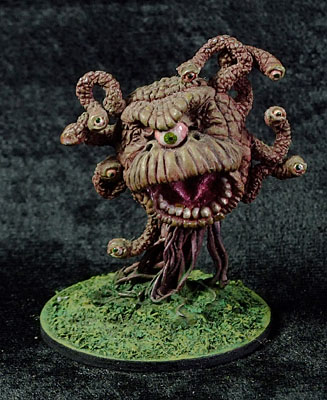
Behold! A trademark-innocuous Tentacled Eye Monster!

And so the painting of the Bones mountain proceeds, with a creature that beholds, while simultaneously maintaining its product-identity-sensitive status by pretending to be called something else entirely.

Getting a paintbrush inside that mouth was a giant pain in the bum; I'd have much preferred it if the miniature had come disassembled, allowing me to paint its innards and then glue it together myself.

It now has a significant dental tartar problem, among its other personal defects.

I glued it to a 30mm steel washer and expanded the base modelling with Green Stuff.

Tuesday, 10 September 2013

Bonesium Smirnoff (and "magic wash" recipe)

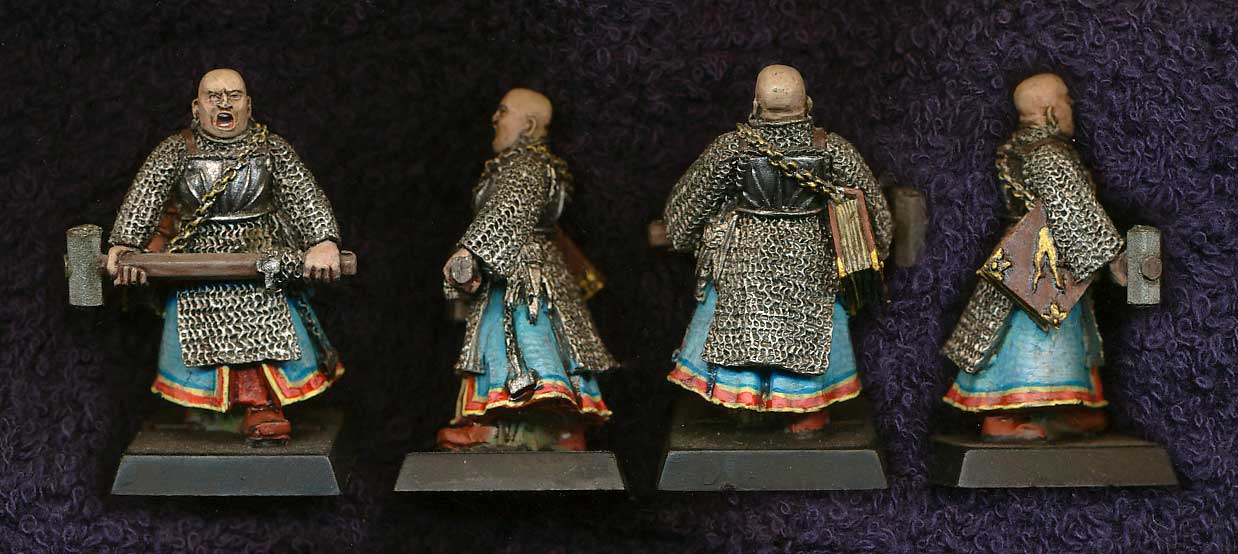
Well, he's done I guess. The miniature that will now and for all time be Smirnoff the Huge and Stupid Fighter to me. Pity I didn't have it when I was actually playing him, but them's the breaks I suppose.

I made an error using a Vallejo wash over the armour instead of the superior Citadel washes, or one of my own concoctions*. The Vallejo washes are rather gloopy; I'm not that impressed with them really.

The figure is glued to a steel washer, which is why the base is extra-thick.

=================================================

For those who are interested, the "magic wash" recipe I use is as follows:

  • 1 part Klear acrylic floor polish (Future in the USA)
  • 1 part Armorall blue windscreen washer detergent. This acts to break the surface tension so the wash will flow into any creases or scratches.
  • 1 part water — distilled water is probably best, but Christchurch tap water is pure enough to use straight.
  • Just enough Tamiya X-21 matting agent to take the shine off — quantity is by trial and error. Add it in small doses until you get a finish that is acceptable to you.
  • Add ink of an appropriate colour, again in small doses until you get the strength of colour required. My most-used general-purpose colour is 50/50 sepia and black.

As I understand it, Klear (Future) may not be being produced any more. You can probably use a clear acrylic medium in its place, but I haven't tried it myself yet. The great thing about Klear is that it's very low viscosity, and self-levelling — that will probably not be the case with acrylic medium.

If you want more of a glaze than a wash, reduce the proportions of Armorall and water. In fact, you can pretty much do away with them completely.

Step Two... Works In Progress

OK, the painting continues. I've chosen the beholder Eye Beast, and this extremely muscular axe-dude to be going on with.

The beholder eye beast, because let's face it, who doesn't love beholders eye beasts? This is a two-piece miniature which, unfortunately, come pre-assembled. Unfortunately, because getting a paintbrush into that mouth, large though it may be, is going to be a huge pain in the arse.
I've airbrush primed it with Vallejo polyurethane black, then a downward-dusting with white, to accentuate the texture and create shadows, allowing me to start painting with quite thin, translucent paint.

The extremely muscular axe-dude, because he's a dead ringer for Smirnoff, the very first of my AD&D characters to survive for longer than one session. He even has Smirnoff's huge axe and very tiny head.
This one I've brush-primed, using a free sample of Reaper's own MSP line of paints, which goes on (un-thinned) very well. The only complaint I have with it is that the dropper-bottle doesn't easily dispense more than one or two drops at a time, which is fine for most circumstances, but a nuisance when you want to get a lot of paint out at one go.

The only other beholder I've painted thus far:
A very old Citadel figure (early-mid 1980s)

Monday, 9 September 2013

The journey of a thousand miles begins with a single step

I've begun painting the vast mass of Reaper Bones plastic miniatures I got via their Kickstarter. I've started with these two pieces of dungeon dressing: a sarcophagus (empty, alas) and its lid, and an eeeeevil altar. At least, I assume it's eeeeevil owing to the skulls on the four corners.... then again, it may just be an eeeeeemo goth altar.

It's not a very spectacular start, but to be frank I'm a little intimidated by the sheer quantity of figures they've sent me. I haven't actually counted them, but I'm pretty sure there's more than two hundred there. That's a lot of painting.

Reaper claim that Bonesium (the plastic they make the Bones figures from) doesn't need priming before painting, but that's not really 100% true. Washes, inks, and any acrylics that are a bit thin will tend to web on the straight plastic surface; they need a layer of paint beneath them to give them a bit of a tooth to hold on to. Vallejo's acrylic polyurethane primer does a pretty good job through the airbrush, but it's too thin to brush on successfully in a single coat.

No doubt I'll have my process figured out by the time I get to the end of the pile.

Monday, 2 September 2013

Reaper, at long, long last

A heapin' pile o' plastic, all for me
At long, long last my Reaper Kickstarter pack has finally arrived, only about a year late (though to be fair, it's only about six months past the last revised final shipping date). This picture really doesn't indicate the scale of the un-bagging task that lies ahead of me. There are a lot of these little suckers.

I ordered the gigantic Cthulhu figure (that's in the box at centre-back), not because I ever expect to use it in a game (except to end a campaign with a Cthulhu-falls-everyone-dies event), but because it's cool, in a groteque sort of way.

Hydra. Troublesome.
Our dread lord Cthulhu. About 180mm to the top of his head.

Everything de-bagged, sorting beginning.

Left to right: a griffon, a hydra, and a beholder.

Wednesday, 28 August 2013

And another FT-17

And here's another Renault FT-17, this time in WW1-style outlined three-colour camouflage.

Friday, 23 August 2013

15mm Renault FT-17

This is Battlefront's 15mm (1:100) scale Renault FT-17, an excellent little World War One-era tank that survived right through the inter-war years and into World War Two. The American 6-ton tank was pretty much a direct copy.

I've done this one in a plain drab scheme, and I haven't added any markings as yet because I'm not completely sure just how I'm going to use it. I have another (they come in a pack of two) which I intend to finish in a WW1 outlined three-colour disruptive pattern.

Wednesday, 21 August 2013

New and shiny vs. old and busted (not really busted)

I've bought myself a new gravity-feed airbrush, a Paasche Talon, to complement my ancient Badger 150 that has served me loyally and well for near enough to forty years. The Badger is at the top of the image, the Paasche is at bottom.

Thanks to the internet making it so cheap and easy to buy things from overseas, this new airbrush only cost me about $75. When I bought that Badger, it was near enough to $200, and that was in the mid-1970s; I'm not sure what that would be equivalent to now, but it would be a lot.

I elected to go for Paasche this time around because I'd used a couple of Paasche brushes at polytech, and found them generally smoother of action than my Badger 150. It meant having to fiddle around with thread converters to attach it to my compressor and what-not, but I thought it would be worth that small trouble.

Alas, this Paasche does not live up to the standard set by those I used at school. Its double-action air/paint trigger is rather abrupt, and quite difficult to use with any delicacy of touch. I've lubricated it as far as I can, but even so it's not nearly as smooth or gentle an action as the old Badger.

I think the issue lies with the machining of the trigger shaft; there are visible machining marks on the sides, as can be seen in the hugely bloated image to the left, and I think these striations are catching as the trigger is depressed, resulting in the brush's jerky and rather clumsy action.

I'll see if I can polish them out, and we'll see if that makes any appreciable difference.

The new Paasche isn't wholly unsatisfactory, by any means. I do like its system for limiting paint flow, which is easier and more accurate to adjust than that of the Badger. The top-mounted gravity feed cup is more convenient for very small volumes of liquid too; there's less wastage as it doesn't need to keep a siphon working. I'm hopeful that if I can ameliorate the trigger action, it will prove to be a very useful tool.

Addendum:

The Talon has become my default brush over the last couple of months, mainly because the gravity-feed makes it a breeze to clean, and being able to use just a few drops of paint at a time is very convenient. I ordered the super-fine (0.25mm) and heavy duty (0.66mm) heads and needles as well, and the .25mm needle has ended up being the one I use all the time. It is quite fragile though; I've already bent its tip once, and although I managed to get it straightened out again I don't think it will take too much more of that sort of abuse.

The trigger is still somewhat problematic, but I no longer think it's to do with the trigger itself, but with the return valve — it has a propensity to stick in the "on" position, especially if being used at low air pressures.

Saturday, 3 August 2013

Teensy-Tiny Brute Squad

Brute Squad
Some considerable time ago I picked up a pack of 10mm Warmaster ogres, because they were going cheap from the bargain-bin, and because I thought I might one day have a use for them. And now that day has come.

These are them, each with a front and back view. Ugly little suckers.

In 10mm scale they're huge and ogreish, naturally. In 28mm scale they're tiny, and would make good little goblins or something. In 15mm scale they're big, hefty dudes, a bit taller than your average 15mm figure, and definitely fatter, and it's in that scale that I intend to use them.

They're going to be my Brute Squad.

As I've mentioned before, I've been toying with using Warlord Games' Hail Caesar rules in a fantasy setting, and that's where I envisage using the Brute Squad. Not that they're all that fantastic; when it comes down to it they're just really big, mean dudes with sharp pointy things and a bad attitude. They're shock troops, so I'd give them a high Clash value, but not much staying-power — difficult to kill individually, but with brittle morale once they start falling.

Friday, 26 July 2013

Finished at last...


These little guys are 15mm medieval crossbowmen. When I bought them, some years ago, they were being made by a company called Tabletop Games, long defunct, alas. The moulds now belong to someone else, I don't recall who, and they're still in production.

I'm not completely sure how long it's taken to actually get them painted, but it has to be at least ten years. Nobody can accuse me of leaping in and rushing things, that's for sure.

There are surprisingly few companies making 15mm medievals these days. I guess the period has fallen out of fashion or something.

I've based them for use with the Hail Caesar rules.

Tuesday, 9 July 2013

On the workbench

I'm in the process of re-basing some of my old Battlefront 15mm WWII British infantry on to individual bases for gaming with the Bolt Action rules. I've mounted them all on 12.5mm (½ inch) steel washers, so if I need to use them in another rule-set, such as Flames of War, I can put mount them on magnetic squad bases easily enough.

One thing about using 15mm figures for skirmish wargaming, especially with my increasingly decrepit eyesight, is that the figures are small enough that I have to make an effort to see which ones are modelled with which weapons.

In an attempt to make life a bit easier for myself in this respect, I've added colour-coded markers to the base of each figure, denoting their primary weapon load — in the case of the three pictured here, orange means a submachine-gun, pale blue a pistol, and white a rifle. Others include red for a light machine-gun, purple for an anti-tank rifle, and black for other man-portable AT weapons such as PIAT, bazooka, panzerfaust or panzerschrek. The little coloured doughnuts are tiny glass beads — highly reflective, and easy to distinguish from a distance. The paint on the base edge, as well as distinguishing the model's weapon, indicates its rear quadrant, on the off-chance that that might become important.

--------------+++++-----------------

Newly-arrived today are some early-WWI British infantry and a single solitary 18 pounder field gun, from Peter Pig.

They're very nice little figures, and Peter Pig's service is top-notch: I ordered them just six days ago, and they're already here in New Zealand all the way from the UK. That's the fastest turnaround I've had from any overseas company anywhere.

I'll be basing them on washers, just like the WWII figures above, and as well as fighting various small colonial actions, they can stand in for VBCW militia and the like.

Wednesday, 3 July 2013

Scenery: Dragon's Lair and Watchtower


The small gazebo-like structure just outside the cave mouth is a watch-tower with an alarm bell to warn when the dragon emerges from its decades-long sleep. It's a low-odds russian-roulette suicide post; if you're on duty there when the dragon comes, you're almost certainly going to die, but you could go your whole career in the Dragon Watch without there ever being an alarm.

Saturday, 29 June 2013

Hiatus

Well, I've officially made the break from GMing for an indefinite time, and I already feel the better for it. Even just running a pre-built adventure module, requiring very little in the way of creativity or prep work on my part, it was weighing me down unreasonably.

When I start up again (as I inevitably will, eventually) I think I'll just run my fantasy campaign in AD&D, pretty much (though not absolutely) by the book. It will simplify the use of third-party material enormously, and it's the system I know best, having begun my roleplaying career with it. AD&D has some odd peculiarities and restrictions, but I find I care less and less about that these days. Most, if not all, of the issues I had with it back in the day can be dealt with by loosening up the class-restricted skill system a bit.

Basing the campaign on AD&D will also mean that I can make use of the ever-increasing support material published under the ægis of OSRIC too, which is all to the good.

Monday, 24 June 2013

Time for a break

I find that I've lost almost all my enthusiasm for roleplaying gaming of late. I think it might be time to take a break, certainly from GMing, and probably from playing as well. It's been coming for a while, and now it's here.

I doubt very much that this will be a permanent state of affairs; I've had this sort of burn-out before and come back from it. For now though, I just can't really be bothered.

Sunday, 23 June 2013

WYSI-more-or-less-WYG

I've had a few games of Bolt Action now, and by and large I rather like it. However, all of the sighting rules are based on a WYSIWYG system, requiring the use of quite elaborate and realistic terrain and largish (28mm or larger) figures for best results. You'd also want to be using a periscope or something to be able to see just what can be seen from the viewpoint of your little toy soldier dollies.

I'm using the rules with 15mm figures, and the WYSIWYG sighting system isn't really all that feasible in the smaller scale. Cover and concealment has to be slightly abstracted to cope, but that's no big deal really, and principles from other rule sets can be easily adapted.

There are no target acquisition rules as written; again, they're assumed in the WYSIWYG sighting system. However, it's a simple matter to add them, taking into account target size, posture, range and concealment. The system used in the venerable WRG WWII rules works well, though it could do with being simplified a little.

One of the things I really like about the various Warlord rules I've seen — Black Powder, Hail Caesar and Bolt Action — is that they provide a simple, robust base to which can be added as much or as little detail as the individual gamer desires without too much danger of breaking everything.

Wednesday, 22 May 2013

Spell books

This is a page from an alchemical manuscript in the Getty collection, and it's a pretty good fit for how I imagine the instructions for casting spells to be written out in spell books in my campaign.

There's no explicit "Tak ye ane silvere bowle by Midnyte ynde fille it with ye Teares of Ane Pure Mayde..." sort of instructions here.

The numerical sequences would have relevance only to whoever it was who wrote them down, or to someone who had deciphered his or her unique system of notation.

The images might be literal renderings of how material spell components must be laid out, or perhaps they're just mnemonic aids to achieve a particular mental state. Or maybe both. Again, unless you know the specific system used by the original writer, having access to the page itself would be of limited usefulness.

As you can imagine, copying out a spell description like this would take plenty of time, concentration, patience and skill, and certainly wouldn't be the sort of task one would want to undertake in the primitive conditions of your average monster-infested dungeon.

So until you've managed to decipher the systems of notation and illustration as used by the person whose book you've just stolen acquired found, it's not going to be of a great deal of use to you. It's still valuable though, so don't lose it.

Saturday, 18 May 2013

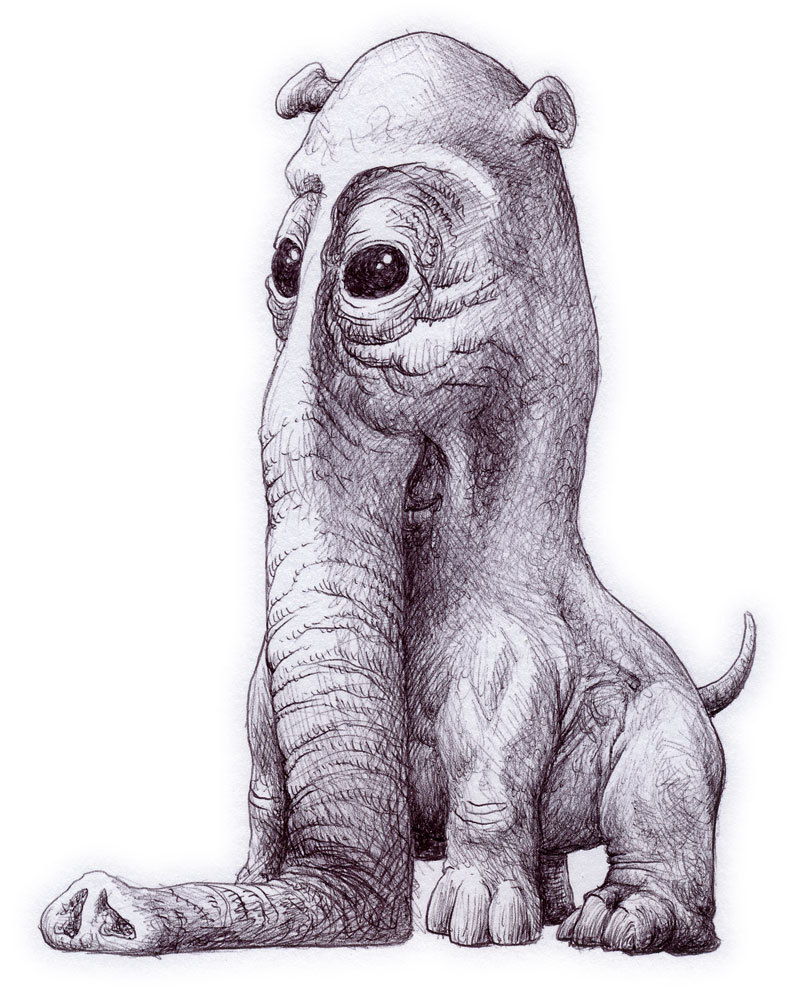
Bugle Doodle - Elephantipuppy

I doodled this guy while listening to this week's edition of The Bugle (the greatest podcast in the universe).

I haven't really decided yet whetehr it's huge and imposing or small and inoffensive. I'm leaning towards small because of its puppyish quality, but then a huge puppy could be amazingly destructive in a playful sort of way.

Tuesday, 14 May 2013

Wyvern

It's been a while since I updated this blog, so I suppose I'd better get my arse into gear and get on with it.


This is a wyvern figurine I got from an acquaintance a very long time ago, in the mid-late '80s. It's rather crudely cast, and I strongly suspect that it was a home-cast pirate miniature; I don't know the original manufacturer, though I imagine that I could probably find out if I put a bit of effort in to the task, thanks to the all-encompassing internet.

Much of the detail is painted on rather than modelled in. The wings were rather ill-fitting and needed a lot of pinning and filling; I did what I could to blend them in to the body with Milliput, but sculpting has never really been my strong suit.

I wanted it to be in a rather dusty, desertish colour scheme, rather like a rattlesnake (though without the patterning).

A while ago, a friend dropped it and bust its legs. I pinned it all back together and repainted the damaged area, and took the opportunity at the same time to remount it on a honking great big 50mm panel washer. That makes it a lot more stable than it was, which is all to the good.

Wednesday, 3 April 2013

Green Stuff Mole-Man Critter

I've never had much success with sculpting miniatures. Up until now I've assumed it's just that I'm useless at it, but it may be that I just hadn't found my medium.

Until now, the only epoxy putty I've tried sculpting with was Milliput. It's a fine material with a multitude of uses, and it does cure really hard, but my modelling efforts with it have been frustrating, unrewarding, and frankly, terrible.

Recently though, I got some Green Stuff, to see what all the fuss is about. It's much, much easier to work with than Milliput, I find, though it cures a lot softer and can't really be sanded or drilled. I understand you can actually mix the two putties together, but I haven't tried that.

Anyway, I had a bit of Green Stuff left over after I finished the job I was doing, and thought I'd have one more go at sculpting something. This little guy is the result.

Now, Tom Meier, Werner Klocke and Sandra Garrity are clearly in no danger of being displaced by me any time soon, and there's nothing very startling about the fruits of my labours, but I'm really quite pleased with the way it turned out. It's not very big (that's a 16mm washer it's mounted on), but it does look pretty much like what I intended, which is a major improvement over previous efforts.

He's some sort of mole-man, emerging from under the grass. Annette thinks he looks creepy, so I've succeeded that far at least.

I doubt that I'll ever do much in the way of original figure modelling, but I'm encouraged enough to maybe try my hand at some reasonably extensive remodelling of other, more talented, people's work.

Wednesday, 27 March 2013

New Arrivals

Just arrived is a whole new bunch of wargames books from Warlord Games, this time their WWII skirmish game, "Bolt Action", plus a couple of army books.

I haven't read them through in great detail as yet, but I've seen enough to know that they have quite a few mechanisms in common with the others of theirs I've seen (Black Powder, Pike & Shot and Hail Caesar), and like them, enough differences to trip up the unwary.

This is clearly not a game designed to please those wargamers who become enraged when the different muzzle velocities of the Lee-Enfield SMLE Mk.IV and the Kar.98 aren't accurately modelled and reflected in combat outcomes on the tabletop. No indeed, they appear to be aimed at much more well-balanced gamers, people who prefer to have fun instead of a pedantry-inspired stroke.

I also bought a set of their "Order Dice.
These are really pretty much of a gimmick; they can easily be replaced by ordinary six-sided dice, or even card chits or the like. However, I've got them now and no doubt they'll do exactly what they're designed to do, which is to display what orders you've given each unit.

Warlord also sent me, unsolicited, some samples of their 28mm pewter figures: three in total (or four if you count the wounded guy being carried). Two (or three) Brave Lads and one Dirty Nazi.
They're not too bad at all. Well sculpted and cast, and quite characterful. It's good business I think; as a customer it makes me feel good to receive these little tokens, and it shows off the quality of their wares in a very tangible way. I doubt that I'll be buying any, just because 28mm metal figures are getting to be out of my price range these days, and reasonably good plastics are readily available, but I do appreciate the gesture. And you never know; after all, I have woeful self-control when it comes to buying more little metal dollies.
I intend to use my 15mm stuff for this. There are a couple of advantages: first, I already have a bunch of figures and vehicles, and second, I can cut all the distances down to centimetres instead of inches and have a decent game on a much smaller table area.

Monday, 25 March 2013

Most annoying ever...

The most annoying character I ever encountered was in a Champions game, built by my friend Mark purely to break the game (I suspect).

The character's name was Nexus. He had only two powers: Duplication (12 duplicates) and a Speed of 12 (out of a maximum of 12). This in a game where a SPD of 6 was pretty damn good.

What this meant, effectively, was that in any given combat Turn, once he'd spent his first action on splitting into his duplicates, Nexus (Mark) got 144 actions. The rest of us got 4 or 5 or 6 or 7. That meant that for 95% of the game, we were lying around twiddling our thumbs while Nexus scampered around doing EVERYTHING. It also meant that a Turn took a long, long time to resolve.

Then, due to everyone ignoring my inspired tactical genius, my blind acrobatic Daredevilesque character ended up fighting a ten-armed octopus villain and getting entangled, while Nexus took on the villain I should have been fighting, the one with the mega-flash attack which blinded all his duplicates at once.

Absolute fiasco.

Not that I'm bitter or anything.

Friday, 22 March 2013

More 15mm Traveller figures — huzzah!


Huzzah!

The RAFM 15mm Traveller miniatures (which, apparently, aren't Traveller miniatures any more) I ordered at the beginning of October LAST YEAR have finally arrived. The original order went astray in the post, so they sent me out replacements, which now are here and ready for me to start painting.

Since we almost never use miniatures in our Traveller game, this might seem like a whole lot of wasted effort. Perhaps it might be time to hunt down a decent set of sci-fi skirmish rules.

Wednesday, 20 March 2013

Tedium

Painting wargames miniatures en masse is incredibly tedious.
If it wasn't so expensive I'd be paying somebody else to do it for me.

Monday, 18 March 2013

Red Priest


I've had this guy sitting unpainted by my worktable for many, many years. I got him down to experiment with Vallejo's "Smoke" glaze (over his coat-of-plates), and figured that since I'd started on him I might as well finish him off. He came in a pack of two; I can't remember who made them, but I think it might have been Citadel, possibly from the Mordheim range, though I wouldn't swear to it.

The Red Priests are a fairly unpleasant, fanatical bunch who lurk about in the background of my campaign. They're cultists of the Great Old Ones, and that's never good. Fortunately, their reputation makes it hard for them to achieve any great degree of overt power, but they're the sort of sneaky bastards who get up to all kinds of shenanigans in the background.


This is the other one that came in the pack; I painted him a long, long time ago. This one isn't intended to be of any particular sect.

Friday, 15 March 2013

SiG 33 auf Pz.I

These are a pair of 15mm (1:100 scale) WWII vehicles from Battlefront, the SiG 150mm infantry gun mounted on a Panzer 1 chassis, sometimes known as the Bison 1.

All in all I'm reasonably happy with the way they've turned out; I think I'm getting the hang of painting Panzer Grey. But compared to guys like Ritterkrieg I can't paint 15mm figures for toffee, my eyes and fingers are just getting too aged and decrepit.

 Feel free to click on the images to see larger, more bloated versions.

Saturday, 9 March 2013

15mm SdKfz 231 (6-rad)

 SdKfz 231 (6-rad) from Battlefront.

I added the Nazi air-recognition flag from Green Stuff, to cover up a nasty glob of resin left over from a miscasting fault. I could have ground off all the excess resin I suppose, but I would also have had to re-do the panel lines, so this was the easier option. In retrospect, it would have been easier (and probably given a better result) to use PVA-soaked tissue rather than Green Stuff. Live and learn.

I also had to replace the turret hatches; the ones supplied with the model were rather ill-fitting.

I have another one in the pipeline as well; I'd like to give it the big frame-antenna they used early in the war, but I'm not sure if my soldering skills are up to the task. I guess all I can do is try

Tuesday, 5 March 2013

More Monsters

Freshly arrived from Lulu is this new OSRIC/AD&D monster book by Rafael Chandler.

I've not done more with it yet than flip through it and write my name on the inside cover, so I can't really comment much yet on its contents. On the outside though, it fits in almost perfectly with my other AD&D manuals — it's clearly been closely modelled on the style of the MM2. The binding is glossier, and I suspect not as hard-wearing as those ancient volumes, but the graphic design is very similar (in spite of the 3e/Pathfinder-style cover critter).

Internally, the layout is basically the same as the MM1 and MM2, though the text is in a larger font (not a bad thing, in my view). It's liberally illustrated in black & white or greyscale throughout, and generally speaking the illustrations are pretty good.

The paper is a smooth, matte, bright-white stock designed for digital printing. It's not as heavy as the rag-paper used in the first AD&D manuals, but it's not as flimsy or shoddy as that used in some of the AD&D2 books. It feels like it should take pen and/or pencil annotations just fine.

On brief acquaintance, I'm pretty happy with it. Now to actually read the thing and see what I can do with it to help in the noble quest to make my players' lives a living hell.


A couple of days later.....

Well OK, so now that I've given it the once-through I'd have to say that I'm not completely over the moon about it, but it's not a complete load of old cobblers either.

There are some good, interesting monsters in there, but many of them are clearly designed to suit a very specific campaign style — and that's not really my style at all. I'd much prefer it if they had their campaign-specific fluff stripped out, and to have them presented in a much more general-purpose style.

I'd also have to say that I'm not that fond of being beaten over the head with an author's own politics/ethics/morality, even when I happen to agree with some of it. I get the strong feeling from this collection of monsters that I'd find Chandler's own campaign intolerably preachy.

I wouldn't say that I wasted my money, but I can't see it being as useful as I had hoped.

Wednesday, 6 February 2013

S&W House-Rules Online; The Multitudes Rejoice

I've gone and put up an HTML-ized version of my Swords & Wizardry house-rules on my website.

There are advantages to using the web for this sort of thing: I can access it from wherever I happen to be, I don't have to carry the book(s) with me, and I can update it easily with whatever terrible new ideas spring into my fevered brain.

I have an idea for improving the navigation of the thing, which I may get around to implementing sometime soon (hopefully).

Monday, 4 February 2013

Leveraging new synergies in buzzword-compliant micro-basing paradigm

From the front
From the back

I've been in the habit of basing my micro-scale infantry on 0.5mm sheet steel for two reasons: first, so that I can store and transport them easily on magnetic sheet, and second, to keep the bases as thin as possible so the figures don't loom over everything around them.

I still like the first idea, but I've changed my mind about the second, for reasons of playability. A thicker (3mm MDF) base makes the unit easier to pick up without inadvertently bending the teensy-tiny figures, and it provides an area at the back of the base to glue unit identification text.

I've moved away a bit from the idea of a tabletop wargame as being a kind of moving diorama, and more towards the figures and vehicles being playing tokens. I wouldn't go quite as far as having everything represented by cardboard squares, like in Squad Leader and the like, but  the usability of the models for gaming purposes has become more important to me than their intrinsic beauty.

And in any case, it turns out that the thicker MDF base doesn't really stand out a hell of a lot more than the old steel base.

I'm not sure what to do about the storage/transport issue, but maybe gluing some very thin steel sheet under the MDF will do the trick.

Also, cutting MDF cleanly in these very small sizes is kind of a pain in the arse.

The figures shown here are Heroics & Ros 1/300 WWII German Fallschirmjäger and Panzer Grenadiers.

Friday, 1 February 2013

So, no mo' mojo no mo'?

Ennui - Walter Sickert - 1914
My GMing enthusiasm and creativity has really dwindled away to next to nothing lately. Not just GMing either; I can't seem to maintain much interest in drawing or modelling or anything much in the creative line. I'm hoping that it will be a temporary state of affairs, but we shall see what we shall see.

The trouble is (and this has pretty much been the case for years) that to play the sort of game I want to play, I pretty much have to GM it. Hey-ho. It's not that I don't enjoy other kinds of games, it's just that I'd really like to play in an old-school D&D-style game instead of having to run one to get my fix.

Anyway, since I have vast echoing caverns of drive space filled up with D&D modules that I've barely grazed the surface of up until now, I think I might start dragging them out and dusting them off, and leech off the creativity of others for a while. If nothing else, that will cut down on the amount of game preparation that I'm not really doing anyway.