Showing posts with label boardgame. Show all posts

Saturday, 11 January 2025

HeroQuest (and HeroQuest-Adjacent)


Some years ago, when I was making some dungeon tiles, a guy gave me these.

They'd taken all the miniatures out, but apart from that they appear to be complete.

Fortunately, I have large numbers of plastic miniatures sitting around doing nothing, and although they won't match the Warhammerish minis that originally came with the game, they'll do the job just fine.

So now, after years of basically doing nothing with these games, I can actually have a go at playing them.

I don't think I've ever played HeroQuest, but I have had a couple of games of Space Hulk way back in the dim, distant past, and that's basically the same thing... right?


Also some years ago, at a clearance sale I bought a copy of the Dungeons & Dragons Fantasy Adventure Board Game, of which BoardGameGeek has little to say except that it's "Quite similar to HeroQuest".

I've never played it.

When I first got it, I did flick through the rulebook, and found that it says very little about how to actually play the game. Which is one reason why I've never played it.

It includes a bunch of minis, some of which would be usable for HeroQuest, but I think it would probably be easier to just use some of the bajillion WotC collectible figures I bought back in the day.


Next day...

It occurred to me that hey, I have 3d printers. So I jumped over to Thingiverse to see what people might have done about making replacement HeroQuest miniatures.

My optimism was fully justified; there are masses of them there. It looks like many of them have been 3d scanned from the originals, moulding seams and wonky weapons included.

I grabbed some and did a bit of clean-up — new weapons, new bases mainly, and removal of obvious mould seams — and pumped out some STLs which I will now print.

Sure, I could have just used old WotC pre-paints, but I kind of like the idea of having the old retro mini designs. Except for the Wizard. The old HeroQuest wizard just didn't look wizardy enough to my eyes, so I got a mini that somebody had made of Gandalf from the animated Rankin-Bass Hobbit cartoon, and whacked that on a HQ base.


Next next day...

I've collected together sufficient figures for the base game. The orcs to the left are WotC pre-paints, as is the gargoyle at right rear and the sorcerer to its left. The two mummies at centre are Reaper plastics, and the two zombies to the right of them are hard plastic GW figures. Everything else is 3d printed, from a variety of sources.

The actual HeroQuest figures are those with the rectangular bases, everything else is a proxy.


Behold! Organisation!

Judging by the detritus in the box originally, it did come with some rudimentary and rather flimsy internal boxing. However, I decided that rather than try to revive that, I'd just make some better and sturdier compartmentalization. So now the game board can sit on top of everything else without crushing it, and the components can be stored and retrieved in a more or less rational manner.

I'm putting a lot of labour into this game which I may well never actually play 😃


Dice

After our first ever attempt at the game the other evening, I've designed and printed some HeroQuest dice, because we didn't have quite enough.

One of the original dice had been misprinted, with a skull overprinting one of the white shields. That could be worked around easily enough, but still. Why not take the excuse to make some of my own?

I've used the Moorcockian arrow symbols for Law and Chaos for the "white" and "black" shield designs.

My dice are printed in Esun resin, and they'll do for the moment. They'd be better printed in one of the tougher ABS-like resins, but as long as we don't go rolling these on concrete or anything, they should do well enough. I don't have any tougher resin, and it's a bit pricey, so I don't feel the need to buy some just for this project.

A brief session of test-rolling returned the expected proportions of skulls, good-guy shields and bad-guy shields, so they're true enough for our purposes.

One of these days I may get around to painting in the faces, but I'm in no great hurry to do that.

Tuesday, 22 November 2022

Onitama (again)


When I made my original Onitama set, I came to realise that I could have made it considerably more compact if I just used the storage box as the game board.

I 3d printed a small set, suitably sized for travelling, but I designed the box for that before I learned that lesson. So I made a new box/game board for those pieces out of a rimu off-cut. The 3d-printed game pieces have steel washers glued to their bases to give them a bit of weight and a lower centre of gravity.


The box-board is basically just two solid blocks of rimu hinged together, with a cavity carved out of one of them to store the playing pieces and cards.

The dimensions of this one, closed up, are 118x90x45 mm. It'll slip easily into a satchel or jacket pocket.

Thursday, 19 May 2022

Minitama

I made myself a miniature travelling Onitama set, this time on the 3d printer instead of out of wood.

The pieces are pegged, to go in the holes on the board, so there's no risk of them being shaken off.

The board is only 60mm on a side, and the whole lot could easily slip into a pocket, were it to be given a suitable box. Which it may very well be.

Tuesday, 15 March 2022

Onitama


I've recently been introduced to a two-player game called Onitama, which has similarities to several other games but uses a move mechanic that I've not encountered elsewhere. Each game uses a set of five cards, two for each player and one pending, which show the allowable moves for that turn. All the cards are open, so you can see not only your own permitted moves, but also those of your opponent, as well as the pending card which they will get next. As they're used, the cards circulate around.

Each side has an Emperor piece and four Soldiers, and the game is played on a 5x5 grid. The centre square on each side is the Throne for that player. The game is won by either taking the opposing Emperor, or by having one's own Emperor occupy the opposing throne.

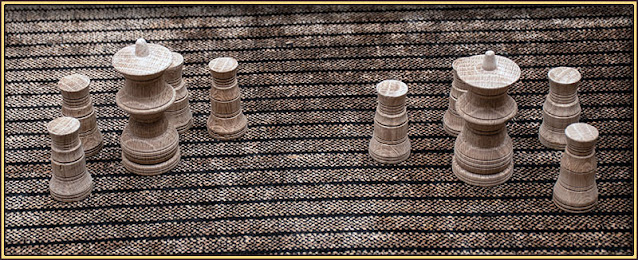
Anyway, it appealed to me enough that I thought I would make a set of my own. The pieces shown here are turned from oak, and at least one side will need to be stained to distinguish them; the Soldiers are about 50mm tall, and the Emperors about 75mm. I'm in the process of making a board from kwila (and some other timbers for inlays). The turn cards are the trickiest bit; I'll probably have to print and laminate some.

Next day...


I've finished the Onitama board and pieces, and now all that remains is to do the cards. I think I might do them as woodcuts on 450gsm card, and fill in the coloured bits in watercolour.

The board is made from kwila planks laminated together, and I've inset a little block of the appropriate colour for each side. The tabs are made from ash, so the dye looks quite a bit brighter than it does on the playing pieces, which are oak. To be honest, I much prefer the tone that the oak gives to the dyes.

The board has had its coat of finishing oil, and when that is well and truly cured I'll give it a coat of wax, just as I did with the pieces.

All in all, I'm fairly pleased with the way it's turned out.


Next day, the cards


In the end I piked out with the cards and just whipped them up in CorelDraw, and printed and laminated them. I might get around to doing the fancy-schmancy hand-made versions at a later date. Maybe.


A bit later


I made some boxes to hold all the bits.

If I had thought ahead a bit more, the cards could have gone into the same box as the pieces, but I did not. It's not quite deep enough.

Monday, 28 February 2022

Nova Luna Modifications


I have a new game, Nova Luna, which I think is destined to be a favourite.

 However, some of the game pieces could do with a bit of improvement, so I've made new ones. 

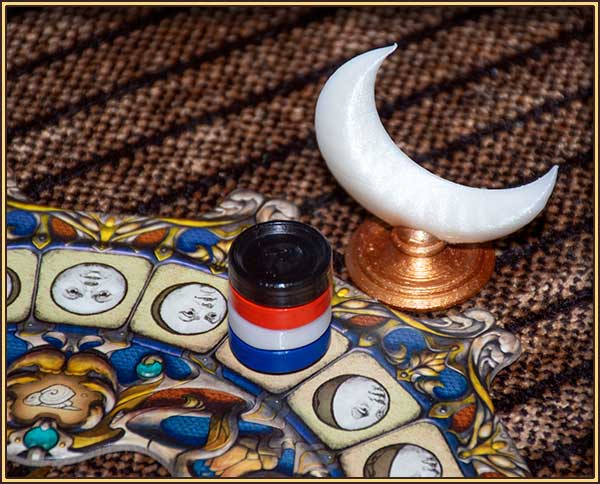
The track counters now interlock for improved stackability; now they're less likely to scatter everywhere under people's clumsy sausage-fingers. And I made a new moon marker too, partly because the cardboard one that comes with the game is just a few millimetres too tall to store upright in the box, and also, because why not?

I'd have liked to be able to print each of the counters in the appropriate coloured filament, but unlike those lucky Americans who seem to be able to buy reels of filament for about a buck fifty, my resources are more limited. So they're painted instead.

Thursday, 8 July 2021

Power Grid Resources


Power Grid is probably our most-played boardgame. I have a bunch of expansions for it, and it constantly results in surprising and exciting play — no game is exactly like any other. It's immensely replayable.

Today I made a tray out of plywood to organise the resource tokens, which until now have been kept in another little rimu box I made, but which was inconvenient to get the tokens out of. This should be easier.

In truth, it's bigger than it really needs to be, but not by much. The yellow tokens (garbage) are the problematic ones; they're a lot bulkier than any of the others, and there are a lot of them, so they take up more space.

I have a plan for a magnetic lid. I'll probably do that tomorrow.

Monday, 21 December 2020

Quantik


The other day I was introduced to a cute little two-player game called Quantik. I liked it so much that I decided to make myself a set.


The rules are amazingly simple:

  1. Each turn the players will put one of their pieces on the game board.
  2. It's forbidden to put a shape in a line, a column or an area on which this same form has already been placed by the opponent. We can only double a shape if we have played the previous one ourself.
  3. The first player who places the fourth different form in a row, column or zone wins the game immediately, no matter who owns the other pieces of that winning move.
The fancy-schmancy 3d board and geometric pieces are really not necessary; the game could be easily played on a piece of paper marked out in a 4x4 grid, with the quadrants delineated somehow. Then all you need is two distinct sets of two lots of four distinct things — say, a coin, a bottle-top, a jelly-bean, and a hex-nut.

Anyway, now I've got my set printed, and I just have to paint one or both sets of pieces so that we can tell which ones belong to which player. Or maybe I'll just print one more set in a different filament colour — that might be better.


Later...

Fancy-schmancy! I printed another set of pieces in black, and then another game board with a filament colour change at the point where the raised quadrants started printing.

I would have liked to change back when the upper knobs started, so they'd be black on blue, but instead of sitting there watching the print like a hawk to interrupt it at precisely the right time, I went to bed and slept.

Thursday, 7 February 2019

Guillotine for Guillotine

Guillotine

My guillotine
I bought myself a copy of Guillotine, an entertaining enough little card game of chopping off the heads of 18th century French aristos.

The game comes with a folded cardboard thing which is supposed to be a guillotine (it's used to mark the business end of the line of cards on the table) but it is crap. So I made one.

Strictly speaking, it isn't necessary to have a guillotine to play the game, but I'm sure a tiny guillotine will be a handy thing to have around in any case. If nothing else, I can drag it out for our D&D game the next time one of the characters gets hauled up before the law for setting fire to a city or something.

My Guillotine Box
And because I can, I also designed and printed a box to fit everything in to.

Compact! Stylish! Every home should have one!

Tuesday, 15 January 2019

Power Grid — Resource Management

Power Grid is one of my favourite board games. It's been very well balanced, and no two games ever seem to play alike.

Like many of these European games, it uses a multitude of little wooden tokens. I've been keeping them in zip-lock bags, which have the advantage of convenience, but they're not exactly an aesthetic tour-de-force.

Neither is this little box really, but it's nicer than a plastic bag. I made the base-part a while ago out of a scrap of rimu, and completely forgot about it until we got the game out last night — which just goes to show how long it's been since we played Power Grid.

It turned out that I'd made the cavities a bit too shallow to accommodate all of the yellow "garbage" tokens without overflowing. I'd originally intended it just for in-game use, to keep all the tokens in one place, and a bit less likely to get lost on the floor. But somebody — Steve, I think — suggested that with the addition of a lid, it could be used to keep them in permanently, which I thought an eminently sound idea.


So, today I deepened the cavities and made a magnetic lid for it.

The box itself is not perfectly symmetrical, because I never thought it would need to be. However, the addition of the lid means that orientation is actually important. I attended to that by making sure that the polarity of the magnets in each pair were opposite, so the lid will only go on one way.

Thursday, 13 July 2017

Splendor Jewels

I bought myself a cheap copy of the game Splendor from China. It only cost about ten bucks, but that's partly because the jewel and gold tokens are die-cut cardboard, rather than the fancy-schmancy weighted poker-chip style things to be found in the sixty dollar version. Apart from that, and having smaller "noble" tiles, it's identical to the high-priced version.

However, since I like fancy-schmancy trappings as much as the next man, I replaced the cardboard counters with these acrylic jewels and plastic goldish coins.

Fancy! And also schmancy!

Sunday, 9 July 2017

Monster Repurposing

 I recently bought a copy of Fearsome Floors, an entertaining little game of running away from monsters and/or being eaten by them.


A monster construction
 It includes a bunch of die-cut cardboard bits for making a monster, which is fine and dandy, except that the bits fit together quite loosely, and the monster is forever falling to bits as it's moved about.

It's for this reason that I decided to replace the cardboard-bits monster with a one-piece plastic monster that won't disintegrate when someone picks it up. I chose this one for several reasons:

  1. Its base is small enough to fit within the boundaries of the squares on the game board
  2. It's flat enough to sit inside the fairly shallow box
  3. It has a clearly identifiable front an back
  4. It's identifiably monsterish
  5. It was the first one that came to hand

It's a WotC D&D pre-painted 28mm plastic figure labelled "Orc Skeleton" that I gave a quick re-paint. I may very well use other figures as well; it's nice to have a variety critters available, but this is the one that will stay in the box. There's no mechanical effect on the game by having differently-shaped creatures — all monsters' abilities are identical regardless of morphology.

Monday, 28 December 2015

Boxes of Catan

Having nothing better to do this afternoon, I made myself a little storage box for my Settlers of Catan land and sea tiles.

I'd made one for the 5-6 player expansion pieces a little while ago (you can see it in the top-left of the photo), and I thought then, as I thought this time (too late), that I probably didn't really need to go to all the trouble of making a hexagonal internal cache.

Still, it's done now, and a fancy-schmancy hexagonal hole is definitely both fancier and schmancier than a boring old rectangular one.

I'd really like a cheapish printer with a fairly flat paper path, so that I could print on to heavy card stock. Maybe one day.

Saturday, 21 November 2015

Catan — Robber Master

I read an interesting Catan robber variant on boardgame.geek:

The robber, rather than being a passive block on resource production, instead becomes a sneaky mercenary, diverting the resources to its dastardly master (the person who rolled the 7 or played the Soldier).

Whenever the hex's number comes up, the current master of the robber can take the resources into their own hand instead, but must first pay the robber with cards from their hand at a one-for-one ratio.

I'd suggest that the cards should have to be different resources to those being snatched, mainly because that means that the Robber Master can't just keep the robber in place in perpetuity by swapping like for like.

If the master of the robber cannot (or chooses not to) pay the robber in full, it quits in a huff and goes back to the desert.

The only additional equipment required for this variant would be a "Robber Master" token, just so that people don't forget who's benefiting from the little bastard. To which end, I have made this new card to fit in with the "Longest Road" and "Largest Army" cards. (PDF available here).


There was another which is not so much a robber-variant as a robber-replacement:

When you roll a 7 or play a Soldier, you can swap two hex numbers. I'd modify it slightly so that if there are any unexposed numbers, they have to go first — then, when all the number tokens are exposed, you can swap them freely.

In this instance, although people with more than 7 cards would still have to discard down to half, nobody gets to steal anybody else's cards. Just screw with their resource production.

Wednesday, 10 December 2014

Power Grid — Australia, India

I just got the Australia/India expansion for Power Grid. As well as providing new maps to play on, each changes the way the game is played a bit.

AUSTRALIA


  • Australia does not have a single connected power network. Only in the populated regions, mainly in the south east are several cities connected to each other. Because of this, players may connect to any city for a generally higher connection cost.
  • Australia does not use uranium for their power production, but they do mine huge amounts of the material to sell to other countries.

Game preparation


  • In Step 1 and Step 2 of the game only the areas of the resource market for 1 to 8 Elektro are used.
  • There are no uranium spaces in the resource market. The uranium is sold in a separate uranium market in Australia. At the start, all 12 spaces of the uranium market are filled with 1 uranium each.
  • Australia only has 5 regions. In games with 5 or 6 players you always play on the whole map. With 2 to 4 players you may choose the matching number of regions in Australia, the chosen regions do not need to be adjacent!
  • Before preparing the power plant deck, remove the nuclear power plant #17. Place the removed power plant back into the game box; it is not used during the game.

Phase 2: Buying power plants


  • In Australia the nuclear power plants are considered uranium mines. Instead of supplying cities with electricity, the players mine uranium and sell it at the uranium market.
  • The uranium mines are equivalent to the power plants and players buy them in the same auctions. A player may buy a single card during each round - either a power plant or a uranium mine. The uranium mines are not counted towards the limit of 3 power plants (4 power plants for 2 players). In other words, a player may have up to 3 (4) power plants and any number of uranium mines. The uranium mines are considered when determining the player order in Phase 1!


Phase 3: Buying resources


  • The players may only buy coal, oil and garbage. At the start of Step 3 the Australian government establishes C02 Taxes. All prices for the resources in the resource market increase by 2 Elektro. Move the 6 cheapest resource tokens of each type in the resource market to the spaces in the areas for 9 and 10 Elektro. The areas for 1 and 2 Elektro are not used for the remainder of the game. In Step 3 the cheapest resources cost at least 3 Elektro per piece.
  • The uranium tokens are only used to track the uranium prices. They are in either the uranium market or in a separate storage space next to this market. The players only move these tokens in Phase 5: Bureaucracy.

Phase 4: Building


  • Players may connect any available city in the chosen game area to add to their networks. A player either pays the specified connection costs between cities, which are printed on the game board, or he pays the general connection costs of 20 Elektro, in addition to the building costs for the city.
  • The player may always choose the general connection cost, if this is cheaper than the specified connection costs on the map or if there are no connections between the cities at all. In other words: each city in Australia is connected with each other city for a maximum general connection cost of 20 Elektro. A player follows all other rules when connecting a new city: in Step 1 each city is only available for a single player etc.

Phase 5: Bureaucracy


  • Besides getting money from powering the cities with electricity, the players also get money from their uranium mines. In reverse player order, starting with the last player, each player may sell the uranium from his mines to the uranium market. A player may decide not to sell his uranium.
  • In contrast to getting money from powering cities, which players do not get at the end of the game, players get money for selling uranium in the last round of the game.
  • If the player decides to sell uranium, each uranium mine produces an equal amount of uranium matching the number of cities it normally powers with electricity. The player multiplies this amount with the highest available number in the uranium market and gets that sum in Elektro. Then, he places one uranium token per uranium mine (not per produced uranium) from the storage on the highest available spaces of the uranium market. Afterwards, the next player sells his produced uranium for the new price and so on.
  • Afterwards, uranium markers are removed from the uranium market; this symbolizes the demand of other countries for uranium. Starting on the cheapest spaces remove uranium markers in accordance to the resource supply table on the last page and place them into the storage.
  • Finally, fill the resources on the resource market in accordance with the Australia resource supply table.

INDIA


  • The Indian Subcontinent is always in danger of suffering huge power outages if the players increase their networks too fast.
  • Additionally, the players must buy their resources on a limited resource market, which not always guarantees enough resources for all players.
  • The garbage power plants use livestock manure and have a low efficiency. When producing electricity they need one additional garbage.
  • At the start, the prices of resources begin at: coal 1 Elektro, oil 2 Elektro, garbage 2 Elektro and uranium 6 Elektro. Use only 8 uranium tokens during the game and place the other 4 uranium tokens back into the game box.
  • Before preparing the power plant deck, remove the nuclear power plant #11. Place it back into the game box; it is not used during the game. 

Phase 3: Buying resources


  • At the start of the game the resource market is very small. The players can only access the areas for 1 to 3 Elektro. At the start of Step 2 the areas for 4 and 5 Elektro are added. Only at the start of Step 3 is the whole market completely accessible to the players.
  • In reverse player order, starting with the last player, each player may buy just 1 resource token per buying turn. The players continue in this manner for several buying turns. If a player wants to stop buying, he passes. The other players continue to buy 1 resource token per buying turn.
  • The garbage power plants need 1 additional garbage token to produce electricity, but they do not store more garbage. For example, the garbage power plant #24 now needs 3 garbage tokens, but it can only store up to 4 garbage tokens.

Phase 4: Building


  • When the players connect new cities to their networks, they show this by placing their houses on their end.
  • At the end of this phase the players count the total number of houses placed on their end (which were newly connected by all players during this round). If this sum is higher than twice the number of players, at least 5 houses with 2 players, at least 7 houses with 3 players and so on, the players cause a huge power outage. As punishment they get less income in the following Phase 5: Bureaucracy.
  • Finally, all new houses are placed right side up.

Phase 5: Bureaucracy


  • The players must power as many cities in their networks as possible with their power plants. If the power plants have enough resources and there is still an unsupplied city in that player's network, resources may require to be moved between power plants using the same resources, until the power plants produce enough electricity even if they now overproduce. Only if a power plant is not needed to supply electricity, may the player choose to produce no electricity with that power plant and save its resources for the next turn.
  • If the players caused a power outage in Phase 4: Building, all players are punished and receive less income for powering the cities. For each city connected in a player's network, that player must subtract 3 Elektro from his total income. For example, if he owns 10 cities and powers 8 of them, he gets 90 Elektro - 30 Elektro = 60 Elektro!
  • If there is a power outage in the last round, you also play phase 5 for once, so all players get one more income.
  • Finally, fill the resources in accordance with the Indian Subcontinent resource supply table. Refill the most expensive spaces first, even if these spaces are not available in the first turns, like uranium.

Thursday, 28 November 2013

An Historic Achievement


We played a game of Star Trek Catan the other night, at which I lost utterly. That's not the historic achievement though; I usually lose at boardgames because I am the world's worst Player of Games.

The historic achievement is demonstrated by the unbroken string of red starships (they're mine) right across the board.

For the first time in my life, I managed to use up every single road (starship) in a game of Catan, creating an unassailable Longest Longest Road.

Alas, this came about mainly because I seldom had the resources to build anything but roads, but that's not the point. The point is...

LONGEST. LONGEST. ROAD.

Friday, 4 October 2013

Tsuro

I was introduced, a short time ago, to a cute little tile-placement game called Tsuro.

It's very simple, plays quickly, and will cater to two – eight players.

I couldn't find a copy locally, so I thought I might as well make a set of my own. This is (almost) it — I still have to make the layout grid (the work of a moment, hopefully) and find something to use as player markers... probably painted chess pawns or the like.

The tiles are 50mm squares of 3mm MDF, lovingly painted by yours truly. I could probably have done them more neatly, but these will serve quite well I think. The blank one in the bottom-right corner isn't used in the game layout; it's a marker tile which indicates who gets the next draw of the tiles. In the proper game it has a dragon printed on it; I've just painted mine metallic gold.

I think, if I were to do it again, I'd bump up the tile size to 75 or 80 mm square, and maybe do them in stained oak or something, with the tracks outlined in pyrogravure.