Tuesday, 16 August 2016

Burford-Kegresse... smaller

I've redesigned my model of the Burford-Kegresse MG carrier in 1/285 scale, and for the first time I've made an attempt at including some human beings.

How much of this detail will be visible in the 3d prints, I'm not sure. The model is only about 19mm long, which is not very big at all, but FUD and FED resin can render some surprisingly fine detail if the stars are right.

It's available as a single model at http://shpws.me/MzEE or as a much more cost-effective sprue of five at http://shpws.me/MzFZ

Monday, 15 August 2016

Komintern (15mm)

This is the last of the current crop of 3d-printed stuff, until I design and order some more. It's the interwar Soviet Komintern tractor, based on the chassis of the T-24 medium tank. The T-24 was an unsuccessful tank, but the Komintern was very successful in its role as a heavy artillery tractor.

This model is 1/100 (15mm) scale, and is printed in WSF nylon by Shapeways.

It's available in the following scales:

Sunday, 14 August 2016

Voroshilovetz (15mm)

Here's my 3d-printed Voroshilovetz heavy artillery tractor in 1/100 (15mm) scale, printed in WSF nylon. Unfortunately I don't have any 15mm Soviets to go with it, so it's been photographed with a bailed-out WW2 British tanker from Battlefront, and a fascist militia officer (ex-WW1 British) from Peter Pig.

It's available in 1/100 scale at http://shpws.me/MmJN and in 1/285 scale at http://shpws.me/MmS9

Thursday, 11 August 2016

Burford-Kegresse (15mm)

Model by me, figures are WWI British infantry from Peter Pig.
This is my 3d-printed Burford-Kegresse MG carrier in 1/100 (15mm) scale.

It was an interwar British vehicle that mounted a pair of Vickers guns on an adapted aerial Scarff mount. I don't believe any made it into service in WWII; the Kegresse track system was thoroughly obsolete by then.

It's available for sale in 1/100 (15mm) scale at http://shpws.me/MiBM , and also in 1/72 (20mm) and 1/56 (28mm) scales.

I really need to get some crew figures to populate some of these models.

Wednesday, 10 August 2016

Shapeways stuff again

Left to right: Vorshilovetz tractor, Komintern tractor, Burford-Kegresse MG Carrier.
All in 1/100 (15mm) scale.
A new shipment arrived from Shapeways today, after being held up in customs and having its cost to me increased by nearly 45% due to juuuuuuuust creeping over the dollar value when our brave NZ Customs start slapping on duty and GST and imposts and levies and fees. Well, fuck. I'll know better next time.

Here they are in all their naked WSF glory, all in 1/100 scale (15mm). From left to right they're the Vorshilovetz tractor (Soviet Union), the Komintern tractor (Soviet Union), and the Burford-Kegresse MG Carrier (UK).

Sometimes I like WSF better than others. When it's fresh and new like this, I sometimes think the models look like tiny snow sculptures.

Monday, 8 August 2016

Paint Stand

Here's the paint stand that I cut out of 3mm MDF with Andrew's little CNC router. It's about 300mm across its widest diameter, with 30mm tiers.

It's mounted on a cheap plastic rotating 'lazy susan' tray that I got a few years ago from K-Mart. At the moment it's just stuck to it with Blu-Tak, and unless that turns out to be inadequate it will probably continue to be so.

It will hold up to 67 25mm Vallejo dropper-bottles — it should have been 69, but we accidentally deleted two cavities from the top tier when we were messing about restarting the cutting after one or another failure. It's currently got all my ModelAir paints, washes, inks and special purpose bottles in it. All of the ModelColor and GameColor paints are in another rack of a similar tiered design, though constructed quite differently and much more heavily.

CNC Cutting — a learning experience

My friend Andrew has a small CNC router/cutter that he built as a kit. It's by no means a heavy-duty machine, and it's not without its issues, but we've been playing with it over the weekend and are starting to learn how to make the most of it.

Our first attempt was cutting some 50mm hexes for my wargames terrain project in 3mm MDF. The machine runs off an SVG pattern, which I put together in CorelDraw.

It differs from a pattern for laser cutting in that you have to make more allowance for the thickness of the cutting bit. In this case we were using a 3mm bit, so each hex had to be over-size — 3mm over-size, in fact.

On this pattern, it got through the first four rows and then the bit broke. I suspect that that might have been because it was quite blunt, so it was being put under more lateral strain than it should be as it was being tracked through the MDF.

Ragged edges
You can see here how furry the cuts are on the first lot of hexes. That's because of the blunt bit.

This was the first purely MDF cutting project Andrew had tried, but he habitually uses MDF as a sacrificial support, and MDF is hell on steel tools, so the tip of the old bit will have been quite worn. You really want to be using tungsten-carbide to get long life out of any tools cutting MDF.

The remaining hexes, after we changed the bit, were cut much more cleanly, but we ran into another issue:

The bed of the machine doesn't appear to be perfectly flat and square to the gantry, so the hexes in the bottom-right of the pattern weren't cut all the way through.

Some of the parts for a paint stand
The following day, we tried something else: a pattern for a multi-tier rotating stand for my Vallejo paints.

We set the cutting depth slightly deeper to account for the distortion of the bed, and we used Instructables' Easel software to automate the placement of the tabs holding all the pieces in place. Though when I say "automate", I really mean "automatically put in far too many tabs and in all the wrong places". They're manually adjustable, but the amount of work involved ended up not being much less than it would have been doing it manually when I made the pattern to start with.

The cutting, once again, did not go without incident.

After partially completing the large circle (bottom-left of the photo), the machine suffered a brain-fart and started cutting again in completely the wrong place. Fortunately, Andrew had thought ahead and marked the original zero-point, so we could just stop it, delete the parts that had already been cut from the pattern, and start again.

Everything went quite smoothly until we hit another snag: because we'd increased the cutting depth to accommodate the bed inaccuracy, the auto-generated tabs were cut too deep, and therefore too weak. When it tried to cut out one of the edge-tabs (top-centre of the photo), the tabs broke as the bit was cutting an indent, flinging the piece about and breaking another bit.

We started again, deleting all those problematic elements, and things seemed to go fine until the smallest circle, which again broke free. It didn't break anything this time, but it did move around which meant that the tab-slots weren't cut accurately. Hey-ho.

So, what did we learn?


  • It's better to split up a large, complex cutting job into smaller, more manageable chunks. That way, when something goes wrong, only part of the job will need to be re-done.
  • Good, firm attachment tabs are vital to keep cutting accurate, and to protect the bit. The cut-out circles were all left without tabs, but they were all small, light pieces, and without any indents that could catch on the bit and over-torsion it.
  • Very light material like 3mm MDF should probably be secured with double-sided tape rather than edge-clamps, which tend to bow it slightly.
  • I suspect that the issue with bed flatness might be ameliorated if the whole shebang was placed on a firm, unyielding surface of guaranteed flatness. The material of the gantry and frame is insufficiently rigid to provide its own support.


In summary

It has the potential to be an amazingly useful machine, just as long as its limitations are taken into account. It's not as fast or powerful as the big commercial machines, but on the other hand, it didn't cost tens of thousands of dollars either. It would be of limited value in furniture making because of its small size and lack of power, but it could make making small things like boxes very easy, and I could see it being exceptionally useful for doing inlay work.

Friday, 5 August 2016

The Forest of Hex

I finished off the hexes I have at the moment — this picture includes about a third of them — and I think I'll call them a qualified success. It's not diorama-quality terrain, but it looks OK to my eye, and it will allow for considerable flexibility in laying out woods and copses.

I have a friend with a computer-guided router/cutter, and this weekend I'll have a go at cutting some hexes and hex arrays in 3mm MDF, which will be a superior material to card, I think.

The tanks are Churchill Mk.1 from C-in-C, the figures are Heroics & Ros WWII British infantry. The buildings are a couple of simple shells that I whipped up out of light card and painted.

Thursday, 4 August 2016

HexLand

Models, left to right:
H&R British BL 60pdr (WW1), GHQ A9 Cruiser (WW2), H&R Napoleonic Spanish artillery.
I'm trying out something I've been thinking about for a while for 6mm terrain, and that is to build it in a modular format, though without going to the lengths of building complete terrain tiles. Sculpted terrain tiles, while they can be beautiful to look at, are inherently limiting, and they're also a pain in the arse to store.

I've built some less rigidly geometrical terrain modules before: here, and here for example. I may return to that format, but I'll make a few of these hex-based ones and see how they compare in terms of playability.

I had a bunch of 50mm hexes I made many, many years ago from heavy 3mm thick card. Those were originally intended for a home-made copy of Knights of the Air (one of which, a Fokker D-II you can see to the left of frame), which did get completed but then hardly ever got played. I'll never use them again for their intended purpose, so waste not, want not. For WWI aerial gaming these days I use Canvas Eagles and 1/300 scale miniatures, mostly from Heroics & Ros.

I bevelled the edges of the card hexes on my belt sander. I was in two minds about doing that; on the plus side, it means that the hexes slope down to the table surface and will blend in better with a ground-cloth, but on the minus side, it makes them harder to pick up by the base to avoid damage to the terrain modeling.

The trees are very cheap Z-gauge railway scenery from China, some with plastic trunks, the others in twisted wire. I paid about $5 per 100 of the plastic ones, and if I recall correctly about $10 for a hundred of the wire ones. I mix the two, with the wire-trunked trees to the outside; they're stiffer and make it easier to pick up the hex, and they're a bit less regular than the plastic ones too.

Monday, 1 August 2016

Yet another Vickers

15mm version — http://shpws.me/MuYJ
I've modified my 3d-printed 1/100 scale (15mm) Vickers Medium Mk.II to the Mk.II* with turret bustle and enhanced ventilation for tropical deployment — e.g. India or Egypt.

It's available now at http://shpws.me/MuYJ

I've only recently learned that the Italian WWII 47mm anti-tank gun was a licence-built copy of an Austrian design with virtually identical performance to the 3pdr used in many interwar British tanks. That's handy, because while accuracy and penetration data is readily available for the Italian version, there's not a hell of a lot available for the 3pdr. In short... compared with the 40mm 2pdr, it really sucked.

6mm version — http://shpws.me/Mv2T
I've now also made it available in 1/285 scale, as a sprue of five vehicles.

That one's at http://shpws.me/Mv2T

Wednesday, 27 July 2016

Lose 2d6 SAN....

...and then roll to avoid shitting yourself.

(Scene comes from an anime called Parasyte, apparently.)

Friday, 15 July 2016

Next up... the scum of the earth

Now that the Spaniards are out of the way, it's time to move on to the British.

There are not as many of them as I'd thought, but there's still enough to be a somewhat daunting task.

They'll do three battalions of infantry, four of cavalry of various sorts, and four guns (representing four batteries). Plus, there are sets for Wellington (and staff), Hill (or maybe Picton — there's a top-hat present), and the idiot cavalryman whose name I've temporarily forgotten. Uxbridge, that's right.

I'll get them all primed black, and then tackle them one battalion at a time.

Thursday, 14 July 2016

Headless Horseman

One of my dragoons appears to have lost the top half of his head.

It's OK though; I don't think it will have much impact on his military usefulness.

And now that I see them close up, I notice that the guy on the left doesn't have a face.

Saturday, 9 July 2016

Last of the 6mm Spanish


Today I finished off the last of the Heroics & Ros 6mm Napoleonic Spanish that I got from the last Christchurch Wargaming Club bring-&-buy. I've had pretty long breaks between bouts of painting these things, because frankly, I find this production-line stuff pretty boring.

Once they're based up — this lot will make four or five bases of line infantry and twenty half-bases of skirmishers, and I have another four-base battalion of infantry and a couple of batteries of artillery already done — I'll get on and make a start on my Napoleonic British. I haven't done an accurate count, but I'd say there's probably about five or six times as many of those as I have Spanish, so it may take a wee while to finish them. And then I suppose I'll have to get some French, since otherwise they'll all just have to fight amongst themselves.

I'm basing them on 40 x 20 mm MDF bases, with the intention of using them with the Black Powder rules. I'm casting my mind back, and I do believe that I've actually never done any Napoleonic gaming at all, so it's probably about time.

Later....

Turns out they're not the last of the Spanish. I found some cavalry that I'd overlooked; a couple of packs of lancers and dragoons. So, now I have to find out what they looked like so I can paint them.

Later still....

I've based up this lot, and they're shown here with one of the skirmisher stands out in front.

The flags are somewhat huge; I've exaggerated the size so that my decrepit eyes can distinguish them on the wargames table. They're images downloaded from the internet, printed on my laser printer, and glued to brass pins stuck into the MDF base. I added a little bit of gold paint and some shading.

And even later than that....

These are the cavalry I found, now painted and almost ready to go. At the back we have dragoons, the Villa Viciosa, and in front lancers, the Voluntarios de España. Though perhaps, considering the level of my knowledge of these things, we should just call them Yellow and Green Horsey-men.

Because it's winter here, my workroom is bloody cold. That means that everything takes longer: glue dries more slowly, varnish dries more slowly, and therefore basing these guys properly is going to be spread over a couple of days instead of hours. I had to brush the Villa Viciosa pretty vigorously because the flock was sticking a bit to their varnish, which is not as well cured as I thought it was, so I've delayed flocking the Voluntarios until later — I've brought them all into the warm, hopefully to accelerate the process a bit.

Saturday, 2 July 2016

Empire Knight

I picked up a few Games Workshop 28mm Empire Knights from the bargain bin* quite a few years ago, and then did nothing with them.

Except for this guy.

You will observe that I've left him gloss varnished. That's because it brings out the colours; matte varnish tends to subdue them.


* If they hadn't been in the bargain bin I'd never have gone near them. GW's pricing is ludicrously high.

Thursday, 30 June 2016

Long Tom Long Tom Long Tom Long Tom Long Tom Long Tom

I re-scaled my 1/100 model of the Boer War vintage "Long Tom" to 1/285 scale, and put it on a sprue of six.

I did it mainly to see how much it would cost for a battery of guns of this sort of size — in FUD it comes to $12.50, and in WSF $8.00 (though I strongly suspect the WSF would look pretty crap).

They're available at http://shpws.me/Mns5

Wednesday, 29 June 2016

Coming to grips with new technology

Well, not very new technology, but new-ish. I have a new camera, a Panasonic Lumix DMC FZ-300, to replace my aging Fuji f6500d. It has many bells, and also whistles, and it will shoot 4k video, which is nice I guess.

There's not really all that much difference when it comes to automated point-and-shoot photography, but there's enough difference when I'm shooting models on my little lighting stage that it's taking me a while to work out exactly how best to approach it.

Tiger 1 (15mm resin and pewter, from Battlefront)

Tiger 1

Tiger 1

Tiger 1
 The camera's resolution is fine at 12 Mpx — it's not up to the standard of high-priced DSLRs, but that's not really an issue for me since I don't need the capability to print high-rez full-frame A1 posters. The lens is good (it's a Leica product) and it has a very respectable zoom, 25–600mm equivalent at f2.8 throughout.

These photos of my Tiger 1 were shot straight to .JPG and then re-sized to 800x600px.

I need to learn a bit more about how to manipulate the camera's metering system, as these images tend to favour the light background over the more important foreground stuff. I know I can adjust for that, I just don't yet know exactly how.
Tiger 1

These next were shot to RAW, cropped down to frame the important bits and resized to 800x600px. I couldn't figure out why they were so grainy until I remembered that when I was fiddling around with the camera controls, I'd reset the ISO to 800 and forgot to set it back to ISO 100, my usual for shooting models. Even so, the images are reasonable for display on the web.

SdKfz7/2 37mm Flak

SdKfz7/2 37mm Flak
 Generally speaking, I'd say that I'm pretty happy with the camera, and if it gives me as long service as I got out of my Fuji f6500d (which is still perfectly serviceable, I might add) I'll be very pleased.
SdKfz7/2 37mm Flak

Tuesday, 28 June 2016

Voroshilovetz in 1:285

http://shpws.me/MmSD
I re-scaled the Voroshilovets tractor to 1:285 scale and put it up on Shapeways as a single model, and as a sprue of four vehicles.

This one has been a lot more difficult than I expected, but I think I've cracked the canvas tilt at long last. It could certainly be improved, but it looks a lot better than my first attempts. Unfortunately, it also massively inflates the file size, but que sera sera.

The 4-up sprue is at http://shpws.me/MmS9, the single vehicle model is at http://shpws.me/MmSD.

http://shpws.me/MmS9

Sunday, 26 June 2016

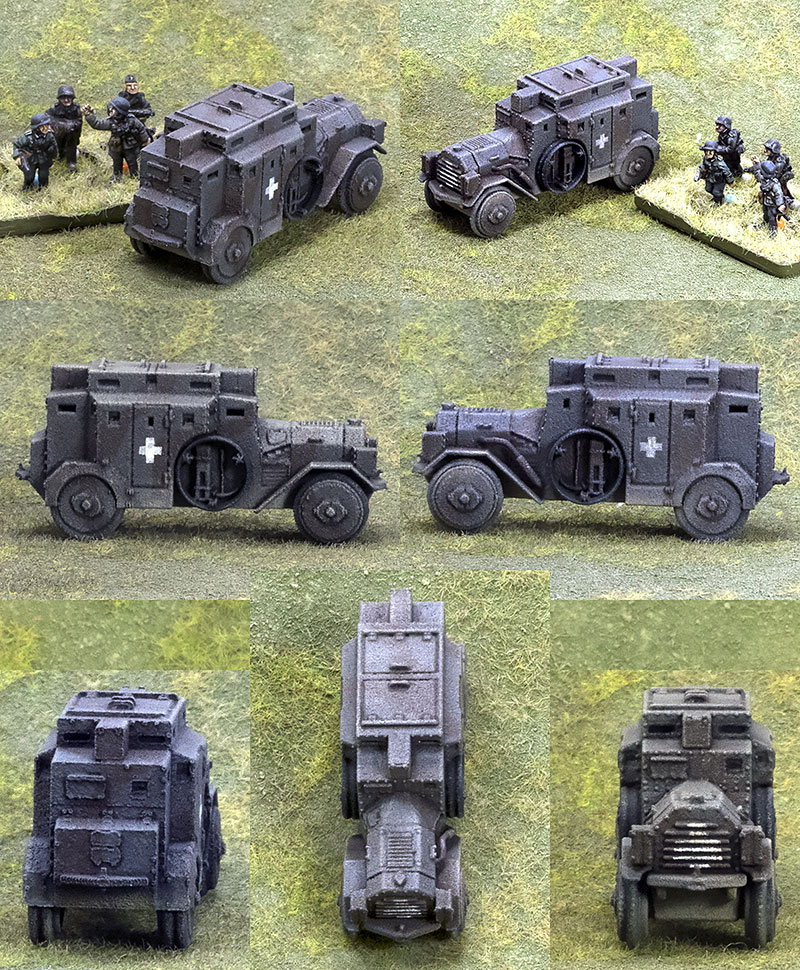
Gepanzerter Mannschaftstransportwagen MTW SdKfz 3


Large, heavy and underpowered, and unarmed except by sticking a machine-gun up out of the large trap-doors in the roof, the Gepanzerter Mannschaftstransportwagen MTW Sd.Kfz.3 was based on the Daimler DZVR chassis and entered service in December of 1920 with the newly-reformed Reichswehr of the Weimar Republic.

105 were produced by Daimler and issued to 7 motor transport battalions (15 each). MTW was designed to carry 12 men and 3 crewmen.

This heavy personel carrier weighed 11 tons and had poor cross-country performance even with four-wheel drive because of its solid rubber tires.

Vehicles remained in service into 1930s and entered service with the Wehrmacht as Sd.Kfz.3. They were quickly relegated to tactical training duties as reconnaissance armoured cars. Some were equipped with radio sets and frame antennas and were used as radio command vehicles and used in the invasion of Poland.

This model is 3d-printed by Shapeways in WSF nylon; it's also available in high-resolution FUD resin. It's available for purchase at http://shpws.me/MbaF

Saturday, 25 June 2016

Voroshilovetz

I'm building another Soviet artillery tractor in 15mm (1/100 scale), this time the Voroshilovetz, the replacement for the aging Komintern.

A lot of the geometry is from the Komintern model, but almost everything needs some adjustment, and the running gear had to be rebuilt almost from scratch.

I had a go at building a canopy for the back, but it wasn't very successful. I can't seem to get the drape of the fabric right. I'll give it another go, but I have to say that organic shapes are really giving me grief.


Droopy canvas
I've sort of managed to get the canvas of the canopy looking more like fabric, though I think some of the geometry is a bit suspect for printing.

We shall have to see how it goes. Shapeways' automated pre-checks passed it, which is nice I guess, but those automated checks seem to be countermanded fairly regularly when the model gets to the manual pre-checking stage.

Adding the tilt to the back bumped up the WSF printing cost by about two bucks fifty, and the FUD print by about four bucks fifty, which is less than I had feared.

Thursday, 23 June 2016

T-18 (15mm)

Here's my 3d-printed T-18  in 1/100 scale (15mm) all painted up.

I'm not really completely happy with the weathering — the chipping isn't particularly convincing, and I'm not sure quite what to do about it.

Character Generation Wheel

This is the system I like for generating characters for my D&D-ish games.

It provides players with a reasonable degree of flexibility in choosing the class they want to play, providing decent characters without churning out a never-ending string of superheroes.

Here's the PDF file (21.3KB, opens in a new tab or window). It's laid out with two A5 pages on A4, and instructions are included.

Note that this is NOT a character sheet, though I guess you could use it as one. It's simply an aid to character generation.

Note also that this is just a no-frills version of a much fancier one I've presented before. This one just requires no assembly, is all.

Wednesday, 22 June 2016

The Itch, It Returns To Trouble My Slumbers

That OSRIC cover always makes me think "Jazz hands!"
If I were to start GMing my fantasy campaign again — and it's quite a big if — I think I'd probably go with an AD&D / OSRIC based system. (Or maybe I'd revive my increasingly eclectic version of S&W).

There are elements I'd add from more recent systems, such as D&D5e's Advantage/Disadvantage system, and the much more intuitive ascending AC system with attendant combat bonus. There are other things that would need to be adjusted too, to get around absurdities like only thieves ever being able to even attempt to pick a lock or only rangers ever being able to have any chance of tracking.

I've seriously considered using D&D5e with all the "Old School" optional rules and restrictions in place to make it a bit less of a fantasy-superhero game, and that could conceivably work quite well for what I want, but I think it would tend to be confusing for the players who would have a whole bunch of expectations from other campaigns which would be doomed to disappointment, leading to resentment and muttering.

Anyway, it's just the germ of an idea at this stage.

Friday, 10 June 2016

Burford-Kegresse (15mm)

This is the Burford-Kegresse, a British half-tracked machine-gun carrier, from about 1926 I think.

It mounted two Vickers guns on a modified aircraft Scarff mount.

I've been pondering how to build the model so that the guns could be adjustable; it's not impossible, but I think the 3d-printing tolerances might make it impractical in this scale. Maybe when I re-scale it up to 1/72.

The 1/100 scale model for 15mm gaming is available at http://shpws.me/MiBM

Now the 1/72 scale version is available at http://shpws.me/MiXh

The rivets on this one are the same size as the 1/100 scale model, but thanks to the overall increase in size, they look a bit less like baseballs.

Also, the Scarff mount and Vickers guns are separate components, sprued to the main body of the vehicle. That means that after they've been cut away, they can be assembled at any orientation and/or elevation you choose.

Wednesday, 8 June 2016

T-24 (15mm)

Here's my 1/100 scale (15mm) 3d-printed model of the 1932 Soviet T-24 medium tank.

This one is printed in WSF nylon, and is available at http://shpws.me/Ma76

I notice that the blurring of detail in WSF makes the road wheels look like tiny Thomas-the-Tank-Engine faces painted by Munch. That's kind of weird.

Long Tom (15mm)

The latest of my digital models for 3d-printing is an artillery piece.

The 155 mm Creusot "Long Tom" was a French field gun manufactured by Schneider et Cie in Le Creusot, France and used by the Boers in the Second Boer War.

Shapeways' render
The gun barrel and trail are separate pieces (sprued together), so that the gun can be assembled at any elevation, or even in travel mode.

This model is 1/100 scale, for use with 15mm figures. It's available at http://shpws.me/MhXb

Saturday, 4 June 2016

6mm Improbable - painted


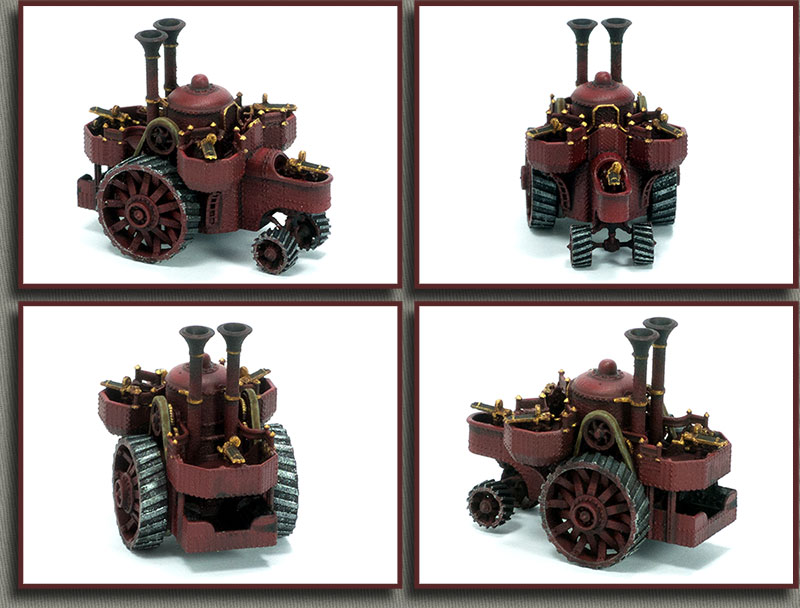
3d-printed by Shapeways in FUD (frosted ultra detail) resin. It should have two Gatling guns on the rear balcony, but one was lost in transit. At some stage, I'll get some 6mm artillerymen (probably Franco-Prussian War Prussians, because I like the pickelhaube) to crew it.

Dimensions are 37mm long x 24mm wide x 30mm tall, to the top of the funnels.

It can be bought at http://shpws.me/M8Xl

Thursday, 2 June 2016

Huge, but tiny - HMSLS Improbable in 6mm

Available at http://shpws.me/M8Xl


Here's the FUD print of HMSLS Improbable in 6mm. It's just had the Gatlings glued in place and been primed black (the picture is overexposed so that we can see anything more than a silhouette).

It shows some quite rugged printing artifacts on some of the surfaces, but it looks much worse in a close-up photo than it does in real life, so I'm not too unhappy. It would be better printed in FED, but this will do me for the present.

One of the Gatlings was lost during the handling process, so it's only got one at the back instead of two. There are a couple of places where it could do with fragile structures being beefed up, such as in the front wheels which are only attached by a slender post.

T18, SU18, SdKfz3 primed

SdKfz 3 (15mm, WSF) primed
Here are my latest military vehicle prints from Shapeways.

I've cleaned off the extraneous printing crap (though possibly not completely, by the look of the T-18's suspension) and sprayed them with Vallejo surface primer, which makes them a thousand percent easier to photograph, without hiding any surface imperfections.

The SdKfz 3 (to the right) has been printed in WSF, while the T-18 and SU-18 (below) have both been printed in FUD.

[Insert here regular complaint about the high cost of printing in decent resolution resin]
T-18 and SU-18 (15mm, FUD) primed.

The next batch

Booty arrived precisely as scheduled on 2016-06-02.
The newest batch of prints from Shapeways arrived this morning. Three sets of earrings, some 15mm vehicles, and two versions of HMSLS Improbable in 15-20mm and 6mm scales.

There was some breakage and incomplete printing on the Improbable — I shall have to beef up the railings and steering rods a bit more to make them sturdier and more reliable in printing, and the Gatling guns on the 6mm version are going to be very fiddly to install, but overall I'm pretty happy with it. Now I need some figures to go on them. The Gatlings in WSF on the 15mm/20mm version are surprisingly decent; I had thought that they might need to be replaced by FUD prints, but now I think they'll be just fine.

The earrings are, as with all the metal stuff I've ordered from Shapeways, just great. I've been very impressed with the quality of their cast bronze, and I'll be very interested to see how it ages over the years.

Wednesday, 1 June 2016

Tančík vz. 33 tankette (15mm)

Here's the WSF render for a new model, the Czech Tančík vz. 33 tankette, based (like many others) on the chassis of the Carden Loyd carrier.

This is the 15mm (1/100 scale) version; there's a 20mm (1/72) version in the works.

You can get it at http://shpws.me/MgdR

http://shpws.me/Mhq3
The 1/72 scale (20-25mm) version is now also available. You can find it at http://shpws.me/Mhq3

There's not much to differentiate the two of them except size, but the 1/72 version has a bit more refinement in detailing things like the machine-guns.