Tuesday, 10 April 2012

Initiative... again

I use Ascending Armour Class (in which a higher AC number means better armour) in my game, because I find it makes combat easier for everybody. However, while I was gazing slack-jawed into nowhere this morning, it occurred to me that Descending Armour Class (in which a lower AC number is better) could be usefully employed to modify a character's initiative score. Like so:

First, roll 1d12.
          (Why a d12? Because d12s are cool, and they aren't used nearly enough. Stick with a d6 if you must, it doesn't really make any difference.)

Then modify the roll as follows:
  • ± AC score
  • ± DEX modifier
  • ± any magical bonus/penalty for armour

Three modifiers to a roll are too many for regular off-the-cuff calculation, in my opinion. But in this case they'd generally only have to be worked out once and noted on one's character sheet.

If you wanted to go that way, you could also build in modifiers for long/short/heavy/light weaponry as well, though that might start getting a bit convoluted.

Sunday, 8 April 2012

Character generation — a dream within a dream

I've used at least one oodle, and probably many oodles of character generation methods across a multitude of roleplaying systems. I've even built a character for a game called Space Opera (I think) which had a character generation system so convoluted that by the time we'd finally finished, we were too exhausted to actually play the game.

What I want to concentrate on right now are some of the methods I've used to create characters for my various D&D campaigns, in no particular order.

1) 4d6, drop the lowest, in order

This is the system I was first introduced to when I started playing AD&D in 1981. As far as I could see, from the fairly tiny pool of D&D players in Palmerston North and Wellington in those days, it was pretty much the default method for everyone.

It's a pretty decent method that is reasonably good at not producing a string of crippled gimps, but exceptional characteristics (i.e. anything in the 16–18 range) were still rare enough to be special. We seldom discarded a stat-block as rolled, unless it was really, really bad.

To begin with, we just rolled the stats in order and built whatever character class would fit them. In a revolution in player-enablement, our DM actually started allowing us to swap two of the stats around so that we weren't necessarily forced into (or out of) any given class. Wow! The power!

It was under this system that was born a character whose every stat was either 10 or 11. Naturally, he had to be called Mean Norm the Average Ranger. (That's a statistics joke, folks. They're few and far between, so make the most of it).

2) The 6x6 3d6 matrix

This is a system I came up with all by myself, though the chance of me being the first person ever to have this particular blinding flash of inspiration is pretty small.

In this system, the player rolls 3d6 36 times, writing the results in a 6x6 grid like the one shown here. The order in which the stats are laid out is unimportant as long as they're the same horizontally and vertically.

The player can choose one statblock from any of the rows or columns, or, at a pinch, from either diagonal. The stats can't be rearranged, so if you want to play a specific class you may have to make some compromises — for example, in the set shown here, if the player wants to play a magic-user and get the 16 result into their INT slot, they're going to have to accept a CHA of 6.

This is a fairly decent system for pumping out characters that will perform pretty well. It gives the players a certain amount of freedom to choose which class they want to play, but being limited to 3d6, doesn't often produce terrifying Übermenschen.

3) The 12 x 3d6 decoder ring system

This is another system of my own invention. The player rolls 3d6 12 times and writes the results in a row. Then any contiguous set of six stats can be chosen, depending on which class the player wants to build

The stats wrap around, so if you fall off the right-hand side you complete your set of six from the left — as shown in the animation, the red set (fighter or thief) starts its statblock 5 places from the right, so its 6th stat is taken from the left-most. The statblock, once chosen, can't be rearranged.

Again, it's a system designed to allow for a degree of player freedom without tending towards mega-stat monsters.

4) 3d6 in order, and suck it up

I include this although I've hardly ever actually used it. I would only use it these days in a high-mortality one-off game in which character replacement is going to be very frequent. I know it has a certain masochistic appeal to some grognards, but in my experience most people prefer to play reasonably capable characters; the novelty of having to deal with a weak, clumsy, sickly, stupid, foolish, hideous character wears off pretty quickly for most.

Saturday, 7 April 2012

Simple character sheet

I was looking at one of my recent character sheet designs today, and it struck me that, though efficient, it was rather sterile.

So I whipped up this little one, which will fit on an A5 card. Alternately, you could print it at the head of an A4 (or letter) sheet and have a whole lot of extra space to make other notes on.

This one is not sterile. This one is... woogly.

You can grab the PDF here — it's only about 37 K.

Saturday, 24 March 2012

2nd Edition's 2nd edition

My booty
Today I found these in a local second-hand book shop.

I did buy the PHB and DMG for AD&D 2nd Edition when they came out in 1989, but I really can't say I was particularly impressed. The binding and paper quality wasn't nearly as good as my old 1st Edition books, and I didn't really think much of the layout aesthetic. I did import one or two 2nd Ed. things into my AD&D campaign, but we pretty much just carried on playing AD&D as we always had.

By the time this edition was published in 1995, I'd dropped AD&D entirely and was using the Hero System exclusively for all my campaigns. I didn't even really know this edition existed until just a few years ago.

Anyway, I bought these out of a sort of archaeological curiosity, just to see what TSR thought might revive their sadly sagging fortunes in the mid-'90s. As with the first version of AD&D2e I bought, they don't really excite me much. They're not terrible, but the paper feels even flimsier than the earlier version, and though there's a lot more colour scattered through the pages, the illustration seems, for the most part, a bit lacklustre. The organisation and layout is OK, I suppose. There are some semi-useful bits and pieces of reference info in there, but nothing makes me sit up and say "What a fool I've been! 2nd Edition is clearly the One True Way!"

I'm glad to have them in my collection though.

Friday, 23 March 2012

Lots of eyes, lots of muscles

Inevitably, there comes a time when, convinced that there's something there to find, the whole party all search the same place to make sure that somebody picks up something that everyone else has missed, or all try to open the same stuck door, or pick the same lock, or find the same traps, or whatever. Apart from the fact that it takes up valuable time, and thus increases the chance of being mutilated by some treasure-less wandering monster, it can certainly help swell the party's coffers.

Assuming there really is anything to be found, that is.

Of course you can always throw a die for each individual searcher (I like to use a different coloured d6 for each character so I know who has and hasn't succeeded, just in case they want to keep the news to themselves or something, the sneaky bastards).

However, if you want to skip over all that and get the show on the road, you can always convert all those individual rolls into one combined d100 roll.

The formula for finding the probability from a whole bunch of d6 (or any other die type) is this:

1 - [(chance of NOT showing the desired pips) to the power of (the total number of dice)]


Assuming that you might just want to know the numbers and not have to do a whole lot of tedious maths to find out, here are some I prepared earlier:

Number of d6 Chance of at least one 6 showing on a handful of d6:
1 - [(5/6)^N]
Chance of at least one 1 OR 2 showing on a handful of d6:
1 - [(2/3)^N]
1d6 16.7% 33.3%
2d6 30.6% 55.6%
3d6 42.1% 70.4%
4d6 51.8% 80.2%
5d6 59.8% 86.8%
6d6 66.5% 91.2%
7d6 72.1% 94.1%
8d6 76.7% 96.0%
9d6 80.6% 97.4%
10d6 83.9% 98.2%
11d6 86.5% 98.8%
12d6 88.7% 99.2%
13d6 90.6% 99.4%
14d6 92.2% 99.6%
15d6 93.5% 99.7%
16d6 94.6% 99.8%
17d6 95.4% 99.89%
18d6 96.2% 99.93%
19d6 96.9% 99.95%
20d6 97.4% 99.96%

Saturday, 17 March 2012

Hydra

Apparently this mutation is more common than you'd expect.

Friday, 9 March 2012

More leeching off the creativity of others

Jim Raggi over at Lamentations of the Flame Princess has just presented an idea that I rather like for determining how much of your character's hit-points are represent the amount of actual physical damage you can sustain and how much is luck, favour of the gods, plot immunity and so forth.

To summarize, at character creation you'd roll hit-points as if you were a zero-level normal, including any CON bonus/penalty (minimum of 1), and the result is your Actual Physical Damage Hit-Points. Those points take longer to heal than normal hit-points, while normal hit-points (always lost first) recover a lot more quickly (Jim suggests 1d4+CHA or WIS modifier per day). If you go below 0 on your APDHP, you're dead.

If one wanted to make combat more deadly, then natural-20 critical hits could come directly off APDHP, by-passing normal HP entirely. Personally, I've moved away from that sort of thing, but whatever floats your boat.

I'd also like to link that result with the character's physique, so a character with few APDHP would be tiny and frail-looking, while one with many would be huge and hulking. I'd probably want to throw the character's STR into the mix there as well, to avoid those odd tiny-and-skinny-but-infeasibly-strong results.

Thursday, 8 March 2012

Scenery: The End of the World


Time for another scenery post. This is Beachy Head, one of the chalk cliffs on the southern coast of England. Apparently it's a very popular suicide spot.
Friday, 17 February 2012

Finest Hot-Pressed Soylent Bond


Last night, in the course of our semi-regular game, the party wanted to get some paper, pens and ink for mapping (to replace the scrap of oilcloth and bar of red sealing wax they had been using).

I told them that the stuff they got was like parchment, but very light and slightly translucent. Their first thought — from more than one of them simultaneously, I might add — was "Omigod! It's made out of OLD PEOPLE!"

I sometimes worry about them. It wasn't even Call of Cthulhu or anything.

Thursday, 9 February 2012

Demon Doodle

There's a lot of sitting around and waiting at polytech right now; for reasons best known to themselves, the powers that be have decided that we need a whole hour for lunch, and also they've combined two classes into one so we spend quite a bit of time waiting for the tutors to finish with the other group before coming over to tell us what to do.

Fortunately I have an ereader for reading things on, and a notebook for scribbling things in. This is one of the latter.

The medium is black ball-point pen. It's a demon thingy of some kind.

The image, as so often is the case, can be clicked upon to bloatify.

Wednesday, 25 January 2012

Fuuuuu......


That is a substantial eating machine right there. Holy crapsticks.

Wednesday, 18 January 2012

Here comes D&D 5e!!!!


I don't care.


OK, I do care a little bit, but only to this extent: WoTC have the clout to affect the whole roleplaying world. I want 5e to succeed because I want the population of roleplayers to grow. However, I've been too turned off by the bloated number-cruncher that 3e turned into, and the pseudo-MMORPG that 4e proved to be, to be all that bothered about WoTC's products for my own use.

In other words, I've been too badly hurt, and I'm afraid to love again. Sob.

Thursday, 5 January 2012

Desert Mat

The mat - about 1500mm square

My productivity for the day is the creation of this terrain mat for desert wargaming. It's canvas, about 1500mm square, and painted with standard acrylic house-paint.

The paint does leave the canvas a little stiff, but that's no great problem since it's really only there to provide a textural background to other terrain pieces — and the wargaming models, of course.


Close-up
15mm models on the mat

Saturday, 31 December 2011

Fun For All The Family... With Tables!

Demon-slaying is a fun and profitable pass-time that everyone can enjoy. But demons aren't your everyday monster; they shouldn't just fall over and expire when you slay them. So, when you land that killing blow, rattle your d20 and...

What Happens When A Demon Dies?
d20Result
1The killing wound bursts into flame which spreads rapidly through the demon's body, incinerating it from the inside out and leaving nothing but greasy ashes and thick, stinking smoke.
2The demon collapses into a pile of squirming, slimy worms, which rapidly disperse, leaving behind a foetid slime-patch where the demon fell.
3The demon deflates as thousands of small black beetles pour from the killing wound and scurry away.
4The demon petrifies instantly into solid granite. A weapon that inflicted the killing blow is momentarily trapped; make an easy STR save to free it (the attempt takes one attack).
5The demon petrifies instantly into very soft, friable stone that will crumble to the touch.
6The demon instantly freezes solid, falls over and shatters into a million shards. A weapon that inflicted the killing blow is momentarily trapped; make an easy STR save to keep hold of it as the slain demon falls.
7The demon transforms into a cloud of tiny, vicious birds that immediately turn on each other, pecking and slashing until the flock disperses in 1-3 rounds.
8The demon swells up like a bullfrog, tearing open from the point of the killing wound and spilling its bones and entrails out across the surrounding area. Anyone within 20' must make a CON save to avoid throwing up in their mouth.
9The demon disappears with a blinding flash and a deafening crack, leaving behind nothing but a small cloud of stinking smoke. Save or be dazzled and deafened for 1d3-1 rounds.
10The demon implodes, its hide crushing its bones and entrails, until all that is left is a small, leathery, wrinkled ball (about 6" in diameter) smelling strongly of putrescence.
11The demon explodes, showering everything within 20' in stinking mince.
12Translucent, ethereal tentacles spring up from the ground and drag the demon down to the abyss, leaving nothing behind but a shadow that slowly dissipates.
13The demon collapses into a pile of worn terracotta blocks, a couple of inches on a side. If someone wanted to take the time and effort, and had access to mortar and brickworking skills, they could be reassembled into a brick statue of the demon.
14Thick, stinking, tarry ooze gushes from all of the corpse's orifices. It sticks like treacle (and tastes absolutely disgusting).
15The demon and everything within 20' is covered with (harmless) electrical arcs for 1-3 rounds, after which it disappears with a flash and a smell of ozone.
16The demon disappears, leaving behind only an irridescent green pearl about half an inch in diameter. It is subtly unpleasant to look upon or to touch, and leaves a viewer with the distinct impression that it's watching them.
17The demon putresces and mummifies incredibly rapidly, as if a hundred years of decomposition takes place in a moment, and then falls to the floor, shattering into scraps of hide, bone and dust.
18The demon's skin sloughs off, then its muscles and entrails fall away, leaving its skeleton standing in the posture it was in at the point of death. If touched, the bones will collapse into dust.
19The demon, and everything around, it appears to suddenly stretch out to a hundred times its length and then snap back like a rubber band, disappearing with a noise like a bag of custard hitting the footpath, having been dropped from the top of a high tower. Make a WIS save or be severely disoriented for 1d3 rounds.
20The demon is petrified into a statue of sand; a wind arises and blows it back to the Abyss in 1d3 rounds. Make a DEX save to close your eyes or be temporarily blinded by wind-blown demon-grit.

Friday, 30 December 2011

Android Ahoy!

I recently got a B&N Nook Color from a friend, which has been rooted and turned into an Android tablet. I'm pretty happy with it so far, and I've just loaded it up with a bunch of gaming PDFs.

I'm using RepliGo for PDF reading at the moment, and it works pretty well and reliably, but it does have one major fault (for my purposes), which is that it will only keep one file open at a time. I believe that something called GoodReader for iOS uses a tabbed interface to switch between open files, but I haven't been able to find anything comparable for Android. Does anybody out there know of such a thing?

Being unable to switch easily and seamlessly between files makes tablet-based reference reading much, much less useful or easy than it should be. I really hope they'll be addressing this soon.

Tuesday, 27 December 2011

Sweeeeeeeeeet!

Xmas goodies for FREE! Go here, where you can find your way to this spectacularly well produced hundred-and-a-bit pages of adventures, locations, tables and what-not, all produced from the fecund brain-meats of people just like you and me and offered up FREE (did I mention that it's free?) to people just like you and me.

I'm impressed. Also grateful. Thanks, people-less-lazy-than-me! Thanks a bunch!

Saturday, 24 December 2011

Tombworld


I originally saw this this illustration by Les Edwards in Omni magazine (I think), and then again in a collection of illustration that I bought in about '83 (I think).

I found it immensely evocative then, and still do. It would make an excellent setting for a megadungeon-based campaign.

Wednesday, 30 November 2011

Dang!

Dang! Looks like Hero Games is pretty screwed. They're cutting their full-time staff down to a total of ONE, which isn't a good sign. I really hope they can come around again, they've managed to return from the dead before, but I wouldn't bet my life on it.

Saturday, 26 November 2011

Creepy Critter


All I know about this thing is that it's a bat of some kind, and that it creeps me out. Enlarge it to human-size, and you have a creature of nightmares.

And here's another: a leaf-tail gecko:


Friday, 18 November 2011

Hirelings from Planet Algol

Read this.

It's the first time I've seen anything written from the point of view of the hirelings. It's great.

Tuesday, 15 November 2011

The Very Excellent Screen of Fitz


I've made several DM screens in my time, as I've moved through various rule-sets and their various editions.

The first one I ever made was made of very heavy card (Whakatane board, for those who know what that is), lovingly illustrated on the players' side by me in pen and ink and coloured pencil, and like all of them until the Age of Computers, the DM's side assembled from photocopied tables from the PHB and DMG. It took me many, many hours of loving work.

That one was eaten by a dog. I was not happy.

This one consists of four sheets, 210mm square, in a concertina fold, the whole lot held together with white (off-white, really) cloth tape. Previously I've mounted the printed sheets on heavy card; this time I just laminated them back-to-back and taped them together, and it seems to be quite sturdy enough for use, and will fold a lot flatter.

It's designed for my ultra-houseruled version of Swords & Wizardry. There's really not a lot in S&W that the DM has to have constant reference to; there's so little to the rules that they're pretty easy to remember, so I've had to pad out these four sheets to get enough stuff on there to fill them up.

The outside — the players' side — has been decorated with an assemblage of Dyson's excellent dungeomorphs, slapped together with the aid of the also excellent Dave's Mapper.


Wednesday, 26 October 2011

In praise of the Dice of Fudge

Minus one. Slight bummer.
Once upon a time, a chap called Steffan O'Sullivan instigated a process that ended up with the creation of a generic roleplaying game system which he called FUDGE.

I really like FUDGE conceptually, but it requires a lot of work from the GM to build a campaign. There's a reasonable amount of stuff available for it, already built by people like us with an unreasonable obsession with playing make-believe games — for example, there was a pretty complete port of AD&D to FUDGE built by a guy called Peter Mikelsons some years ago (it, and he, appears to have dropped entirely off the internet). But if you want to build something from the ground up, expect to put in some pretty hard slog.

Anyway. About the dice.

FUDGE's core resolution dynamic rests on rolling a number — often, but not always, three or four — of d3 marked with a plus sign, a minus sign, and blank face (there are two of each on a d6, like those in the picture). You can buy dedicated FUDGE dice like those shown here, or you can just use ordinary six-siders, counting 1-2 as a minus, 3-4 as blank, and 5-6 as a plus. The pluses and minuses are tallied against each other, with blanks being neutral, so scores from -4 to +4 are possible on 4dF (though there's only a 1:1,296 chance of getting either of those results on any given throw). The higher your plus result, the better the outcome. The lower the minus result, the worse things turn out.

What I like about them is that the results conform statistically to a bell-curve, where things are most likely to be only averagely good or bad, but with the (small) possibility of astounding wonderfulness or horrifying horribleness. You can easily modify the degree of potential wonderfulness/horribleness by adjusting the number of dice thrown. I like to use them as Luck Dice, in situations when things could go either way and the outcome rests in the laps of the gods. They fulfil a similar role to a d20 saving throw, but without the linear result curve, and without any level-based modification.

Of course there's no reason why I couldn't just use regular six-siders. But as may have become apparent, I really do like special dice.

Friday, 14 October 2011

Falling

Falling damage is something I've been wrestling with for many years. On the one hand, one doesn't want to make it as deadly as it is in real life, as that would tend to make for a level of character mortality that would delight only the most sadistic DM (or masochistic player). On the other hand, if it's not serious enough you end up with the situation where a massively muscled but brainless fighter with many, many hit-points* will simply hurl himself off a hundred-foot-high cliff as a means of getting into a fight faster. That may be heroic, but it's a bit too anime-ridiculous for me these days.

What I'm thinking is this:

  • Falling characters take 1d6 damage per 10' per 10' fallen — i.e. 1d6 for the first 10', plus 2d6 for the second 10', plus 3d6 for the third, and so on — up to a maximum of 20d6 (terminal velocity).
  • Falling (or fallen) characters are concussed for one Turn per point of damage over their level. They will be seeing double, will probably puke if they attempt any vigorous activity (or even no activity), and all their die rolls will be at minus 1 per Turn of concussion remaining. For example, a level 5 character who takes 10 points of falling damage will be concussed for 5 Turns, and will be at -5 to everything the first Turn, at -4 the second, -3 the next, and so on.
  • A character who takes more falling damage than their level plus CON score is knocked out; the duration of unconsciousness is up to the DM, but when they wake up they will be concussed (as above) for at least a day.

Hopefully this will make falling dangerous enough to make players wary of suffering it, but not so dangerous the campaign will be littered with more broken and splattered corpses than is fun.

I'm tempted to allow a saving throw to halve falling damage, just because I think almost anything should allow some chance at mitigation. If so, I'd probably make the save at -1 per die of damage taken after the first, or something like that. Or maybe you get to knock off one die of damage for every point you make the save by... that might be better than a flat halving.


*His name was Smirnoff. He was one of my very first D&D characters, and had practically no skills except taking damage and dishing it out in vast amounts.

Tuesday, 11 October 2011

The Damage Done

Back in those ancient days of yore when giants walked the earth and D&D was O, every weapon and every monster did 1d6 damage with a successful attack. The rationale was, I believe, that because a dagger was capable of killing a person with a single blow, and a two-handed sword was equally capable of inflicting a mere scratch, that having different damage ranges for different weapons would be functionally pointless, though I believe (I'm not really sure here) that weapons like greatswords got to roll two dice and took the best score. Maybe not. Anyway, the system is still used by people playing with the original D&D Little Brown Books, and with S&W White Box. Somebody on the Swords & Wizardry forums suggested using it for S&W Core Rules as well, but using a d8 instead of a d6.

I find the idea attractive for one major reason: it makes a character's choice of weapon largely aesthetic; there's no weapon-damage min-maxing to be done. If a scimitar suits a character conception better than a greatsword, the player won't be tempted to go for an inappropriate weapon for mechanical reasons. Also, there's nothing for the DM to remember when it comes to what damage a monster does with its fangs or claws or tail-bash or whatever.

It does have its aesthetic down-side though. In a game in which encumbrance is actually important, everyone is going to be using daggers exclusively — and why not? They're lighter, smaller, you can throw them, and they do just as much damage as anything else.

The most important reason not to adopt Ye Olde Damyge Systeme though is this: it reduces still further the use of all those excellent funny-shaped dice. And the poor d12 already gets the short end of the stick there.

I think I'll stick with the many-dice model.

Friday, 30 September 2011

Dear oh dear oh dear

After a false start last week, I re-started my S&W campaign last night. Oh deary deary me.

I totally sucked. The suckage was immense. I stand in awe at my own suckitude.

I was really not on my game at all; I forgot to take all my maps and other prep stuff for a start — we were playing at Andrew's place, not mine, so instead of just going to another room to get the stuff I'd forgotten I had to go home again. Then, once we got going I found that I was really just not feeling the vibe, and my descriptive powers were bland and lacklustre to say the least. I managed to kill one of the party more or less accidentally in the set-up to the campaign start, and then killed half the party with trolls later on due to woolly-headed thinking about the nature of the battlefield* (it was on board a small ship). I may have to go back to using miniatures and tabletop battle-maps so that people can make meaningful tactical decisions without having to rely on my worthless brain-meats to keep track of everything.

Now, I don't actually mind too much killing characters, but I really do prefer it if it's their fault (or at least, the fault of an uncaring universe via random probability variations) and not mine. Annette really takes it personally, but then she seems to think that the GM should actually be benevolently on the side of the characters, poor naïve trusting soul that she is. I don't think that, but I don't think the GM's incompetence should have to be one of the challenges the characters have to work against.

D. Must try harder. See me after class.


* In my own defence, nobody except Andrew actually asked any questions about the battlefield or attempted any sort of tactical action, so the combat just boiled down to a dice-rolling competition — three 5th-level characters against five critters, each roughly the combat-equivalent of a 9th-level fighter. I'd say they got off lightly, really.

Wednesday, 28 September 2011

More creativity from somebody else

Zak, from over at Playing D&D With Porn Stars, came up with this excellent rationalization of a D&D-style multiplanar milieu. I do believe I may steal it in its entirety and run off sniggering into the night, with a muah-ha-ha-haaaa and a twirling of my dastardly moustachios.

Tuesday, 27 September 2011

Monsters and Manuals: Yes I Just Collated Loads Of Stuff From Other Blog Entries

Monsters and Manuals: Yes I Just Collated Loads Of Stuff From Other Blog Entries

Oh, the irony. Sort of. Of just publishing a link to a collation. I don't necessarily agree with 100% of what noisms has to say, but he does often stir up my brain-meats.

Wednesday, 21 September 2011

Talking Animals

I was reading through some AD&D spell descriptions yesterday, and noted that the druid and magic-user versions of Reincarnation differ quite dramatically in the range of critters a dead character can come back as. The druid spell will probably bring you back as an animal of some kind, while the magic-user version will always result in some humanoid type or other.

Dark Sword anthropomorphic mouse fighter,
nice miniatures, if you like that sort of thing
In my Swords & Wizardry campaigns, I've conflated the magic-user and cleric spell lists, so there's just the one version of reincarnation, and there's no set list of resulting creature types. It occurs to me that the spell would be an ideal explanation for the existence of talking anthropomorphic animals with opposable thumbs and a bad attitude....

It's an outcome that would have to be employed with some care. Not every player is a secret (or not-so-secret) furry, not every player is going to enjoy waking up as a talking badger. But for those who swing that way, it could be fun, until the novelty wears off.

I've never really seen the point of the druidic reincarnation spell; it always seemed to me that it was mostly a pointless waste of time and an annoying "gotcha!" — your character dies, boo-hoo, but not to worry, you can be reincarnated! And you come back to life, but as a muskrat or something, and scurry off to burrow through the leaf-litter eating bugs (or whatever muskrats do). Not a lot of scope for adventuring there.

Tuesday, 20 September 2011

Hirelings


Looking back over some old — sometimes very old — campaign journals, I note that hirelings are most notable by their absence. It seems to be taken for granted in all the old-school rulebooks that PCs will hire flunkies to do their heavy carrying and what-not, but we almost never did as far as I can find.

Maybe it's because we were always too cheap to pay wages, but I think it's more likely because we were a bunch of softies who felt guilty at the inevitable demise of such fragile creatures, for whom we felt a responsibility of care. It's bad enough having to constantly replace horses, especially if (by some miracle) they'd lasted a couple of adventures without being gutted and eaten by some hideous abomination.

It's a pity really; the addition of a miscellaneous group of sometimes questionable reliability or loyalty, largely reliant on the PCs for their very survival, can add an interesting social element to running a party. It actually makes Charisma useful, instead of becoming the inevitable dump-stat. And if, as we were, the players are basically decent types who played basically decent types, the very vulnerability of the hirelings to a ridiculously dangerous environment can provide the DM with a host of side-quest ideas.

NOTE: The picture to the right, of Bearer No.4, was one of the very first things I coloured in Photoshop 2, but I can't for the life of me find the coloured version, so this will just have to do. The one to the left is a recent thing that I doodled in Painter VIII.

Sunday, 18 September 2011

Adder-wyrm

Adder-wyrm

HD: 1-3 hp
AC: 5 [14]
Attack: Bite 1-2 pts, claws 1-3 pts
Move: 12"
Save: 18
Special: Venomous bite, climbing, camouflage

These shy, diminutive creatures are hunters and scavengers, about the size of a chihuahua, preying on any insect, reptile or mammal up to about the size of a rat, or feeding on the remains of any larger animals they may find. They are not particularly aggressive unless cornered, and will (if possible) flee from anything larger or more dangerous than their prey; if they attack a larger creature, it will be solely so that they can escape, and they will not persist if an escape route presents itself.

Their needle-like fangs can inflict deep puncture wounds, and the bite is venomous: a paralysing and  necrotizing poison that numbs and eats away at the surrounding tissue, leaving it dead and gangrenous. A bite to a hand or foot will, over the course of a few Turns, will leave it numb, useless and stinking. A bite to the head or neck can easily kill the victim.

The adder-wyrm has gecko-like pads on its spatulate toes, allowing it to run up sheer surfaces and even across ceilings. Like a chameleon, it has an extensible tongue that it can use to attack flying insects and the like, and it can also change its colour to match its background — when motionless, an adder-wyrm can be quite difficult to detect.

The retiring nature of the adder-wyrm means that it usually presents no great threat to adventurers, but they will sometimes creep into a bag or pack in search of food, and may sometimes be surprised during the search of a chamber.

Adder-wyrms live in all sorts of environments short of arctic cold, and in the tropics they can become something of a pest, as they breed more successfully the warmer and more humid the climate. They are often found underground when food is plentiful.

Adder-wyrms make very poor pets, but might possibly serve as a wizard's familiar.

Monday, 12 September 2011

Byzantium


I'm not sure where this excellent map of Old Constantinople came from, but it's great. It wouldn't be as easy to use in a game as a boring old plan view of the city, and it's certainly not accurate to scale, but it's a wonderfully evocative image.

This is a modern image, but it's very reminiscent of 15th-16th century woodcut city maps I've seen from Northern Europe, especially Germany.

Friday, 9 September 2011

Treasure Map

I like to have physical props for my players to fiddle with, and one of the ones I've created over the years was this treasure map which I made to go with the opening of a low-level campaign I ran once.

All the characters started out as zero-level farm brats, the McMurdoch siblings, forced off the farm upon the death of their father. This map was found amongst his effects, along with his old sword and chain shirt.

That campaign was at its most fun when the characters were all hopelessly incompetent, but as they gained experience it became a lot more run-of-the-mill — I don't mean it wasn't fun then too, but it wasn't really much different to any other campaign. In the beginning, decisions like what farm equipment to take with them really mattered (they decided to take the anvil, for some reason). Later on, that sort of stuff disappeared. Ah well.

Anyway, I drew the map with coloured ink on heavy rag paper, and then baked it until it became quite fragile so that the players (just like their characters) had to be quite careful about how they handled it.

Wizard

Another old picture. A creepy bald wizard this time; you just know he means no good.

Sandman

I have shown this image before, but not here, so here it is.

This is a critter I drew for my AD&D campaign some considerable time ago. Apart from some camouflage ability, there was nothing particularly special about them; they were pretty much just generic orc-replacements for a desert adventure.

However, that's not to say they couldn't be made a lot more interesting if one were so inclined.

The image can be inflated merely by clicking on it. What a marvellous age this is in which we live!

NOTE: The image is skewed because that's how I drew it. I don't remember why I did that.

Monday, 5 September 2011

Siegfried Slays the Dragon Fafnir

I was looking through some old sketch books and found this — I drew it some time in 1985, when I was "working" at the Lyttelton Library on some student job scheme or other. I was hired to produce a history of Lyttelton for the Harbour Board, but when they found out how much it would cost to print they dumped that idea and shuffled me off into a back room at the library, out of sight and out of mind. I spent my time there reading through their science-fiction and fantasy collection, and scribbling in my sketchbooks.
Even older than that is this one, from 1983. It was drawn from a photograph of a Tibetan rhododendron forest, and I just added the little dude on the rock. It's drawn with a Rotring rapidograph, probably a 0.18mm nib since that's what I favoured at the time. I quite like it really.

Saturday, 3 September 2011

I shall call him... Mini-Me

A couple of days ago, another purchase arrived in my mailbox. Observe, if you will, the beauty and glory that is the A5 size imprint of the OSRIC AD&D retroclone, from Usherwood Publishing. I show it here with the large-format hardcover and softcover versions of the same content.

It's a Lulu print-on-demand book, and costs $US 13.50 (plus postage to NZ of about $7). With the exchange rate as it is at the moment, it ended up costing me about $NZ 26-ish all-up, which is not too bad at all.

It's terrific, and I can see it being my default version in use. I'm a great fan of smaller book sizes than the traditional US Letter format; they take up less room on the table, they're easier to shelve, and they're much lighter and more convenient to carry around.

A tool in search of a task

Today was the official grand re-opening of Comics Compulsion, the pusher of all my comic-based junk, who had been forced to move owing to earthquakes knocking down most of our central business district. They also stock wargaming and roleplaying stuff, though naturally they go for the more commercially viable brands (Warhammer, Flames of War, D&D4e etc.) rather than the weirdo crap I prefer.

I wandered along there to take a look at the new premises and to pick up a stash of 2000AD and Judge Dredd comics, and while standing at the counter I saw THIS ⇒⇒⇒⇒⇒

A d30. A thirty-sided die. A die for generating random numbers from one to thirty.

Now, at present I have absolutely no use for a d30, except maybe to generate random days of the month (which I could do with a d3 and a d10 anyway). However, if there's one thing I've learned over the years it is that not having an immediate use for a Cool Thing is no reason not to own one, so without hesitation I laid down the princely sum of four bucks to get a d30 of my very own.

So, now I have one. All I need now is some reason to use it. Time to start hunting out all the d30-based random generation tables people with too much time on their hands have been obsessively compiling for just such an occasion.

Monday, 22 August 2011

I am alive!

It's been a while since I posted anything here, and I think that's because I'm not GMing at all these days.

When I'm GMing, I think about roleplaying a lot (especially about how to torture an innocent rule system into some sort of freakish, twisted, mutant form of itself), but when I'm not actually running a game I find that I don't really think about the nuts and bolts of gaming at all. I play, I enjoy myself a lot, and then I go away and think about other things until it's time to play again. It's quite laid back really, which is good for a while.

As for modelling stuff — well, it's winter here and it's bloody cold in my workroom. It's much nicer to sit by our nice new wood-burner, all toasty and warm than to huddle in my man-cave with my nose running and teeth chattering. I've been tinkering with a design for a portable modelling-station-in-a-box with built-in lights and what-not, but haven't progressed very far with it as yet, not least because to build it I would have to spend time shivering in the refrigerator that is my workshop. It's kind of a Catch-22 thing, since when my workshop becomes bearable I won't have to worry about needing a portable workstation, and it will therefore fly from my mind.

Tuesday, 2 August 2011

Misty Temple Scenery

I'm not sure where this is, or what those conical structures are, but it has a south-east Asian look to me. I could be completely wrong though.

Mist and fog are great for atmospherics, but they work more easily in film (or real life) than in DMing. You really have to work your descriptive muscles to accentuate the claustrophobic creepiness, and stretch your players' paranoia levels until their nerves are really twanging, and then...... maybe nothing happens. What a let-down. Pffft. Then, BOO! The running, and the screaming...

Sunday, 24 July 2011

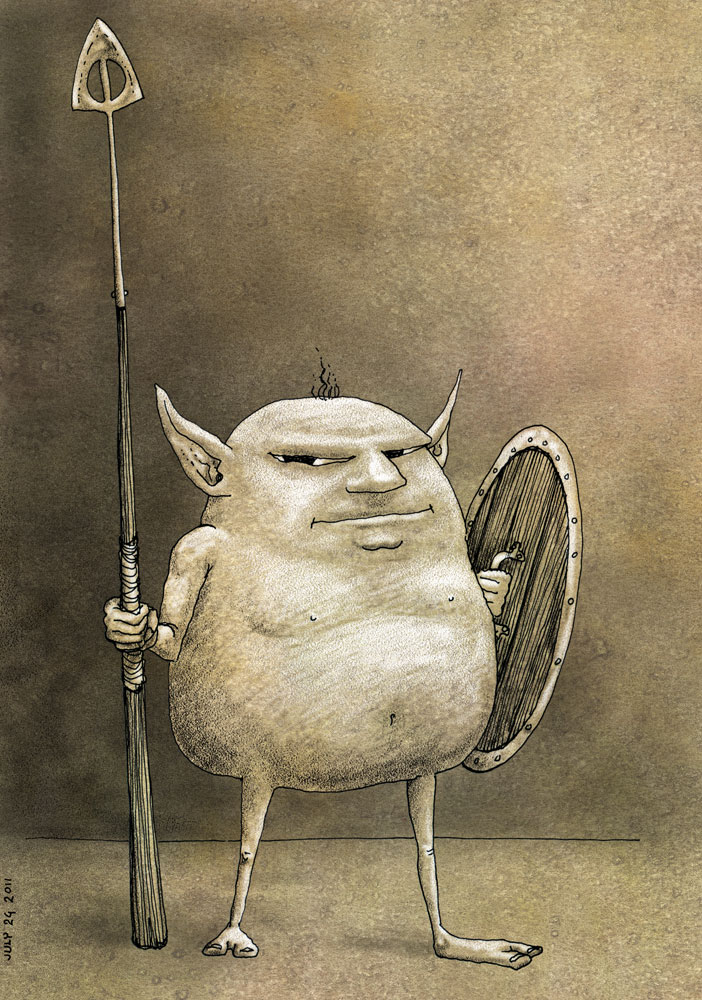
Mister Potato-head Goblin

This is just a little doodle I did this evening and finished off with texture and tone in Painter XIII.

Monday, 18 July 2011

GHQ vs. H&R

Clickify to embiggenate
Here's a comparison between GHQ infantry (on the left) and Heroics & Ros infantry (on the right). They're both Vickers machine-gun teams; the GHQ figures in desert uniform and the H&R figures in ETO battledress.

GHQ cost $US 9.95 for 50-60 figures. H&R cost £2.50 for about 50; at current exchange rates, that's about $NZ 11.50 and $NZ 5.00 respectively. Postage rates are more expensive for H&R; they charge an additional 40% for shipping from the UK to New Zealand, but that's still not nearly enough to make them as costly as GHQ figures.

GHQ figures cost more than twice as much as H&R, but then they're undeniably better sculpted. However, though they're cruder, H&R figures are still easily identifiable as to weapon load, troop type and so forth, and so serve perfectly well as wargaming units. At arm's length, on the tabletop, GHQ's finer modelling really doesn't make itself obvious, so from a functional point of view, H&R would be the obvious choice — after all, why pay all that extra for detail you're mostly not going to see?

I do like a nicely-detailed model, but that alone wouldn't be enough to make me pay a premium for GHQ. What does push me over into buying from GHQ is the fact that I can do all my purchasing automatically, direct from their website, and their stuff arrives here in New Zealand within seven to ten days. When dealing with H&R, on the other hand, I have to make my choices, send them an email order, wait for them to send me a PayPal invoice, pay them, and then wait for the figures to arrive. That extra inconvenience is enough to get me to pay extra just to avoid it.

Thursday, 14 July 2011

Castle in the Mist


More gamish scenery. The hand-rails and lamp-post might be a bit out of place, but apart from that...

(Image nicked from imgur)

Wednesday, 13 July 2011

The Genius of Zak Makes Me Weak at the Knees

Zak, of Playing D&D With PornStars and Vornheim fame, suggested this initiative sysytem:

Each side rolls initiative (one die for all the PCs, one die for the GM).
  • The winning side has one character go (if it's the PCs, they just choose among themselves who'll go first)
  • Then the losing side has one character go
  • Then the winning side has one character go...
etc. etc. the side with more characters has the leftovers all go at the end.
This is an idea of sublime genius, and I want to try it IMMEDIATELY.

Tuesday, 12 July 2011

New toys make me happy

I just received an order of GHQ 1:285 infantry in the post, and I'm more excited by it than a grown gentleman of a Certain Age should be. They are ridiculously detailed, though they're also rather large for what are supposed to be 6mm figures (they're more like 8mm). Personally I don't really mind that they're a trifle gigantic; there tends to be differences in scale between terrain features and vehicles anyway, ground scale vs. model scale is way out of whack, and as long as they don't look too out of place the infantry can all be 8-foot heroes as far as I'm concerned. And they are great little figures.

The trouble with very highly-detailed figures is that one is tempted to spend more time than is really warranted for wargames figures in painting them; even so, they're still a lot quicker and easier to paint than 15mm stuff.

Realistically, once they're based and on the table being pushed around to the sound of mouth-sound-effects and the rattle of dice, there's not really any functional difference between these guys and Heroics & Ros infantry, which are smaller (much closer to nominal 6mm scale), much less detailed (though still perfectly identifiable) and much, much cheaper.

Monday, 11 July 2011

Crusader Mk.I (15mm)

This is my latest 15mm (1:100 scale) AFV model — a Crusader Mk.I, from Battlefront. The Crusader, in any of its incarnations, is one of my favourite British tanks of WWII; from an aesthetic point of view I find it a great pity that the Sherman was so much more useful, and so displaced it.

Sunday, 10 July 2011

Lock-picking for all!

I'm not in favour of absolute exclusivity between the classes in my D&D campaigns. Anyone can try pretty much anything, as long as the players can reasonably justify it somehow. The benefit you get by choosing one class over another is that, whatever your class schtick might be, you can do it better than any of the other classes. At first level the difference might not be extreme, but it will become so as you rise in level.

In this spirit, I present my house-rules for handling lock-picking.

Picking Locks

Anyone, with access to a set of lock-picks and a little bit of training*, can attempt to pick a lock. An attempt takes one Turn (ten minutes) and succeeds if a 1 is rolled on 1d6.
* When I say "a little bit of training" I really do mean a little bit. Basic lock-picking is easy; a couple of hours instruction is enough to get anyone of reasonable intelligence into action.
If you buy a set of lock-picks as part of your starting equipment, it can be assumed that you've had that basic training as part of your character's background. If not, (i.e. after character creation) you'd have to seek out such training in-game.
If a 6 is rolled, the lock is unopenable — the pick breaks off in it, the mechanism is jammed, or something else similar occurs — and will require attention from somebody with real skill (i.e. a Thief or a locksmith) to clear it before another attempt can be made.

A Thief works in fundamentally the same way, but has advantages:
  1. A Thief takes a Round (one minute) per attempt, not a Turn.
  2. A Thief succeeds on a 1 or 2, but still jams the lock on a 6.
  3. A Thief can use a successful picklock roll to clear a jammed lock. (Note that a 6 rolled on a clearing attempt makes the situation worse: each additional 6 doubles the number of successes required to clear the lock).
  4. At every three levels, a Thief gets an additional die to roll per attempt; a 1 or 2 rolled on any of them indicates a success, and a success on one die can be used to cancel out a jamming result (a 6) on another (a success used to cancel a jamming result doesn't count against the successes required to open the lock).
Note that a successful picklock roll won't neccessarily open a lock; more difficult locks might require two, three or more successes to get them open. Particularly fiendish locks might even require multiple simultaneous successes, and would thus only be openable by Thieves of elevated rank. Or by a key.

Saturday, 9 July 2011

Certain Death

Why "certain death"?

Because if you get rid of that modern-looking cable car, then getting into this place will probably involve a party swimming and/or climbing.

Both of those activities have a much higher mortality rate, in every game I've played in, than even the most terrifyingly armoured, venomous, fire-breathing, fanged and clawed monster.

This can only be in Japan, and there's no way I'd live there — a decent earthquake would be likely to snap those puny supports and send the whole kit and kaboodle into the sea.

Friday, 8 July 2011

Magical Landscape


Just because I haven't done a scenery piece for a while, here's this magical landscape. It's somewhere on the borderland between Germany and the Czech republic.

Last night

We finally managed to get another session of Joff's Travelleroid game played last night, after a bit of a hiatus due to various real-world irritations, and it was a HOOT!

To cut a long story to its absolute essentials: we successfully nicked a spaceship and some other stuff from a bunch of mercenaries without actually getting any of us killed (but only just).

More detailed session log here.

Our gaming group appears to have an uncanny ability to roll dice at either end of the curve without ever visiting the middle, which means strings of either abject, humiliating, farcical failure, or crushing triumph, with nothing much in between. The GM, no matter who might actually be taking that role, somehow manages to regularly roll higher than is statistically likely.

We're using a d20 mechanic, which means that the curve is actually a line. I'm not a fan of that for simulationist gaming; I think a multi-dice bell curve is better in that respect, as it reduces the effect of luck and emphasizes adjustments for character skill. However, I do like linear probability for more cinematic gaming because extreme results are more common, and extreme results are more amusing... as long as you're not taking things too seriously. It can get a bit depressing when the extreme results consist of nothing but pathetic fumbles, one after the other, but que sera sera.

Anyway, we can enjoy our ill-gotten spaceship for a while before its inevitable theft from us in turn, almost certainly stranding us all on some awful shit-hole of a planet, because one of us once again manages to throw a 1 at a crucial juncture.