Monday, 9 February 2015

Spell-casting house rules

Initiative : minus 1d6 + spell level 

So, if you're casting a cantrip, your initiative score is reduced by 1d6. If you want to cast a level three spell, your initiative count would be 1d6+3 less.

If you take damage, or have to endure some sort of environmental hardship before your initiative comes up, you must make a Concentration save to be able to cast the spell. If you fail, your action is used, and the spell is not cast (though the spell slot, nor any material components, are not used up). You can still move and take reactions and bonus actions if appropriate.

Rituals : casting time one hour per total levels plus 1d4 hours.

For example a level 4 ritual would take 1+2+3+4=10+1d4 hours to cast. Note that partaking in a ritual, either as caster or recipient, does NOT count as resting.

Corruption : casting without a patron or via ritual may result in corruption.

Note: I haven't really thought this one completely through, and I'm not sure quite how workable it would be. I really just want some mechanism that might encourage people to consider before using magic willy-nilly.
Channelling magical forces directly through one's own body, without the buffer created by a ritual or magical intermediary, is potentially hazardous to one's spiritual well-being. There are certain physical signs of magical corruption, but more important are the mental effects: gradually (if it's not already there) the magic-user's alignment shifts around towards chaos and evil.

There are rituals designed to remove magical corruption, or to transfer it to some other unfortunate.

When you cast any spell, make a DC 5 + spell level save vs. your magic-using characteristic. If you fail, you gain one point of Corruption. I'll let you know what that means as and when it occurs.
Note: Warlocks, Clerics, and Paladins are deemed to get their magic through magical intermediaries. Other spell-casters will have to come to their own arrangements if they want a patron.
Note: It occurs to me that this would make an excellent game-mechanical reason for a spell-caster to have a familiar, which would act as a magical conduit as long as it's within line of sight and thus remove the risk of corrupting one's own self with all this magical jiggery-pokery. It would also explain the intimate psychic connection between familiar and "master". I shall therefore Make It So.

The Joy of the Tomb of Horrors

I'm currently running the party through the good old Tomb of Horrors, much to the disgruntlement of one of the players who has been complaining endlessly about how everyone is going to die horribly. Whine, whine whine.

Anyway, it's a bit of a side-step from the main campaign, and I've been struggling with the old D&D3.5e freebie version, trying to run it pretty much on the fly and convert to 5e at the same time. That rewrite was, as I've said before, not very good, either in terms of layout, nor as regards the placement and explanation of various features of the dungeon. I've missed (or misinterpreted) several things simply because the full description of what should be going on was located in some completely different location in the document, and it's really been pissing me off. Add to that the fancy-schmancy 3e-style map, which adds a whole lot of needless fooferaw and consequently decreases its actual clarity and usefulness.

I've just got hold of another rewrite, this time one that appeared in Dragon #213, for the then-named D&D Next — the working title for the playtest version(s) of D&D5e. It is so much better in every way than the 3.5e version. It is a model of clear, rational layout and description (with the exception of a couple of stat-blocks that crowd the text somewhat) and I really wish I'd had it to begin with.

Ah well, not to worry. I can switch over to it quite seamlessly as far as the players are concerned.

Sunday, 8 February 2015

Attack Of The Mega-Spells of DOOOOOOM!

As we make our way into my new(ish) D&D5e campaign, I'm finding quite a few things that have changed from Ye Olde Dayes that have a tendency to make PCs into unstoppable superheroes. The new hit-point recovery rules are one, though I don't really have too many issues with that; it improves survivability at low levels and keeps things moving along a bit more than they did when a party had to hole up to recover for a week after half an hour of dungeon-bashing.

The idea of having to take a character down below negative their hit-point total to kill them starts to get problematic once they get past the first couple of levels; a mid- to high-level character pretty much needs have no fear of death from a one-shot unless it's an attack that's doing hundreds of points of damage. Add to that the use of Hero Points to guarantee successful Death Saves, and a PC with more than 30hp or so is pretty much unkillable.... unless.....

Intelligent creatures will be aware of the issue, and if they spend a bit of effort after the PC has gone down whacking away at them to make sure of automatic Death Save failures, then the unconscious PC is in real trouble. This is where being swarmed by vicious little bastards like goblins or kobolds gets very dangerous.
Note: I believe, during play-testing, death was set at negative CON+Level; I'm not sure why they decided on the current system. I suppose to give players as much opportunity as possible to save their characters.
I've previously made my disdain for the new Find Familiar spell known. What a stinker.

Another spell that is giving me pause is Lesser Restoration. This is a real uber-spell. It requires no material component, and it pretty much gives the PC four spells for the price of one 2nd level spell slot: it replaces the old Cure Disease, Neutralize Poison, Cure Deafness/Blindness, and Remove Paralysis. That seems amazingly powerful for a humble second-level spell to me.

I think that what I will do with it is, first, make it a lengthy ritual spell, and second, give it a reasonably rare and expensive material component that varies depending on what it is that the caster wants to heal. That still leaves it a very powerful spell to have in one's repertoire without letting it become overly dominant.

So:

Lesser Restoration

2nd level abjuration
Casting Time: 3+1d4 hours (ritual)
Range: Touch
Components: V,S,M (50gp worth of powdered gemstone, which is consumed by casting the spell — diamond to cure a disease, amethyst to neutralize a poison, aquamarine to cure deafness or blindness, or emerald to remove paralysis.) 
You draw a magical circle of runes and sigils around a creature and, after a period of 4 -7 hours of chanting and magical jibber-jabber, can end either one disease or one condition afflicting it. The condition can be blinded, deafened, paralysed, or poisoned.

I think that should do the trick. At least it will make it a bit less egregious.

Thursday, 22 January 2015

Bah! Humbug!

I'm supposed to be running a game this evening, and I am feeling generally disgruntled and out of sorts. I shall have to BUCK MY GODDAM SELF UP, or else there is a distinct possibility that rocks may fall and everybody dies.

I've been waiting and waiting on a fucking timber merchant to let me have some fucking timber, and they are being fucking useless about it, so I can't get on to the fucking project I want to get on to, and I am fed up to the back fucking teeth with them. Apparently, when they tell me "Wednesday afternoon, or first thing Thursday" (after I've rung them repeatedly to find out what the fuck they're up to), what they ACTUALLY mean is "Ahahahahahahahaaaa.... yeah, fuck you".

So, bleeagh. And also, poop.

Sunday, 18 January 2015

Giant Bat

Here's an old miniature of a giant bat I've had hanging around for decades, along with a 25mm Ral Partha wizard for scale.

I don't know the manufacturer of the bat; I suspect it was GW, but I can't be sure. The wings were monstrously thick, and I had to carve them down substantially just to get a thin edge. Its original base was missing, so I've mounted it on a piece of wire soldered to a steel washer.

I wanted to get its wings looking translucent and skin-like, but that proved to be beyond my powers in the time I felt the miniature warranted, and I got leathery instead. That's OK, I guess.

Wednesday, 14 January 2015

D&D 5e DM Screen update

I've added another couple of pages to my DM Screen, adding tables for Chases, Traps, Carousing, Crafting and Selling Magic Items, and Madness.

I don't have these two pages permanently mounted on my screen; I've just printed them double-sided and laminated, and keep them with — but not of — the screen.

The PDF is now 6 pages, and about 260 KB. You can get it here.

Tuesday, 13 January 2015

Wave Echo Cave

Here's the map of Wave Echo Cave I gave my players after they cleared out Cragmaw Castle, failed to save the dwarf from having his throat cut or find the dastardly evil-doer they were actually looking for, and got 25% killed by an enraged owlbear which saved the rest of them from being butchered by the remains of a depleted century of hobgoblins.

Whether or not they'll ever actually get to Wave Echo Cave is now doubtful. I seem to have gone a bit off-piste with that adventure, and now they're in Neverwinter trying to find out what's going on behind a nasty plague of zombies and things, and people not staying decently dead as they should do.

I should note that I'm not actually using Faerûn as my campaign setting, I'm using my own world that I've been playing with for a bit more than thirty years now. I've just inserted Neverwinter's bit of the Sword Coast in the north-west of my main continent where it can't do too much harm.

Tuesday, 6 January 2015

Pond — water terrain experiment

This is an experiment in water effects. I painted on the back of a piece of clear 1mm acrylic and then laid the groundwork on top. It doesn't display to its best in these photos, but having said that, it's not a good as I'd have liked anyway.

In this photo to the right, with some 15mm Battlefront Panzer Grenadiers, it manages to make a small, scummy pond. With the 28-30mm Essex knight below, it's more of a small, scummy puddle.


Here's a more-or-less straight-down shot. I didn't get the effect of depth I was hoping for with the back-painting, nor was the surface texture using gloss medium terribly successful.


Saturday, 3 January 2015

D&D 5e DM Screen — updated


I've updated my D&D 5e DM Screen to include material from the DMG, and I also took the opportunity to fix a couple of errors that had crept into the first version. It's a fourseven-page PDF*, about a couplahunnerd KB. You can nab a copy here.
NOTE: I've taken to using the pages as a laminated flip-book set of reference sheets rather than a screen, but you can print and use it in the form that best suits you.


Here it is in use, in all its glory. I could maybe just fit another page and not quite have it falling off the edges of the table, but it would be more trouble than it's worth I think.

The fundamental structure of the thing is just box card; I've used much heavier card in the past to make other screens, but there's not really much benefit to that, or so I've found. The outside is covered with some antique Edwardian wallpaper I found in a junk shop, the inside is (of course) the laser-printed data sheets. It stands 175mm tall, so it's low enough for me to see over pretty easily. Laid out flat, it's about 1230mm long.

Monday, 29 December 2014

Hobbit III: MEGABRAAAAAAWL!!!!!

Warhammer!
I wish I had said it first, but I didn't. Zak S said it, and I absolutely, thoroughly agree:
"Hobbit: Battle of 5 Armies may not be very faithful to Tolkien but it is really faithful to Warhammer Fantasy Battle which is a way better thing to be faithful to. It is the Warhammer Fantasy Battlest movie ever made . #wargoats"
 I thoroughly enjoyed this movie. I liked the first two a lot better having seen the extended versions, which put back in a lot of bits and pieces that I'd missed, but of the three I enjoyed this one the most.

I will spoiler no spoilers (though I doubt that there's much there to be spoiled because frankly it's not a movie of great subtlety), but I will say this: you really, really don't want to piss off Galadriel, because she will fuck your shit up.

Wednesday, 24 December 2014

On the Day Before Xmas, A Red and Pleasant Land

My copy of A Red and Pleasant Land by Zak S. arrived today, the day before Xmas, which is kind of appropriate I think.

I love everything about this book. I love the size, and I love the red fabric binding and gold foil stamping. I love the feel and smell of the thick, cream-coloured paper, and I love the crispness of the printing. I love the typefaces and the layout, and I love the drawings. And, luckily, I also love the content — what I've seen of it so far.

This is, without a doubt, the most beautiful gaming book I've seen. It is positively sumptuous.

I don't know yet how much or how little I'll use of it in my own game. I'm pretty sure something will leak out though, because it's just jam-packed with interesting stuff.

At present, I'm just enjoying reading it as a somewhat trippy work of imagination. It reminds me, in feel, of some of the drug-addled sci-fi/fantasy writers of the '60s I was reading in my youth, though the writing is less mannered and pretentious than twats like Moorcock, and it includes a lot more useful pictures and charts and things.

The stuff in the background: the triptych is a thing I did in oil pastel a few years ago, on a cheap folding MDF screen I'd bought many, many years ago. The garuda is a carving I picked up for about eight bucks at a junk shop, going cheap because it has a crack through its base. Fortunately, I don't give a shit about stuff like that, so I was just happy to get it for a shiny penny.

Tuesday, 23 December 2014

Ch-ch-ch-changes

Having just finished my initial read-through of the new DMG, there are a few options that I'll be adopting, some of which are new(ish), some of which restore some features of earlier editions.

  • Hero Points (p.264) is one — I prefer it to the Inspiration mechanic. I suspect a major use might be to stop people dying of crappy saving throws.
  • Healer's Kit Dependency (p.266) — I'll have to sort out just how much, in terms of game mechanics, a Healer's Kit can be used before it's exhausted and has to be re-stocked.
  • Action Options (pp.271-272) — Climb on to a bigger creature, Disarm, Overrun, Shove aside, and Tumble are all options I'm happy to adopt. I'm not convinced about Mark, and probably won't use it. I'll also reinstate Cleaving Through because I like the trope of fighters cutting a bloody swathe through legions of mooks, though it may very well make being mobbed a bit less frightening.
  • Lingering Injuries (p.272) — I'll use this, but only for when characters are reduced to 0 hit-points but not killed, not also for critical hits. It will mean that restoration/regeneration magic will be more necessary, of course.

I like the Chasing rules (pp.252-255), which will make chasing and escapes a lot more interesting and fun.

Something we haven't been doing, which we should get back into the habit of, is declaring actions before Initiative is determined, for the purposes of spell-casting interruption and so forth. I'd like to get back to using Speed Factor Modifiers (p.271) for initiative too, even if only for spell-casting and potion-glugging and the like.

Apart from anything else,
it gives me an excuse to use
my Judge Dredd playing cards.
I'm also wondering about modifying initiative determination from die rolls to secret card-drawing, and then running each turn through an initiative count-down. We'd use a standard deck of playing cards, with your initiative being the value of the card you draw (1 to 13 — Ace to King) plus or minus any DEX or situational modifiers. Maybe if you draw the Joker, you get to go first OR swap it with another player's (or DM's) card. (?) That would mean that if you have an absolutely vital spell in the offing, you can give the Joker to your wizard and be secure in the knowledge that she's not going to be interrupted in the casting... or not for that turn, anyway.

When the deck runs out, it's shuffled and re-started.

The advantage of all this is that it makes combat ever so slightly less predictable, since none of the combatants will know exactly when any of the others is going to act.

Monday, 22 December 2014

Forward mail to...

High above the Thieves' Guild on Cutpurse Row in the Snail Quarter (P/F) is where, living mostly quietly in semi-retirement, you will find Prince Fnord the Golly-Gosh Darned Nice Guy (fighter 13), and a few floors below, his hideous and intellectually stunted compatriot Smirnoff (fighter 9).

It's tragic the way they've just relaxed into getting old and fat, instead of running around trying to avoid getting killed by everything they meet.

And now, behold the power...

...of this fully functioning character generation wheel!

I've fancied it up since I first made it, so it's now also available in glorious full colour (pdf is about 480 KB).

You will observe that I've cut out a disc of clear plastic to write the scores on in dry-erase marker, and pinned it to the card with one of those brass bendy-staple things that I don't know the name of so that it rotates freely.

This particular set of characteristics were generated with just 3d6, so they mostly suck, but the set I've selected actually aren't too bad... except for that DEX. This person is going to be kind of a klutz if something isn't done about that when choosing its species.

Hey Boys & Girls, It's Neato-Keano Time!

My DMG just arrived from Amazon, precisely on schedule.

So, that pretty much takes care of any of the other things I might have had planned for today.

Friday, 19 December 2014

Alas, Poor Owlbear, You Were Great Once

Statblock and illustration from the AD&D Monster Manual
From the AD&D2e Monstrous Manual description of the owlbear (basically the same as the AD&D1e Monster Manual version):
"The owlbear attacks prey on sight, always fighting to the death (ignore morale rating for purposes of determining retreat). It attacks with its claws and snapping beak. If an owlbear scores a claw hit with a roll of 18 or better, it drags its victim into a hug, subsequently squeezing its opponent for 2-16 points of damage per round until either the victim or the owlbear is slain. The owlbear can also use its beak attack on victims caught in its grasp, but cannot use its claws. A single attempt at a bend bars/lift gates roll may be made to break from the grasp of an owlbear. Note that if the Armor Class of a victim is high enough that 18 is insufficient to hit, the hug is not effective and no damage is taken."
(Emphasis is mine.)

One of the things that used to make owlbears terrifying to low-ish level characters back in the day, besides their psychotic rage and refusal to run, was this potential for damage escalation. Getting hit by a claw would sting, but if your luck really ran sour you suddenly went from taking maybe 6 or 7 points a round from claw hits to anything up to 28 points a round as it crushed and pecked you to bloody tatters while you struggled helplessly to get away. And like a Terminator robot, it would never stop.

D&D3e sort of kept this, though it shoehorned it into its terrible grappling combat system, a system awful enough to make grown DMs shudder and go weak at the knees. If it managed to grab you, it would (probably) keep doing damage each round, and I guess it could still peck at you, but working out just how much damage it was doing wasn't spelled out — the DM had to work it out from the grappling rules. Bleeuch.

The rot was clearly setting in.

D&D4e dropped the hugging damage entirely, and just said that if the beast hit with both claws it could bite its victim as well. There was no ongoing round-to-round effect. Booooooring.

In common with most 4e monster descriptions, there's practically no information about it except combat stats, but such description as there is drops any suggestion of congenital insanity for a vicious temper.

Now we come to D&D5e, and things are not getting any better.

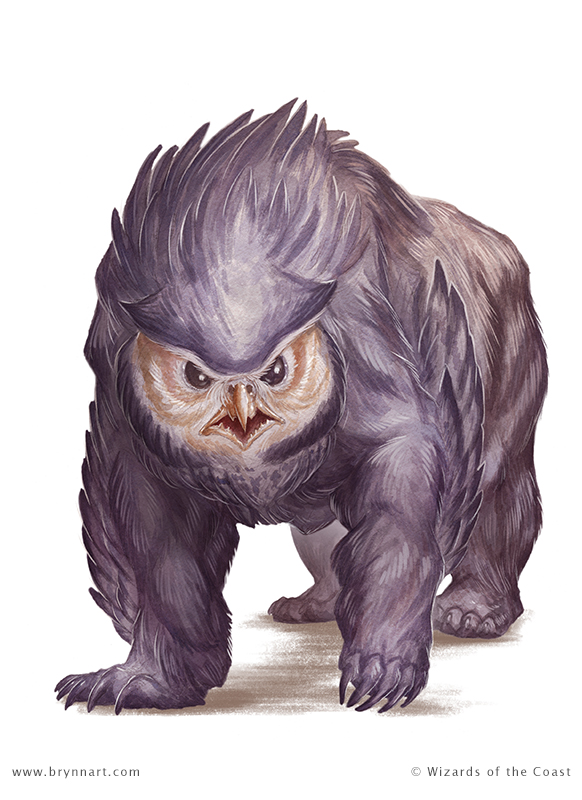
Apart from anything else, I think this may be my least favourite artistic rendition of the owlbear. It doesn't look fearsome or crazy or ferocious, it just looks rather stupid and sedentary. Regrettably, the illustration pretty much matches the D&D5e treatment of what used to be an iconic D&D monster.

It's no longer a magically-blended abomination, it's basically just another forest beast. It's no longer fundamentally insane, it's just a bit bad-tempered. It even suggests that it can be tamed and kept as a pet, for fuck sake. It no longer gets its old signature crushing hug attack at all, it just gets to attack once with its claws and once with its beak each round.

Ho-hum. Ho-bloody-hum.

Basically, what we have here is a long slow slide from what was once a basic but reasonably imaginative creation, to a bear with a funny head.

It's tragic, and it's a crime.


Just as a matter of interest, I intend to re-write the 5e version of the owlbear and take it back to its bizarre, huggy, crushy, psychotic roots.

Here's the original plastic toy the owlbear was imagined from,
along with the rest of the set.

Thursday, 18 December 2014

...paved with good intentions...

Drawing by Dylan Horrocks
Tonight, Ash the paladin died because she put herself between an owlbear and its escape route, under the impression that she was protecting her friends. Alas, a tragic and fatal mistake. Jay-Zee (the bard) had previously done it entirely by accident, but was better at making life/death saves, and so survived the whole horrible affair.

One good outcome though — the escaping owlbear scattered the approaching hobgoblin warband which would almost certainly have killed everyone else.

Tee-Bee-Ay (wizard) was surprised and badly chewed up by a grick, before dual-longsword-wielding Bea sliced it up in a trice with max-damage critical hits from both attacks in the very first round of combat.

Jay-Zee was surprised and stabbed in the face by the single remaining goblin (hiding fearfully under the altar) which then ran away and hid, and amazingly, got clean away. Jay-Zee is disgruntled at the pathetic level of treasure to be found, in spite of having scored ten year's wages worth of coin and other loot.

There appears to be an issue with killed things refusing to stay lying respectably still; they insist on getting back up after a while and shambling about moaning. It's a disgrace, and most inconvenient.

Wednesday, 17 December 2014

Owlbear

77156: Owlbear by Jason Wiebe
D&D is no stranger to stupid monsters, and this is one of them — the Owlbear. Mechanically, it's not terribly interesting; it's just a big biting, clawing monster, more dangerous than some, less dangerous than others, but with no real distinction about it. It might as well just be a bear. A rabid bear, but just a bear.

Its existence in the D&D canon does have implications for the standard milieu, implications that are borne out repeatedly: in the D&D universe, anything can be interbred with anything else. It's a concept that really doesn't hold water in the real world, though it appears to be central to the world view of those peculiar people who think that two men getting married is going to lead to general mayhem and apocalypse. But that's a bit beside the point.

This figure does have something going for it that I haven't really seen in others. The owlbear is supposed to be fundamentally bonkers insane to its very core, and this figure does look a tad doolally.

Tuesday, 16 December 2014

Potion Labels

I'm kind of a fan of using handouts and, where possible, props at the table, just because I think they're fun and cool.

I like the idea of your common-or-garden potions — things like potions of Cure Wounds, Neutralize Poison, Cure Disease, and so forth — being sold like the snake oil that hucksters used to peddle out of suitcases back in the day, with the difference being that you have a slightly higher chance of getting something that will actually work instead of just making you a bit drunk while dissolving your innards.

The labels might serve, after a while, to reassure the players that they're going to get the results they expect (or to make them suspicious that they won't). After all, everyone knows that Professor Pinkman's remedies are generally reliable, but what about this Doctor Arnolfius? has anyone ever heard of him? Should they risk it?

To both of these ends, I thought I might start coming up with some labels that might be found on potion bottles. This is the first.

Here's a link to a PDF (about 880 KB) which will print at the 60x120mm I intended.

And here's another, for the unknown and therefore suspect Doctor Arnolfius' Muscular Enhancer. This one's only 470 KB.

Monday, 15 December 2014

Chesty

77048: Mocking Beast by Julie Guthrie
I've finally got around to painting the Reaper Bones Mimic figurine I got in their last Kickstarter.

I don't believe this is a monster I have ever used in any of my games. I'm not sure why, because I'm not at all averse to making my players just as paranoid as can be.

Thursday, 11 December 2014

Ah, fun times!

Cave Monster by lpeters on deviantart
I like this picture. I like it for many reasons, but not least because the guy with the torch is clearly shitting himself with fright and concentrating his whole being on getting the fuck outta there rather than bravely standing up to his mighty foe with raw grit and cold steel.

Judging by the sanguinous state of the critter, torch-guy has already seen what happened to somebody else who attempted to bravely stand up to his mighty foe with raw grit and cold steel.

I would run away too. Just as fast as I could.

Wednesday, 10 December 2014

Power Grid — Australia, India

I just got the Australia/India expansion for Power Grid. As well as providing new maps to play on, each changes the way the game is played a bit.

AUSTRALIA


  • Australia does not have a single connected power network. Only in the populated regions, mainly in the south east are several cities connected to each other. Because of this, players may connect to any city for a generally higher connection cost.
  • Australia does not use uranium for their power production, but they do mine huge amounts of the material to sell to other countries.

Game preparation


  • In Step 1 and Step 2 of the game only the areas of the resource market for 1 to 8 Elektro are used.
  • There are no uranium spaces in the resource market. The uranium is sold in a separate uranium market in Australia. At the start, all 12 spaces of the uranium market are filled with 1 uranium each.
  • Australia only has 5 regions. In games with 5 or 6 players you always play on the whole map. With 2 to 4 players you may choose the matching number of regions in Australia, the chosen regions do not need to be adjacent!
  • Before preparing the power plant deck, remove the nuclear power plant #17. Place the removed power plant back into the game box; it is not used during the game.

Phase 2: Buying power plants


  • In Australia the nuclear power plants are considered uranium mines. Instead of supplying cities with electricity, the players mine uranium and sell it at the uranium market.
  • The uranium mines are equivalent to the power plants and players buy them in the same auctions. A player may buy a single card during each round - either a power plant or a uranium mine. The uranium mines are not counted towards the limit of 3 power plants (4 power plants for 2 players). In other words, a player may have up to 3 (4) power plants and any number of uranium mines. The uranium mines are considered when determining the player order in Phase 1!


Phase 3: Buying resources


  • The players may only buy coal, oil and garbage. At the start of Step 3 the Australian government establishes C02 Taxes. All prices for the resources in the resource market increase by 2 Elektro. Move the 6 cheapest resource tokens of each type in the resource market to the spaces in the areas for 9 and 10 Elektro. The areas for 1 and 2 Elektro are not used for the remainder of the game. In Step 3 the cheapest resources cost at least 3 Elektro per piece.
  • The uranium tokens are only used to track the uranium prices. They are in either the uranium market or in a separate storage space next to this market. The players only move these tokens in Phase 5: Bureaucracy.

Phase 4: Building


  • Players may connect any available city in the chosen game area to add to their networks. A player either pays the specified connection costs between cities, which are printed on the game board, or he pays the general connection costs of 20 Elektro, in addition to the building costs for the city.
  • The player may always choose the general connection cost, if this is cheaper than the specified connection costs on the map or if there are no connections between the cities at all. In other words: each city in Australia is connected with each other city for a maximum general connection cost of 20 Elektro. A player follows all other rules when connecting a new city: in Step 1 each city is only available for a single player etc.

Phase 5: Bureaucracy


  • Besides getting money from powering the cities with electricity, the players also get money from their uranium mines. In reverse player order, starting with the last player, each player may sell the uranium from his mines to the uranium market. A player may decide not to sell his uranium.
  • In contrast to getting money from powering cities, which players do not get at the end of the game, players get money for selling uranium in the last round of the game.
  • If the player decides to sell uranium, each uranium mine produces an equal amount of uranium matching the number of cities it normally powers with electricity. The player multiplies this amount with the highest available number in the uranium market and gets that sum in Elektro. Then, he places one uranium token per uranium mine (not per produced uranium) from the storage on the highest available spaces of the uranium market. Afterwards, the next player sells his produced uranium for the new price and so on.
  • Afterwards, uranium markers are removed from the uranium market; this symbolizes the demand of other countries for uranium. Starting on the cheapest spaces remove uranium markers in accordance to the resource supply table on the last page and place them into the storage.
  • Finally, fill the resources on the resource market in accordance with the Australia resource supply table.

INDIA


  • The Indian Subcontinent is always in danger of suffering huge power outages if the players increase their networks too fast.
  • Additionally, the players must buy their resources on a limited resource market, which not always guarantees enough resources for all players.
  • The garbage power plants use livestock manure and have a low efficiency. When producing electricity they need one additional garbage.
  • At the start, the prices of resources begin at: coal 1 Elektro, oil 2 Elektro, garbage 2 Elektro and uranium 6 Elektro. Use only 8 uranium tokens during the game and place the other 4 uranium tokens back into the game box.
  • Before preparing the power plant deck, remove the nuclear power plant #11. Place it back into the game box; it is not used during the game. 

Phase 3: Buying resources


  • At the start of the game the resource market is very small. The players can only access the areas for 1 to 3 Elektro. At the start of Step 2 the areas for 4 and 5 Elektro are added. Only at the start of Step 3 is the whole market completely accessible to the players.
  • In reverse player order, starting with the last player, each player may buy just 1 resource token per buying turn. The players continue in this manner for several buying turns. If a player wants to stop buying, he passes. The other players continue to buy 1 resource token per buying turn.
  • The garbage power plants need 1 additional garbage token to produce electricity, but they do not store more garbage. For example, the garbage power plant #24 now needs 3 garbage tokens, but it can only store up to 4 garbage tokens.

Phase 4: Building


  • When the players connect new cities to their networks, they show this by placing their houses on their end.
  • At the end of this phase the players count the total number of houses placed on their end (which were newly connected by all players during this round). If this sum is higher than twice the number of players, at least 5 houses with 2 players, at least 7 houses with 3 players and so on, the players cause a huge power outage. As punishment they get less income in the following Phase 5: Bureaucracy.
  • Finally, all new houses are placed right side up.

Phase 5: Bureaucracy


  • The players must power as many cities in their networks as possible with their power plants. If the power plants have enough resources and there is still an unsupplied city in that player's network, resources may require to be moved between power plants using the same resources, until the power plants produce enough electricity even if they now overproduce. Only if a power plant is not needed to supply electricity, may the player choose to produce no electricity with that power plant and save its resources for the next turn.
  • If the players caused a power outage in Phase 4: Building, all players are punished and receive less income for powering the cities. For each city connected in a player's network, that player must subtract 3 Elektro from his total income. For example, if he owns 10 cities and powers 8 of them, he gets 90 Elektro - 30 Elektro = 60 Elektro!
  • If there is a power outage in the last round, you also play phase 5 for once, so all players get one more income.
  • Finally, fill the resources in accordance with the Indian Subcontinent resource supply table. Refill the most expensive spaces first, even if these spaces are not available in the first turns, like uranium.

Tuesday, 9 December 2014

Red Light Artillery

And here are the Gatling guns of the Red Army.

I think this will do for artillery for a while. Both armies could do with a bit more padding out with infantry and cavalry yet.

Wednesday, 3 December 2014

Blue Light Artillery

Progress has slowed a little recently, mainly because we've been having an unseasonable cold snap. That means that it's not that comfortable in my workroom, and also that it takes quite a bit longer for the Quickshade varnish to cure.

Something I've learned is that you shouldn't use a hair dryer to blow off the excess Quickshade, because the heat accelerates its tacking off, and it doesn't give it time to drool down off the high points and self-level, and you end up with something that looks like it's been bathed in black treacle. The offending model is at the back, on the right.

Oops. Well, now I know that. Now, back to the Reds!

Sunday, 30 November 2014

Gatling Gun

“
Whatever happens,
we have got
the Gatling Gun,
and they have not."
— jolly morale-raising Victorian jingle by Hilaire Belloc.
Here's the first of my HäT Gatling guns, which will be filling the role of light artillery for my generic Victorian Red and Blue armies. These guys, obviously, belong to the Blue army.

There are seven more yet to do, so each army will get four each.

I'm quite impressed by the quality of these little models. The sculpting is a bit more refined than that of the infantry set, and they were pretty good to start with.

Thursday, 27 November 2014

None so blind as those who will not see

Tonight's game revolved around the party playing hide-and-seek with a green dragon.

Success was made possible by the fact that they were dealing with maybe the least observant dragon in the whole history of dragoning. Over the course of the evening, it got to make maybe twenty perception rolls of various sorts; none of them scored more than a seven. And whenever its very respectable passive perception might have been relevant, the party were happily rolling natural twenties for their stealth skill as if there was no other number scribed on the die. (There was, I checked.)

All that was to the good of course, from the players' point of view, since if the dragon had actually found them it would very probably have made pretty short work of the whole lot of them. As it is, they nicked its loot, torched its lair, and got away unscathed.

I have the worst luck with dragons.
P.S.  Annette was most aggrieved that I didn't mention that they were clever too. So then, they were clever too.

Red Artillery

Following on from the Blue artillery, here's their opposition. Exactly as with the Blues, the two medium guns have four crewmen each, while the heavy gun (the ACW howitzer in the centre) has six.

I've conscripted some of the figures from the Revell ACW artillery set to fight for the Reds.

I've managed to track down some HäT Gatling Gun sets, so I'll grab those just as soon as I can and put together some light artillery for each side. And I suppose I'd better get on to some more infantry as well, and some cavalry. There's just no end to it.

It's The Waiting I Can't Stand

The only things I don't like about Army Painter QuickShade are

  1. How long it takes to cure, and
  2. The price.

I hate waiting.

Monday, 24 November 2014

Blue Army Artillery

Here's the beginnings of the artillery park for the Blue Army.

In point of fact, the uniform is that of the British Royal Artillery, of the same era as that of the Red Army, so they really should be shooting for the Reds and not at them. However, I cast aside all historical considerations, and because these lads are dressed in blue, they'll be fighting for the Blue Army — and they'll like it!

The two outside guns came with the figures, and are from HäT's Colonial British Artillery set. They'll be doing duty as generic Medium Artillery, and I've therefore only given them a puny four cewmen each. The middle gun is from a Revell set of American Civil War artillery, which will serve as Heavy Artillery and therefore gets a crew of six. The Revell crew figures will end up crewing guns for the Red Army.

I want to get one or two of HäT's Gatling Gun set, to serve as Light Artillery, but that will have to wait until I can find some.

Brave Boys of the Blue

Here is the first battalion of those brave boys of the Blue Army, ready to take on those repellent and repulsive rapscallions of the Red.

For some reason that I can't put my finger on, I feel like this colour scheme has a Bavarian look about it. My knowledge of actual uniforms of the late Victorian era is sadly lacking though, so it may just be fantasy. Which this army is, so it's got that going for it, which is nice.

I considered going a bit more realistic with the base landscaping, but in the end I decided on this plain, even, bright green grass, which I think is a good compromise between the toy soldier aesthetic and the more modern mini-diorama wargamer's style. It hides the individual figure bases well enough, which is its main function.

Friday, 21 November 2014

Blue Army - Command


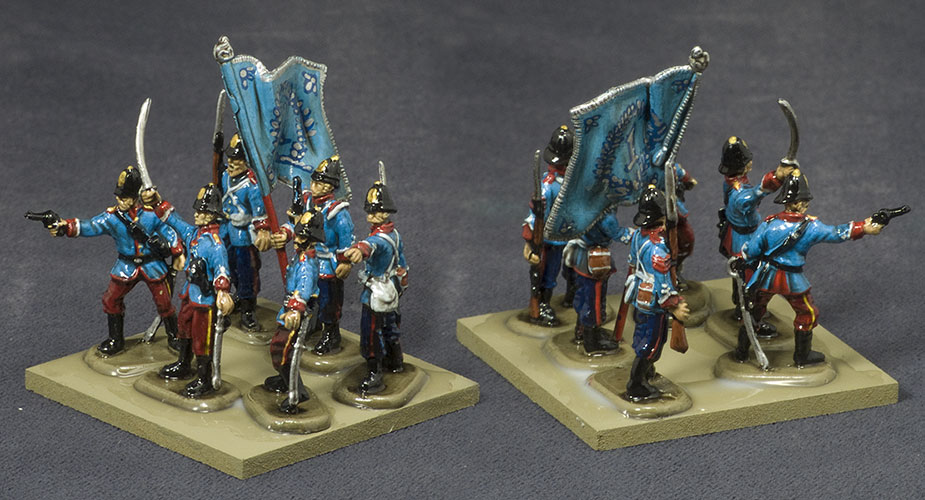
Here's the command base for the first Blue Army battalion, front and rear. Note that all the officers get fancy-schmancy crimson pants, while the ruck and swill in the rear rank have to make do with common old dark blue.

I'm pretty happy with the way that these figures are turning out. They do look a bit terrible in high magnification, but in real life they're quite acceptable as gaming pieces.

D&D5e Character Generation Wheel

This PDF (some assembly required), when printed on to card and a circle of acetate or clear plastic pinned to it (for writing on with dry-erase marker), creates a handy-dandy tool for initial characteristic generation for my D&D campaigns.

Basically, the way it works is this:

  1. For each of the small circles, roll 4d6 and write the sum of THREE of them on the plastic over the circle. (I've used this system with 3d6 straight as well, and still got pretty decent characters.)
  2. Repeat until all the circles are filled.
  3. Rotate the plastic circle until you get a characteristic array you like matched with the characteristic name labels in the bottom quadrant of the array.
  4. Once you've chosen a set, you can rearrange them, but at a cost:
     .....For the first pair, each score of the pair is reduced by -1.
    .....For a second pair, each is reduced by -2.
    .....For a third pair, each is reduced by -3.
    And so on, if you really want to play around with them.

Note that I have included the Strength reduction I use for the teensier races. If you hate that idea, just ignore it.

Wednesday, 19 November 2014

Goblins

Posted on reddit by MrApophenia, which I then found out about from ZakS, who found out about it from danbuter on therpgsite:
“
So I was thinking about goblins in my game, and came up with an idea I thought was kind of fun. Figured I'd post it for anyone who wants to swipe it. 
In my game, I want goblins to be scary, even though they're mechanically identical to the usual low-level baddies. Mostly I'm swiping the Pathfinder mode of Gremlins-inspired craziness for my goblins, but rather than being cowardly, I'm planning to make them gleefully suicidal, with absolutely no concept of self-preservation or survival instinct. These guys will throw themselves at the heroes in giggling hordes no matter how many get slaughtered. 
Then I got to thinking about why they would have this trait, and an idea struck me: Nematodes. Specifically, nematode cannibalism. 
Nematodes are a type of flatworm with an odd characteristic - if one nematode eats another one, it seems to take on the memories of the consumed worm. Yes, really! 
Goblins, it turns out, are the same. Goblins don't fear death because they have a very peculiar form of immortality: As long as a dead goblin is eaten by another goblin, all its memories will be passed on to that goblin - including any memories from previous consumed goblins! And since goblins are voracious cannibals, most goblins remember dozens or even hundreds of lives (and deaths), and see it as little more than an inconvenience. 
A goblin who eats a hobgoblin not only gains the memories of that hobgoblin, but will begin to grow; over the course of about a month, it will become a new hobgoblin, with the personality and memories of the deceased hobgoblin. This is why hobgoblins are always sure to keep some goblins around, despite their contempt for their inferior cousins - when a hobgoblin dies, assuming it's a hobgoblin the others still want around, they'll go grab the nearest goblin and feed the corpse to it. 
However, one hobgoblin eating another is a severe taboo, because of the result - a bugbear, a monstrously huge goblin that hunts and eats other goblins and hobgoblins. (Bugbears tend to be solitary and avoid each other, so what happens if one bugbear eats another is left to the imagination of the GM.)"

Monday, 17 November 2014

Half a zombie is better than none

Among the stuff I got at the Christchurch Wargaming Society's annual bring-and-buy was a plastic bag labelled "Various Zombies" for three bucks.

Naturally, I couldn't pass up Various Zombies for only three bucks, so I snapped it up. They're plastic, 28mm scale, and thirteen of them, so, 23 cents per zombie. That's a bargain by any measure.

Among them was this guy, which I've repainted and rebased.  I can't help thinking now that the pile of guts in front of him would probably not be as fresh and pink, considering how decrepit the rest of him is, but never mind.

Sunday, 16 November 2014

1st Battalion, Red Army


Almost finished — all bar the base landscaping, on which I have not yet finally decided — is the 1st Battalion of my generic late 19th century Red Army. Another two or three battallions of infantry, a couple of troops af cavalry, and a few artillery pieces, and that will be one army... then I do it all over again for the Blue Army.

I'm impressed with the labour-saving utility of Army Painter Quickshade varnish; it really speeds up production, and gives a pretty good shaded finish. It dries very glossy, and I was considering matte-coating the figures, but I now think I won't bother — I quite like the toy soldier glossy look for these.

The figures are HäT's soft plastic 20mm (1:72) Zulu Wars British. There's no particular reason why I couldn't use exactly the same figures for the Blue Army, and I probably will — these sets of figures deliver the best bang for the wargaming buck of any I've seen. I was considering using, say, 1870s Prussians for the Blues, but of the sets I've seen, I'd end up using about half a dozen figures from each box and tossing the rest. Since the main benefit to me of using plastic figures is their low cost, that would pretty much make using them pointless.

This is the furthest I've got towards building a whole army in many, many years.

Friday, 14 November 2014

The Dip

A mass-production miniatures painting technique that has really taken hold in the last decade or so is auto-shading by using glazes or washes of various formulations. Vallejo and Citadel both produce water-based washes in an increasing range of colours, and when used sensitively they can create excellent, subtle shading with minimal effort.

For wargames figures, less finesse is required. The miniatures are intended to be viewed at arm's length or further, so the shading results can (and probably should) be less subtle. Plus, wargaming figures benefit from being well protected from the vicissitudes of handling by a good, sturdy sealing coat.

Here are a couple of alternatives to achieve that end.

On the left, Army Painter Quickshade (Dark Tone). Quickshade comes in three strengths of tone, so you can use whichever best suits the underlying colours. This 250ml tin cost me $45, which is not cheap.

On the right, Cabots Varnish Stain (Indian Tea). This can be tinted in a much wider range of colours. The 250ml tin cost me about $25 — slightly more than half the price of the Quickshade.

However, price is not the only determining factor when one is choosing a product. How do they perform? Both, as far as I can determine, do fundamentally the same job: both are oil-based, fairly low-viscosity, tinted varnishes.

Below are two varieties of Reaper plastic zombies. Each type has been block-painted and then just dipped in the stain — a crude method of application; brushing the stuff on would certainly give you more control.

Of each type, the Quickshaded one is on the left, the Cabots Varnish Stained one is on the right.


The Quickshade gives you a much more subtle shading effect than does the Cabots, which is probably usually going to be preferable. I haven't yet tried thinning the Cabots to see if that ameliorates the chalk-and-soot effect — if it does, then its much lower price would make it a more cost-effective option. Both products do a decent job; if price is no object, my taste runs more towards the Quickshade outcome.

Both of them harden over about 24-48 hours to a a rugged, glossy finish. That means that unless you like your toys shiny, you'll need to hit them with a decent matte-coat afterwards. Some acrylic varnishes don't work or play well with oil-based underpainting, so that means that the matte-coat should probably be spirit based.


The Next Day...

I gave the zombies a squirt of Vallejo acrylic matte varnish to take the gloss off them, and it went on just fine. It doesn't seem to be bothered by the oil-based varnish underneath, which is good.

Something I've found about acrylic matte varnishes is that they really do work best sprayed. I've never achieved anything better than a satin finish by brushing them, while the identical varnish goes dead flat when applied through the airbrush.


Thinning the Cabots

Thinning doesn't work very well. I suspect that what it needs is not thinning, but dilution — I may get an un-tinted can and use that to get the exact degree of tint I need. However, there's not much point in that until I run out of Quickshade, and a pot does go quite a long way, especially when it's brushed on.

More Plastic Toy Soldiers

These are some of HäT's 20mm (1:72) plastic Zulu Wars British infantry, based for the Black Powder rules.

They're painted somewhat inaccurately, but that really doesn't matter for my purposes, since these particular guys are intended for one of two generic late C19th Red and Blue armies, made up of whatever figures I can lay my hands on.

HäT figures are ideal for this sort of thing, because compared with metal figures, or even with hard plastic 28mm figures, they're as cheap as chips. The Zulu Wars sets are especially good for wargaming purposes because the sprues are mercifully free of the sorts of "character" poses you tend to get in figure sets from the likes of Airfix, Italerei, or Revell, which improves their cost/benefit ratio enormously.

The only problem with them is that they're not that easy to source here in New Zealand. There's a local chap who imports them, but I keep forgetting to get his contact details, and so whenever I see him at conventions and what-not I pretty much have to just be happy with whatever he might have in stock at that moment.

So far I have enough infantry for about twenty stands, half a dozen artillery pieces, and a couple of dozen cavalry. Those in this picture are HäT late C19th (Zulu Wars/Sudan) 17th Lancers, but I have a box of Revell Waterloo-era British Life Guards that I'll also press into service. The horse-drawn artillery limbers shown here come from the Revell American Civil War set of Union artillery. At a pinch, I could even throw in some HäT Peninsular War British infantry, though they might start looking just a teensy bit out of place amongst the pith helmets.

Thursday, 6 November 2014

Spell Book

Here's a little thing I whipped up — it's a 4-page A5 booklet-fold spell book, with spaces to record spell level, name, casting time and components.

Click here to grab the PDF.

Campaign Details: Half-Elves

Half-Elves move a lot more freely in Human society than do pure-blood Elves, mainly because it's easier for them to pass for Human.

If they are revealed as having part elvish ancestry, they're very likely to be shunned and discriminated against — the days of Elvish domination may be far in the past, but their reputation lives on on tales of Ancient Times, when Elvish overlords exercised ruthless powers of life or death over whole populations, and humanity was utterly subservient to their will. There are plenty of superstitions about the Elves, few of them complimentary, and though the learned may know them for the fictions they (mostly) are (these days), most of the ruck and swill of humanity still give them full credence.

The situation in Elvish society is different, but certainly no easier for the half-Elf. Even fairly tolerant, enlightened Elves tend to view Humans with a degree of distaste — to the Elves, humanity (and pretty much all the non-fey humanoids) are untermensch; at best, barbaric, and at worst, actually bestial. Half-elves are therefore, at best, objects of pity, being as they are the products of bestiality. In the more xenophobic Elvish domains, a half-Elf is an abomination to be expunged as quickly as possible.

Probably the most congenial societies for the half-Elf to live among, as far as acceptance goes, are those small, primitive tribes of Wild Elves, who have fallen far away from the knowledge and mores of old, and to whom purity of blood is much less important than the individual's usefulness to the tribe. Life among the Wild Elves is far from easy though; they live fearful, furtive lives of hiding, hunting, and being hunted in turn.

Monday, 3 November 2014

Bugs Galore

These are some of Reaper's Bones plastic miniatures — 77130: Vermin: Beetle Swarm, by Bob Olley.

I got them amongst the first Bones Kickstarter, and in truth they're not the sort of thing I'd normally spend any actual money on. You'd get much the same effect by printing pictures of swarming beetles and sticking them to tiddlywinks or something. However, I've got them, so I thought I might as well make use of them.

I haven't yet looked at the vermin swarms in the new Monster Manual, so I don't know how frightening they're likely to be. I'm imagining something like the swarms of carnivorous scarabs in The Mummy, which could be fun. Though I may need a few more beetle-swarm-markers.