Friday, 28 September 2012

Plastic Riflemen

The 1/72 (20mm) plastic Peninsular War British set from HäT includes a bunch of spare heads, some wearing the Waterloo-era Belgic shako, and others (more useful from my point of view) wearing the tapered Light Infantry shako with the bugle badge of the 95th Rifles.

That makes the set much more useful, since with a simple head-swap, a bayonetectomy and a green paint-job instead of red, I can field some skirmishers to screen my nicely ranked line companies. It also increases the wargame-worthy poses in the set quite substantially, though there are still a reasonable number that I wouldn't use, myself.

There are some detail differences between the uniforms of the Line regiments and the Rifles apart from the different shakos; the Rifles should be wearing pantaloons and spats rather than the cuffed trousers these figures have on. Their jacket cuffs should be pointed, and the jacket buttons are differently arranged. Fortunately, I am not anal enough for any of that to matter to me, so all I need to do is paint them to suit.

I flailed around for quite a while trying to find an appropriate dark green for the Rifle uniform; Most of my Vallejo paints are rather too camouflagey in tone, quite unlike the dark bottle-green the Rifles wore. I eventually settled on this one: Vallejo Game Color 72.147 (Heavy Blackgreen). It's not perfect, but it looks OK to my eye, and very much better than any of the camo greens I'd tried.

Sunday, 23 September 2012

More terrain


I've been fiddling around with some more wargaming terrain pieces, in this case, a low grassy hill with an impassable rocky section on one side.

The body of the hill is made from laminated MDF, carved to shape with a belt sander. The rocks are my old favourite, pine bark chips. The pine trees are bits of tapered chenille snipped to size and painted. The grass is various grades of railway modellers' flock.

For my next hills, I want to try using a sand mould to cast them in expanding polyurethane foam. It should be fairly straightforward... but things seldom are, alas.


Thursday, 20 September 2012

Dices Make Throg Brane Hurting

I'd quite like some of these dice. I have no idea who makes them, or where to get them, but if I ever find out, I'll buy some. If they're not too expensive, because they're really just a novelty, and novelty wears off, so I don't want to drop too much loot on something that I won't care about after playing with them for a couple of hours.

I'd really like to see someone trying to play one of those massive dice-pool games with these. That's something that would amuse me... for a little while.

Sunday, 16 September 2012

18mm "Man at War" Napoleonics

I've bought myself some more toy soldiers, because I clearly didn't have enough toy soldiers. It's not entirely my fault; I was led astray by Evil Companions. Honest.

Anyway. I bought a box of Waterloo-era Napoleonic British infantry by Man at War for their "Napoleon at War" game — which may have been a bad idea, when it comes to mixing and matching them with figures from other manufacturers. They're described as "15/18mm scale" and measure 18mm from foot to eyebrows, which would make them giants of men among actual 15mm figures. Never mind; if it comes to the crunch I'll call them Guards or something.

As far as sculpting goes, they're not too bad. Not the best I've seen, but far from being the worst. The picture shows an unpainted and painted version of the same figure (almost the same — the unpainted guy is a flank company soldier, with the swallows-nest epaulettes, while the painted one is from a centre company. The epaulettes are the only real difference... though the flank company guy seems a trifle taller).

The figures don't need a great deal of cleaning up, but there is some to be done. They're moulded in a very soft alloy, and a lot of them arrived with their muskets wrapped around themselves like cthulhoid tentacles, so they need to be carefully straightened out. Also, there tends to be quite a bit of roughness around the somewhat massively chunky bayonets that needs to be trimmed off. As usual, there are some visible mould lines to be smoothed away, and that's about it for the pre-painting clean-up.

The test figure I did (to work out a reasonable production-line paint process) painted up pretty easily. The detail on the figures is well delineated without being too chunky, which eases painting enormously — tiny figures with in-scale lacing, frogging and what-not can be a bit of a trial to paint for the wargames table, in my opinion; I like a bit of "colouring book" help to speed things along.

The box includes plastic bases designed to hold 4 figures, for the Napoleon at War game system. I may replace those with MDF bases, since I prefer square-cornered bases to rounded ones for formation-based games like this. Ideally I'd like to mount them on 2mm MDF, but if need be, I'll go to 3mm.

Thursday, 13 September 2012

Movement, Encumbrance, and Material Components

To quote Hack & Slash: On Movement
"Now the real world movement rates are very slow. Several people by themselves have done 'tests' where they map their environment or attempt to cautiously move around in these environments. In every case they say, 'I am able to walk so much faster then the listed rate'. They then reach the conclusion that the listed rate is wrong. In every single case none of the following is considered. 
What you can usually see in the dungeon, if you're lucky
The environment is cramped and pitch black. The ground is uneven in the best case. The light is torchlight. Mapping is done with either parchment and charcoal or an ink pen. There are no hash marks or clear markers to indicate distance, it must be measured. Groups range in size from 4 to 12. Many are uneducated hirelings. Many are wearing metal armour and carrying heavy gear. Movement must be coordinated and silent. The rate is an abstraction, looking around corners, stopping to listen (and having to get everyone silent first) and quiet hurried discussion about what to do make up for the time spent moving slightly faster down an open corridor. 
When you look at real world examples of these things the movement rate is much more realistic. Getting people in line and moving orderly is time consuming. Exploration of caves tends to take much longer (with modern equipment) than people assume, and we know they aren't trapped, filled with demons and monsters, and actively inimical to your survival."
I know I don't take as much notice as I should of party movement and timekeeping; it often feels like pettifogging book-keeping to no purpose, like being strict about encumbrance.

However, a large part of old-school D&D style gaming is resource management and exploration, and to play that sort of game properly you really do need to know exactly what resources you have to manage, and how far and how fast you can get those resources to where they'll be useful (i.e. the massive piles of treasure).

I've been pondering for a long time on ways to make keeping track of encumbrance as painless as possible, because I know that if it puts players to any trouble at all, 99% of them will just try to ignore it. And I think I have a workable solution, though it will mean a little bit of design work on my part.

I'm thinking of separate sheets — index cards, maybe — for each container the characters are carrying, each card marked with the container's dimensions and a number of encumbrance "slots" that can be filled with Stuff. To this end, I'll largely hark back to Gygax's old AD&D equipment encumbrance values, since they took into account not only the item's weight, but also its size and general awkwardness. There will still have to be a certain amount of common sense employed (no putting barrels into belt pouches, for example), but in general it should work out easily enough. Plus, having a bunch of cards to sort through for all your packs, pouches, sacks and porters  should neatly represent the problems of having to find that thing you knew you had but just can't quite remember where you put it...

On a semi-related note, I think I'm going to return to the idea of having set material components for spells again, a la AD&D, rather than just hand-waving the matter. Again, it's to do with the resource management aspect of the game. If you don't have the components available for the spell you want for the situation at hand, what do you do? Try and substitute something else and hope it works? Or find another plan?

Sunday, 9 September 2012

Borodino 2012

This weekend, over two days, the Christchurch Cavaliers (a local wargaming club) staged a massive re-fight of the Battle of Borodino in 28mm, using a somewhat modified version of the Black Powder rules.

I only saw part of the last couple of hours. The photos here (taken with my camera, so not great quality) really don't do justice to the awesome splendour of this game.

By the time I left, things were looking decidedly dicey for the Russians, with the almost total collapse of the centre-left and the loss of the Grand redoubt.


There are a couple of much better reports at Craig's Wargaming Blog and Rebel Barracks, with much more information and better pictures.

Saturday, 1 September 2012

Painted Bones

I've finished painting the initial batch of Reaper Bones (plastic) figures I bought, and now am waiting with great anticipation for the vast avalanche resulting from their wildly successful Kickstarter.

There is absolutely no way I'm going to get all of that lot painted before I die.

Click on the images, if you so choose, to see larger versions.

Kobolds... not the greatest sculpts ever made, but suitable enough for Mass Mook Attacks.
Great Worms — from left to right, sand-worm, ice-worm and that old favourite, purple worm.


Rats. Sculpted by Sandra Garrity.

Friday, 31 August 2012

Mystery Thief

Clickupon to embloatify
I found this figure when I was fossicking about in amongst my vast dunes of unpainted stuff recently. I don't know who the sculptor was, or which company produced it, but I think it was Grenadier, some time in the early- to mid-eighties.

The standard of sculpting isn't particularly high, even by the standards of the time, but it's not terrible either, and I quite like it. I have a preference for gaming figures that are depicted in the "moment of repose" between actions; I tend to dislike figures sculpted in action poses, especially some of the extremely exaggerated poses that seem to be in vogue with some sculptors.

The paint-job was a real quickie, as you can see, but it will suffice for my purposes.

Thursday, 30 August 2012

Advanced Accountancy for Spacemen

This evening our Traveller campaign episode revolved around yet another mis-jump, keeping a ship-load of refugees from going stir-crazy with a series of inspirational and educational lectures on a variety of subjects, and eventually negotiating a good price with a TL4 night-soil collector for the ship's sewage. Very little shooting, and minimal innocent collateral damage from what shooting there was.

Sunday, 19 August 2012

Rocks, rocks, rocks

Click on the images to see bloatier versions

I've just finished making a bit of gaming terrain, in the form of rocky outcrops for a desert environment. The "rocks" themselves are bits of pine bark looted from a local playground, glued to shaped 3mm MDF bases, painted, and the ground textured with model railway ballast and grass flock.

The bark does an excellent job of mimicking sedimentary rock like sandstone, and it's as cheap as it could possibly be (i.e. free). It's very absorbent, so it pays to seal it before painting — I used the cheapest white spray primer I could find, which worked just fine.

The dinosaurs in these photos are cheap — very cheap — plastic toys from a local Dollar Store; eight velociraptors for a buck. They're cast in pretty lurid colours, but with a coat of paint they came up pretty well.

The party could be in a bit of trouble here. There are three more velociraptors out there... somewhere.

Broke my cherry...

...my Kickstarter cherry, that is.

Reaper Miniatures have a kickstarter running at the moment to get a whole lot of their metal range into plastic production under their Bones range.

I've kicked in enough to qualify for the "Vampire" level, which means that at the moment I'm in for about 150 figures for substantially less than a buck apiece, with the option to pledge more for some bigger figures like dragons, giants, Great Cthulhu, and so forth.

Not that I actually need any more unpainted figures, you understand. I just couldn't resist.

As of writing, the Kickstarter still has 6 days left to run. If you are, like me, a pathetic grovelling gaming mini junkie, I highly recommend you jump on the bandwagon immediately — the more the merrier!

Friday, 10 August 2012

Reaper Bones - my first look

I'm a sucker for miniatures. I buy all sorts that I know that I will probably never actually use in a game. I'm also kind of a cheapskate — admittedly, a cheapskate with poor impulse-buying control, but nevertheless.

I suppose it's because when I first started buying gaming figurines, they tended to cost less than a buck apiece, and figures designed especially for wargaming were often as low as 20 cents. That makes modern metal figures seem very, very expensive to me, and when it comes to companies like Games Workshop, ludicrously expensive.

Reaper Miniatures have a very extensive range, mostly of pretty good quality, and for a 21st century company, their prices are fairly reasonable. You're still looking at six to ten yankee dollars for a 25-28mm metal figure though, which is a lot when you want to buy a whole horde of orcs or something.

They've recently started producing much cheaper plastic versions of some of their range. The plastic figure range is called Bones, and I decided to try them out. I bought 3 of the Great Worm (77006), Rats (77016 — you get 6 in a pack), and 5 packs of Kobolds (77010 — also 6 to a pack).

The figures are made of a white polymer of some kind, which is bloody hard to photograph effectively. The Rats and Kobolds, shown here, I eventually laid on the platen of my scanner to get an image that didn't blow out the highlights.

The detail appears a bit softer than I'd expect from metal figures, but to what extent that's due to the modelling, and how much to the nature of the medium I don't know. The detail on the Great Worm (below) looks a lot sharper, but then it's also a much larger figure.

The kobolds, by B. Siens, have been mastered in quite flat poses, which tends to be a feature of injection-moulded plastic figures due to the issues the process has with undercuts — attaining a well-rounded, dynamic figure often requires some pretty tricky multi-part mould-making, and that (of course) increases the production cost.

The Rats are by Sandra Garrity, and are pretty good; the proportions and the three poses provided are suitably ratty.


The Great Worm is decently monstrous, and it's with really large figures like this that you stand to save a LOT of money. It costs $US2.99 in plastic, and I doubt that you'd get much change from three or four times that amount if it were made in metal — plus it would weigh a ton, and that means paying extra freight as well.
Of the Bones figures I have thus far, I've only painted the Great Worm, shown here with an old WotC metal figure (circa 2001, I think) for scale. The Worm does stand on its own moulded base, but it's slightly out of balance, and I glued it to a honking great steel washer for the sake of stability.

Reaper say that you can slap paint straight on Bones figures without undercoating, and I certainly didn't have any trouble with the Vallejo acrylics that are my preferred paints these days.


I'm pretty happy with what I've seen of the Bones range so far. I don't think metal figures are going to disappear overnight, but I do think they're going to be reduced to more of a niche market within the next few years, if only because of their expense. A cheaper alternative like these allows me to buy more figures, which means I can throw larger hordes of mooks at my players, and that can't be a bad thing.

Thursday, 19 July 2012

A Tragic Death in the Party

Alas, poor Pansy died of STENCH after being sprayed by a hideous mutant garbage-skunk and then failing more than six saving throws in a row. They left most of her in a cast-iron bathtub, surrounded by great hills of trash, a  few goblin corpses and lots of giant cockroaches.

Now the survivors are riding in the hopper of a biomechanical elephant-mantis — to where? They don't know. Away from here, and that's good enough for now.

Amazing terrain boards


This guy, Bruce Weigle, makes the most incredible wargaming terrain boards. You can see lots more of them here.

I'm in awe, and hang my head in shame at my own pathetic attempts.

They must be bastards of things to store though.

Friday, 6 July 2012

Semovente 105/25

This is the 15mm (1/100 scale) Italian Semovente 105/25 assault gun from Battlefront.

The painting of the camouflage pattern has not been entirely successful; I may have to re-do it one of these days.

Sunday, 1 July 2012

From tiny acorns...

I've got sick of either shivering my nuts off down in my overflowing-with-junk workroom during the winter months, or spending an arm and a leg on electricity to heat it, or just avoiding it entirely until the weather warms up again.

If you will observe the terrible, grainy, fuzzy picture to the right, you will see the beginnings of my answer to the problem: a portable modelling and painting station.

At present it's pretty much just an MDF box with a drop-down lid doubling as a workbench, and a handle to carry it by. I have great plans for it though: I intend to install a bunch of racks and drawers in the back for holding stuff, and a pair of lamps on a hinged support to extend out over the workspace and light stuff up.

The racks and shelves are pretty straightforward, but the lights aren't so much. I have no electrical skills whatsoever, and fear that if I try to wire up the light sockets and switch and plug, I will instantly explodiate and burn down my house. I have a couple of cheap clip-on lamps that can serve as a stop-gap measure, but they're rather clumsy and not ideal, so I shall have to see if I can find a cheap and friendly sparky to do the Magic 'Lectric stuff for me.

Friday, 29 June 2012

Insectoid warrior critter

Here we have an insect-man with a whole lot of sharp things, ready to stick them into some other critter at the drop of a hat.

I drew it for no particular reason, but now that it's here I can think of no good reason why these guys shouldn't start causing plenty of trouble for my hapless party just as soon as possible. I suppose I'd better start thinking about what sort of stats an emotionless insectoid killing machine should have.

Demon-slaying after-effects — a visual aid


This demonstrates admirably one of the sorts of special effects I was imagining when I did my table of demon-slaying results.

I have no idea where this scene comes from, but I'm guessing one of the Nightmare on Elm Street movies, maybe? Because of the overalls.

Thursday, 14 June 2012

Hellmouth


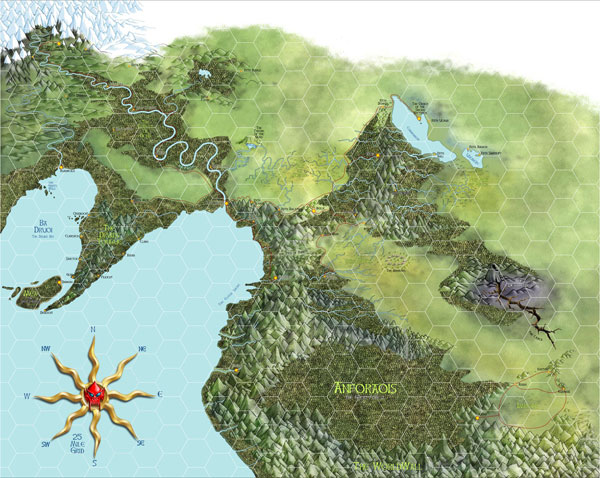
In the northern part of my usual campaign region, there is a great — one might almost say grand, if one had no shame — canyon that penetrates in many areas right through to the Abyss.

It's like a summer camp for paladins, because all kinds of demonic critters crawl up out of there all the time.

That's it, in the centre-right of the map.

(You can see a much larger version of the map here — it's about 980KB).

Sunday, 10 June 2012

Thief's-Eye View

Getting from one side of a city to the other across the rooftops would be pretty easy in a place like this, assuming the tiles didn't keep shooting out from under your feet. It would be pretty annoying for the people trying to sleep in the bedrooms below though; it's bad enough having cats racketing about on one's roof in the middle of the night, and I expect human-sized critters would make even more noise.

I'm not sure if this scene is Chinese or Japanese, but it recalls strongly the excellent night rooftop chase scene from Crouching Tiger, Hidden Dragon.

Monday, 4 June 2012

Achtung! Cthulhu!


Call of Cthulhu
is theoretically one of my favourite roleplaying games of all time. Why theoretically? Because in actual fact I've played it hardly ever, and GM'd it never. It's one of those games I have many good intentions for, which never get realized.

From the Modiphius site:
"Achtung! Cthulhu brings you a two-fisted wartime roleplaying game setting for Call of Cthulhu and Savage Worlds, packed full of fiendish Nazi scientists, terrifying ancient mysteries, legendary German war machines, desperate partisans, gun-toting paratroopers, determined investigators, and enough writhing tentacles to pack ten Reichstags. 
"Discover the secret history of World War Two - stories of the amazing heroism which struggled to overthrow a nightmare alliance of science and the occult, of frightening inhuman conspiracies from the depths of time, and the unbelievable war machines which were the product of Nazi scientific genius - and how close we all came to a slithering end!"
Since I also love pulp action full of jut-jawed heroes and dastardly Nazis, how could I possibly not love this idea? I obviously couldn't.

Whether the reality lives up to the potential, I have absolutely no idea. I know nothing more about Achtung! Cthulhu than what I've read and seen on Modiphius. Cool cover though.

Note: I notice they've wimped out and replaced the wreathed swastika in the eagle's claws with an old Imperial maltese cross. It's not surprising I suppose, assuming they want to be able to sell anything in Europe; apparently the Germans get very shirty about having swastikas on things these days... all part of their official policy of papering over history so that nobody makes any hurtful remarks about it.

Another Note: You can download Chaosium's Call of Cthulhu quickstart rules PDF here. It's free.

Friday, 1 June 2012

Terrific idea

Check out this idea over at Underworld Kingdoms for building megadungeon maps by overlaying a whole bunch of building plans — castles and so forth.

This is the sort of thing that computers and the internet have made trivially easy. It could have been done back in Ye Olden Tymes with overlay cels and what-not, but it would definitely NOT have been easy or straightforward.

This sort of layout looks a lot more like real building than most megadungeon mapping. Structures that accrete over ages don't tend to have any overarching design, and they don't generally conform to a convenient grid, having been tacked on to and built over existing construction.
This would probably drive any obsessively accurate mappers up the wall. Muahahahahahahaaaaa!!!!!

Thursday, 31 May 2012

Friday, 25 May 2012

Terrain Experiments

I've been playing around with building some modular terrain pieces, primarily for micro-scale WW2 games, but ideally also to be usable for non-genre/scale-specific skirmish gaming as well.

The "rocks" are chunks of pine bark lifted from a local playground, glued to 3mm MDF along with some grit of varying coarseness. I've used it before to make some menhirs and dolmens, and it paints up pretty well to represent weathered sandstone.

The forest is a mixture of model railway landscaping flock and clump-foliage on a 3mm MDF base. The pines are pieces snipped from lengths of chenille wire, brushed with dilute PVA and scrubbed a bit to coarsen its texture (in its new-bought state it's very soft and fuzzy). They're OK, but not perfect; I'm still looking for a better method there. The bushes are just pieces of clump-foliage torn into small pieces and glued in place sparsely enough to allow vehicles and infantry bases to be placed among them.

I've kept the vegetation clustered more around the edges; in theory, it represents a homogeneous patch of forest and scrub, but in practice, on the wargames table, that's not very practical.

The building is made of card, from a pattern I downloaded from somewhere years ago, printed via my inkjet and touched up here and there with a little paint. It's mounted on 0.5mm steel, with a little flock to stand in for plantings.

The vehicles are (left to right) a Vickers Medium Mk.II from Scotia, a Rolls-Royce armoured car from Heroics & Ros, and a Cruiser A9 from GHQ.

Thursday, 24 May 2012

Maybe it's not for me after all


I started painting these guys... how long ago? Some time ago. Somehow, considering the time elapsed between starting and finishing this lot, I doubt that a complete Peninsular War British wargaming army is in my future unless I win Lotto and buy one ready-made.

They're soft plastic 20mm figures from HäT. They're not bad for the purpose, and cheap compared with metals (or the hard plastic 28mm figures from the Perries and the like) but out of the 60-odd figures on the sprues, these 16 are about all that I found generally useful; the rest are all in non-wargame-worthy poses and pretty much useless to me. I would rather have just had four sprues entirely of marching dudes, and one of sergeants, officers, standard bearers, musicians and so forth.

Saturday, 5 May 2012

Spell trading — collect the whole set! (No, don't)

For one reason or another (mainly from reading lots of Jack Vance and Terry Pratchett) I've always thought of wizards in my campaigns as being generally mutually suspicious, competitive, and often positively hostile to each other. That's fine as far as campaign background goes, but it's not really usually very workable as an intra-party vibe if players want their characters to survive for long. Cooperation is almost always a better survival strategy than competition.

Players will often want to combine their magical resources, so that there's a degree of redundancy in their spell-books. That's a good idea from a practical point of view, but it doesn't fit well with the campaign background.

It's a simple matter, however, to discourage on-the-fly spell trading without arbitrarily forbidding it. All you have to do is make it a long, difficult, expensive and risky process, and it will happen rarely, if at all.

 In my own campaign, I see magic-users' spellbooks as being like a cross between the Lindisfarne gospels and the Voynich manuscript; ornately illuminated and written in a unique personal code.

It's possible to copy a spell from one wizard's book into another, but it will require a whole lot of Read Magic spells, access to expensive inks and what-not, and plenty of time — at least 1d4 days per spell level. Also, there's a small chance (actual % depending on the ratio of caster and spell level) that the process will destroy the original, like reading a spell from a scroll. Even that tiny risk, along with having to surrender control of their spellbook for so long, makes most players unwilling to freely share their spells with others. However, it does make it possible for MU characters to expand their repertoire from found/stolen material as long as they're prepared to devote the time and resources to doing so.

Friday, 4 May 2012

Captain! We have to do that thing! To avoid the thing!

Roll 1d10 3 times to find out what you have to do to avert the imminent space-crisis!

1Quick! We have to...decouplethe...plasmaconduit
2invertnavigationmodule
3polarizetargetingemmitter
4depolarizewarp-fieldstabilizer
5deactivatepolaronarray
6reprogramlife-supportassembly
7realignfuelcore
8reconfiguresensornacelle
9reinitializeentertainmentmonitor
10disassembledatabanklimiter

I'm not great at coming up with startrekky jargon; I'm sure you could fill the table with much better stuff.

Thursday, 3 May 2012

Beyond the Big Four character classes

I've been angsting on and off about how to allow players to customise their character classes without tipping everything out of whack. Not that it's really been much of an issue thus far; most of my players seem to be perfectly happy with one of the base classes. However, I like to have options available.

I've been using add-on sub-classes which tack on to one of the basic classes, adding abilities and increasing the experience required to rise in level thereby. I think the concept is OK, but it still straitjackets players somewhat, and there's no real consistency in terms of abilities gained to XP required.

Ancient Dragon magazine article to the rescue! In Dragon #109, an article appeared called Customized classes — How to put together one-of-a-kind characters by Paul Montgomery Crabaugh.

In it he proposes a system whereby one begins with a basic human-equivalent nobody, without any particular abilities at all. This mannequin begins with an XP progression that appears ludicrously low: only 400 XP required to get to Level 2, and 75,000 to reach the giddy heights of Level 10.  The catch is that, assuming it survived to get to 10th level, it would still be a pretty useless character.

What you do is, you start adding abilities to the mannequin — things like Hit Dice (from d4 to d10), maximum level, armour and weapons skills, spell-casting (and maximum spell level capability), and even weird species-specific abilities like flight or gills tough skin or whatever.

Each of these things increases the XP requirements for level increase by a certain percentage. For example, if you choose d10 hit dice, you're already at 200% of your base mannequin's XP requirements. Add the ability to use any armour and any weapon, and that's another +125%. If you want to be able to amass HD until 12th level before dropping to a standard per-level increase, that's another 40%. If you want to increase your combat skill every other level, that's another 100%.

By now, your 400 XP to reach 2nd level has turned into 400 x 465% = 1,860 XP. And basically you've recreated a bog-standard Fighter. (Note that there's more stuff to be included, such as saves, special skills and allowed magic items and so forth, I just thought I might as well stop there.)

Crabaugh was writing to players of Basic D&D, though there's an editorial note to the effect that it could be used to slightly modify AD&D classes as well. His system is not completely suited to my own Swords & Wizardry-based campaigns, but it wouldn't require too much tinkering to make it fit, and I think I'll give it a go.

What's the worst that could happen? Actually no, don't answer that. I can already imagine.

Friday, 27 April 2012

Characteristic Saves

I use CHAR (characteristic) saves a lot in my games; I like to get as much mileage out of the characters' stats as possible. For success, I require that the player roll below their relevant stat score — for example, if you have an INT of 15, for a successful (unmodified) INT save you'd have to roll 14 or less.

Where success in a situation is a matter of luck, or the grace (or anger) of the gods, I use the standard level-based character save mechanism with a d20, but where it's a matter of the character's own physical or mental abilities, a CHAR save is more appropriate.

I've vacillated between using 3d6 and 1d20, but I've decided to stick permanently with 3d6 from now on. The graph shown here (which, as usual, you can clickupon to bloatify) describes the result curves for each.

The d20 curve is perfectly straight. You're as likely to roll a 1 or 20 as you are to roll any other number. It's simple, but that's about all it has going for it, and it doesn't reflect the distribution of stat scores as rolled. Compared with the 3d6 curve, it markedly benefits those with very low stats, and markedly penalizes those with very high stats.

With 3d6, on the other hand, your chance of success in a simple, unmodified CHAR save better reflects the rarity of exceptional (or pathetic) stat scores, and positive or negative modifiers can become significant much faster than in the linear d20 scale — for example, if you have an INT of 9 and you make a CHAR save at +2, on d20 that gives you +10% chance of success, while on 3d6 it means +25%. If you're making the save at -2 on the other hand, while on the d20 scale it's just -10%, on the 3d6 curve it's actually -16.6%, and those penalties or benefits flatten out a lot at either end of the curve.

What I haven't quite figured out just yet is how to accommodate CHAR scores beyond the 3-18 range, especially in CHAR-vs-CHAR contests. I have an idea or two, but I think I need to do some more maths to see whether they'll work as I hope they will.

Anyway, BELL CURVES RULE! LINEAR SCALES DROOL! YEAH!

Addendum:

Difficulty No. of dice Range Average Roll
Very easy 1d6 1-6 3.5
Easy 2d6 2-12 7
Average 3d6 3-18 10.5
Difficult 4d6 4-24 14
Heroic 5d6 5-30 17.5
Superheroic 6d6 6-36 21
Legendary 7d6 7-42 24.5
Mythic 8d6 8-48 28
As mentioned in the comments, those with stats over 18 could be assumed to automatically pass any unmodified CHAR save, and very difficult unopposed tests could just require more dice — 4, 5, 6 or more d6, with the players (or monsters) still required to roll below their relevant stat. All that would be required on my part would be to formulate a rational scale of difficulty, probably a FUDGE-like descriptive scale would be most useful, methinks.

As far as opposed CHAR-vs-CHAR rolls go, I'm tending towards a dice-pool system in which you get 1d6 for every 3 points in the relevant stat, and then do a roll-off. The opponent who rolls the highest score wins the contest.

Thursday, 19 April 2012

S&W Monster Book critters

Carrion Fly (p.12)
I was leafing through my copy of the Swords & Wizardry Monster Book this evening, and scribbled pictures of a couple of the critters therein: the Carrion Fly and the Clawed Fiend. Et voila!

I don't know how closely my imagination matches those of the people who originally came up with the monsters in question, but there you are anyway.

Clawed Fiend (p.14)

Thursday, 12 April 2012

Modular Megadungeoneering

I'm running a megadungeon at the moment. The party are in Hell, though they haven't yet experienced much hellishness. Yet. Muahahahahahaaaaa.... and all that.

Anyway, I have to say that I'm not a great fan, as a DM, of the traditional sprawling twisty-turny megadungeon level map.

The reason for my lukewarm acceptance of this model of mapping is purely to do with manageability. A map like this is going to require pages and pages of room and encounter descriptions, even if they're pared down to the bone.

That means a lot of page-turning, and inevitably there will be times when numbered encounters, which may be adjacent on the map, will be pages apart in the written descriptions.

That adds a level of confusion I don't need.

Additionally, the sprawling nature of the map means that the party could go just about anywhere, any time, which makes it that much harder for me to plan ahead, or to take into account relationships between dungeon denizens on the fly, or to foreshadow upcoming event possibilities. I don't mind having to do a little prep work as DM, but I prefer to keep it as minimal as possible.

These little maps by Dyson, on the other hand, are relatively limited in terms of their geography.

I can fit a whole map on a single A4 page at a scale large enough to read easily and to make legible notes on, and I can fit the written descriptions for the whole map on a single facing page.

The modules can be easily interlinked just by noting where the exits are, and how each exit connects with any of the other maps. They could all be part of the same level, or they could be scattered across dungeon levels.

Best of all, wherever the party goes, the map and description are right there together — which makes for excellent manageability. The end result is transparent to the players; as far as they're concerned, all of the maps might as well be one huge many-folded confusing mega-map.

And if I decide, on the spur of the moment, to introduce an area in which all the tunnels are made of rotting meat, swarming with black beetles, worms and maggots, it's a piece of cake to introduce a new map into the ecosystem.

Scenery: River Sentinel

Monumental carving in Romania honoring Decebalus, a general who handed the Romans their collective arse.