Showing posts with label tutorial. Show all posts

Wednesday, 3 October 2018

Zenithal Priming


There is a miniatures-painting technique that has become quite common these days, called zenithal priming.

It's aim is to provide a priming layer of under-painting with highlights and shadows already in place, and this is achieved quite simply.

The figure is first primed entirely in black, and then a lighter colour, usually pure white, is sprayed down on to it at a slight angle from the vertical. The areas sheltered from the spray remain black, while the upper surfaces become white, with gentle gradations of tone between them. Personally, I prefer to finish with a light over-spray of white at a much lower angle to lighten the bulk of shadows, leaving pure black only in those areas that would be completely shadowed.

The ideal tool for this is, of course, the airbrush, but it can be done with aerosol can paints. The spray cans produce a much coarser spray; the individual droplets of paint are larger, so the resulting under-painting will appear much more granular.

It can also be done entirely by hand with a brush, though of course that is a much more labour-intensive method. It's a technique that is much used by picture painters who want to establish the tonal masses of their composition before they start applying colour.

The technique really shows its value when speed-painting using transparent inks and glazes, but it's also very useful when painting with opaque colours because the tonal variation really accentuates the contours and surface details of a miniature, which makes it easier to plan and predict how paint can be applied.

Friday, 23 March 2018

Flight Stands for Gaming or Display

Occasionally — not often, but from time to time — my tabletop wargaming involves aircraft. It might be a specifically aerial dogfighting game, or it might be the aerial component of an all-arms game.

The thing about aircraft is that they need to be up in the air, or they just look stupid. So, here's how I make the flight stands for my planes. This specific one is a metal Hawker Harrier jet from Heroics & Ros, but I've used the same system to make stands for 1/144 plastic kits as well.

 The first thing to address is that a model on the end of a stick needs a bit of weight at the base to make it stable, or else it will just keep falling over and probably damaging the model.

The size of the base and the amount of weight required will depend on how long a stand you want, and the size and weight of the model to be perched on top of it. In this case I'm using quite a short stand, but the metal model is fairly heavy.

I create the base by supergluing together a stack of fender washers of decreasing size. In this case, the largest one is 32mm in diameter. You don't need to use much glue at all at this stage, just enough to tack them together: there will be a lot more glue going on later.

The stand is a length of 3mm clear acrylic rod. I prefer this because it's see-through, but a sturdy length of steel wire will also do the job. I've drilled a matching 3mm cavity in the belly of the aeroplane model; this one is a tight enough fit that it can just be pushed on and it will stay, but another option is to use a pair of magnets, one glued to the tip of the stand, and the other to the belly of the plane.

 Once I have my base stack, I flood the levels with liquid superglue and then cover it with baking soda.

The baking soda combines with the superglue and cures it pretty much instantaneously, and leaves a rough plastic-like mass. The excess is just brushed away — if you're cheap, and it's not going to be used for cooking, it can go back into the box for re-use.

 You will probably have to repeat the superglue + baking soda once or twice to get a more or less even covering over the stack of washers and to disguise their edges.

The next step is to get the acrylic stand attached to the base.

You can see here that I've taped the acrylic rod to a piece of folded card. This is to keep it square and vertical in the base while the glue is setting. It's best to make sure that the end of the rod is a few millimetres above the surface of the table; if it protrudes even a fraction of a millimetre below the edge of the support card, it will throw everything out of whack and your stand won't be perfectly vertical.

You need to make sure that the card's base is perfectly straight, and that it's folded with that bottom edge matching exactly — that will ensure that the folded crease is perfectly square to the bottom edge, and it will also be perfectly vertical to the tabletop when the card is stood like this.

I've cut a notch out of the bottom of the card stand — this is to accommodate the base for the next step.

The cavity in the stack of washers is filled with epoxy, and the acrylic rod, taped to its support card, is lowered down into it.

Leave it to set.

The epoxy in this image is coloured that diarrhea brown because there was a little bit of paint left in the silicon cupcake baking thing I use as mixing palettes. It's not necessary to colour it at all.
I had a lot more epoxy mixed up than I really needed, and spread some out over the base.

I poured some basing sand over it while it was setting to provide a bit of texture.
Once the epoxy has set, the stand is basically done.

Now all that remains is to paint and flock the base as you normally would, to match your battle mat or whatever.

Sunday, 14 May 2017

PaK36 sabot bases — WiP Part 3: The Greenery

Once the dirt layer is thoroughly dry, the greenery goes on.

I start with a layer of strand grass flock, applied in blotches so that some of the underlying dirt shows through.

Next is some bushy stuff. This is Woodland Scenics Coarse Turf.

Again, it's applied in small blotches. I've found that I need to squash it down into the glue spots and leave it until it's absolutely set before brushing away the excess. If the glue is too thin, and/or not yet cured, then the springy foam rubber that it's made from just falls away.

The gun base at the bottom of the picture hasn't yet had all the excess cleared away.

This is as far as I'll go with the infantry base, to the left.

Almost last, on the gun bases, I glued some small bits of Woodland Scenics Clump Foliage.

I want some larger bushes around the gun, but I don't want so much that it will obscure the whole thing. Unlike the crew, who would probably be much happier completely out of sight.

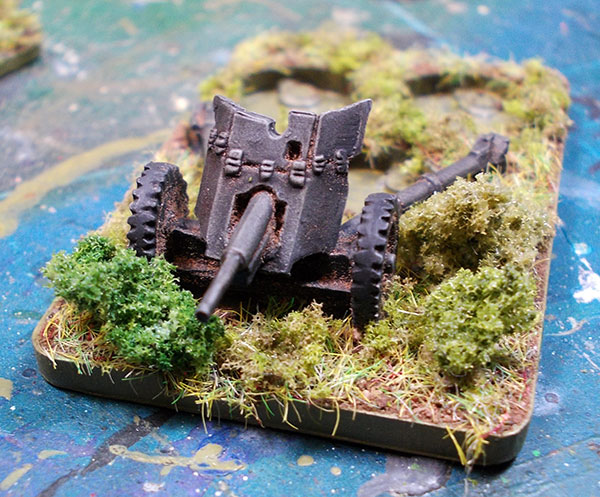
In this close-up, you can see some of the MDF dirt nestling in the nooks and crannies of the gun. I could wash it out, but when you're not looking at it from 10cm away it actually adds to the weathering of the gun, so I'll probably leave it.

And here's one of the guns, complete with some extemporized crew.

These are just some figures I already had painted and based, but as you see, any old figures blend quite well into the sabot base, and are held there reasonably firmly by the magnets.

Once all the glue is dry, I'll give it a couple of squirts with matte varnish, which will help all the various types of flock stay where they are. And then the base will be done.

Part One
Part Two

PaK36 sabot bases — WiP Part 2: The Dirt

Now the guns and bases are painted. The bases aren't painted very smoothly except around the edges; they don't have to be, all of the top surfaces will eventually be covered with various textural materials.

I also haven't bothered smoothing out the hard channels in the surface of the bases, as those same textural materials will soften the hard edges quite successfully without going to all the extra work.

I use a slightly dilute mix of PVA glue (4 parts glue to 1 part water) to fix the first layer of texture. The dilution allows it to spread more easily, and it also slightly increases the glue's working time.

I've got into the habit of texturing the bases in several stages, because in summer the glue goes off quite quickly, and I want it to still be very liquid when the textural material goes on so that it will soak through it. It's late autumn here in New Zealand at the moment, so that's not really necessary, but habits are hard to break.

I'm careful not to allow any of the glue over the lips of the crew cavities; the washers they're based on are already quite a close fit, so there's no room to spare.

On goes the first part of the first layer.

This will be the "dirt", over which will go other materials to represent turf and other foliage. It's not actual dirt; it's actually MDF sawdust that I've coloured with acrylic paint and re-ground to a powder, with some ground-up model railway ballast added for stones.

There's no particular reason I can think of not to use actual dirt for this stage, as long as it's perfectly dry and ground suitably fine. The MDF just guarantees a consistent colour across a whole lot of bases.

Here's the first "dirt" layer complete on all the bases — the two guns, and an extra for a command group, if required.

Something I didn't expect is that the MDF "dirt" appears to be magnetic. I don't know why, maybe it's the ferric oxide in the pigment I used to colour it? It's not important in any case. Once the glue has dried, it will brush and blow away quite easily.

Part One
Part Three

Saturday, 13 May 2017

PaK36 sabot bases — WiP Part 1: The Bases

I found a blister of Battlefront's 15mm German PaK36 37mm anti-tank guns in my stash of unbuilt stuff.

 Regrettably, the crew figures supplied with it are mostly dressed in camo smocks and helmet covers, so they're not really suitable for my 1939-40 German army unless I field them as SS — which I am reluctant to do, because frankly the SS were a real pack of bastards. I don't really fancy the idea of commanding a bunch of war criminals, even in make-believe.

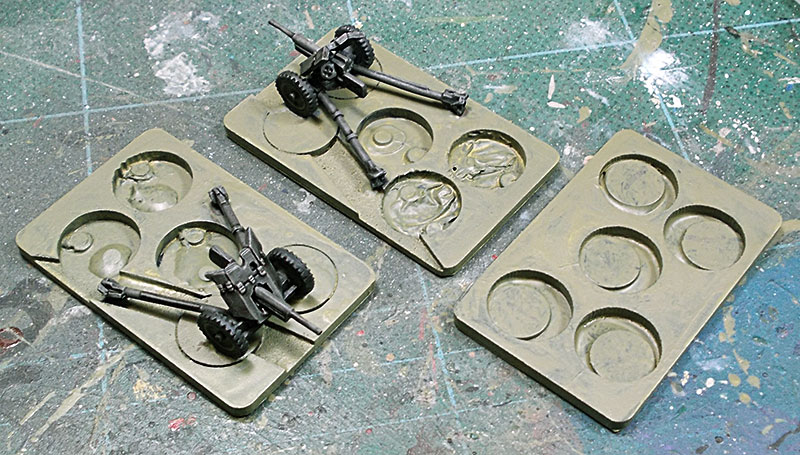
However, the issue is not insuperable, since I have a bunch of laser-cut MDF sabot bases I had made a while ago. The idea of using these bases, rather than fixing the crew permanently to the base, is so that I can swap out figures as required, or remove casualties during a game rather than keeping track of them via book-keeping. That means that if I get some early-war Heer crew from someone like Peter Pig, I can swap them in to the existing gun bases. Easy-peasy.

The figures are all glued to 12.5mm (½") steel washers, which fit into the 13mm holes in the bases. The MDF bases themselves are glued to thin card so that the figures don't just fall straight through.

The two holes where the gun itself will go are filled with a couple of plugs left over from the laser cutting; unfortunately I don't have very many of these, I didn't foresee their usefulness when I got the bases cut, and I suppose most of them were just thrown away as scrap.

The card is trimmed flush with the edge of the MDF, and tiny 3mm x 1mm magnets are glued in the cavities. These are what will hold the crew figures in place during a game — they're not completely necessary, but they do add a bit of insurance against scattering figures all over the table with a particularly fumble-fingered move.

On the base on the right, I've squished some figures down over some cling-film over the magnets to ensure that the epoxy isn't higher than the thickness of the magnets, but with the second base (on the left) I didn't find that a necessary step.

The magnets I sourced from China, very cheaply. It cost me about ten dollars for 500 magnets in this size.

Next stage was to mount the guns in place.

I've left the loader figure in place during the gluing to ensure that the position of the guns and the loader figures is compatible.

Part Two
Part Three