Showing posts with label soviet. Show all posts

Wednesday, 10 January 2024

SU-76i


This is a 1:100 scale FDM print of Bergman's SU-76i model, slightly enhanced by me with a little bit of extra detail.

The SU-76i was a Soviet conversion of captured German Panzer III, with the turret removed and the Soviet 76.2mm gun mounted in a casemate.

This one is based on a photograph I saw of one that had been recaptured by the Germans, some time in 1943 I think.


A few days later...

Here's another one, this time still in Soviet hands.

Another FDM print from the same Bergman model, though this one was printed before I added the track and grill detail.

Monday, 30 October 2023

Sturmovik


Next 1:144 scale tiny-aeroplane project is a Soviet Ilyushin IL-2 "Sturmovik" ground attack aircraft. That's the grey one in the foreground.

This is yet another of Roman Troyan's 1:200 models up-scaled to 1:144. I've printed it on my Mars Pro, using the new spirit-based resin, which seems to be behaving much, much better than the water-washable stuff.

Regrettably, I've got it printed just in time for me to have to leave home for an indeterminate length of time — probably about a month, though that's entirely dependent on circumstance. So it will be a while before I'll be able to finish it.

A Bit Later On...


Well, by neglecting other tasks, I got the Sturmovik painted. Those other tasks were probably unimportant anyway.

Maybe later I'll revisit it and paint some numbers on it.


Thursday, 26 October 2023

Polikarpov I-153 (1:144)


This is a model I've been working on in Blender, the Soviet Polikarpov I-153 fighter, in 1:144 scale.

It has no detail at all on the under-surfaces; the way I use aircraft models on the tabletop, they're never seen from underneath, so it would be wasted effort.

I thought I might be able to reuse some of the geometry to make an I-16 monoplane, but having looked at some drawings of that plane it looks like the differences are too great for that to work out. I'd have to do so much work modifying the current fuselage that I'd be better off just starting again from scratch.

To tell the truth, I'm not quite sure how or why I ended up making this, since I have no immediate need for it in my own gaming. However, I do have a bit of a yen to do something with the Soviet-Finnish Winter War of 1939-40, and it would be appropriate for that conflict on both sides.


And here we have the printed model.

I've changed the resin I'm using from water-washable stuff, which has been enormously troublesome, to some spirit-based resin from the same manufacturer, which seems to be much better in spite of the added hassle in cleanup.

Monday, 3 January 2022

First Model of 2022


Here's my first model of 2022, a member of the Stalingrad Workers' Militia in 28mm.

Model design is by Propylene Foliescu, printed on my Mars Pro.

Thursday, 23 December 2021

Soviet Maxim Team c.1939


Here's a 15mm Soviet Maxim machine gun team from about 1939-40, the period of the Winter War between the Soviet Union and Finland. The troops are wearing the old-style crested helmet and puttees, which dates them: they could also serve as soldiers in the early months of Operation Barbarossa in 1941, before the new uniform changes became general throughout the Soviet armies.

The figures are 3d printed on my Elegoo Mars Pro, and the digital design is by the excellent Propylene Foliescu.

Tuesday, 12 October 2021

Red Peril


This is a 28mm 3d print from a sculpt by Propylene Foliescu, part of his Winter War catalogue.

He's a dastardly NKVD man, though in this scale I'm more likely to use him in a TTRPG as an earlier dastardly Cheka officer — I don't really know how much the Cheka and NKVD uniforms differ, but he'll do me for either.

Wednesday, 16 June 2021

Green Red Horde


Quite some time ago, I designed a 1:100 scale model of the Soviet T27 tankette (based on the Carden-Loyd Mk.VI) and uploaded it to Shapeways. Unfortunately, Shapeways 3d printing is still pretty expensive, so though I did get a sample printed, I never went ahead with the numbers that would be required for these little cockroaches.

Of course, now that I have a resin printer of my own, all that has changed. I've printed 21 of them so far, which is enough for between four and seven platoons, depending on how much I want to pay for them in Battlegroup: Barbarossa (it's 25 points for a three-tankette platoon, and an extra 10 points for up to two more).

The thing is, they're pretty pointless on a Barbarossa-era battlefield. They're unreliable, their narrow tracks bog easily, the armour is minimal, and they're armed with just a single 7.62mm machine-gun. They'd been declared obsolete by about 1935, and though there were still some around by 1941 they were relegated to towing light anti-tank guns like the 37mm and 45mm.

They were more common in the Winter War of '39-40, but even then they weren't front-line vehicles, and they didn't deal at all well with the snow.

Still, I've got them now.

Thursday, 27 May 2021

Delusions of Grandeur, Maybe


I was looking through the Battlegroup: Barbarossa book, to see what extra use I could get out of my Winter War Soviets.

A BT-7 company needs seventeen tanks. That's a lot of printing and painting, and I don't know if I can really be bothered. If I print two more, sans aerial, I'll have enough for two platoons.

Each tank takes a little under four hours to print, so theoretically I could produce six per day, but honestly that's a highly unlikely production rate. Two or three is more my speed, mainly because washing, clearing supports, and and curing is a real pain in the arse.

Wednesday, 19 May 2021

BT-7 remix (15mm)


I figured, since I'd already done a bunch of work on the hull for the BT-42, that I might as well re-use all that labour for a BT-7, also remixed from Zac Kuvalich's original work.

Apart from the extra track detail, the main improvement I've made to the hull is in the engine grill.

I don't know enough about Soviet and Finnish stuff to know just how similar the Finnish BT-42 was to its source vehicle, the BT-7. But ignorance, as they say, is bliss, and it will do well enough for me until I find out otherwise.


Next Day...

Right, so here's the first test print. Overall I'm not dissatisfied.

The only real issue was that I neglected to create locating lugs/sockets when I separated the running gear for ease of printing, and I glued the tracks on wonky. Then I broke them, trying to move them into the right position — it's not too apparent from this side, but the other side is a bit worse.

Never mind, I've adjusted the STLs and I've got another test print under way.

I've sprayed the model with Vallejo Soviet 4BO surface primer, and given it a gentle dry-brush with VMC Green Grey to delineate the surface detail. The transparent red resin I'm printing with at the moment is terrible to photograph, though it is admittedly quite pretty.


Later that day...

Test print number two complete, and all issues are dealt with.

The running gear components now fit into place easily and positively; no more guesswork.


Next day...

Naturally, errors were made.

It turns out that the squared cut-off track guards were just a Finnish thing, so I had to do a bit of juggling with another of Zac's files to get them back to the bulbous Soviet style.

I also had to re-do the tracks. The track links I modelled on the BT-42, though taken from a photograph of a surviving vehicle, are more appropriate for a BT-2 or BT-5. The links on a BT-7 were about 20% shorter. It's possible, even likely, that the surviving museum BT-42 was cobbled together from several vehicles, using the tracks from an older tank.

Several days later...


Print successful.

This is printed in a Frankenstein mixture of resins: the very last drops of transparent red left in the vat, the last dregs of some opaque tan resin, and some transparent green to take the vat level up to a safe depth. They're all the same type of water-washable resin though, and all from eSun, so they're perfectly intermixable.

The only issue is that the inert fillers in the opaque resin mean that you have to be very diligent about washing the print, and it's a good idea to blow off any water with compressed air before curing — I didn't do that this time, which is why I got that white crufty buildup in some of the seams. The transparent resins are much more forgiving in this respect, and in using them I've got a bit lazy.


Compare with this one, in exactly the same resin, that I blow-dried with my airbrush before curing.

You could use canned compressed air  I guess, if you don't have access to an airbrush; I have no idea what those cost as I've never used it for anything.

Friday, 7 May 2021

OT-130 — The Paintening Concludes


The OT-130 was a flamethrower variant of the Soviet T-26B light tank.

Painting complete. The tank and infantryman are both 15mm (1:100 scale), and both were 3d printed on my Elegoo Mars Pro in eSun water-washable resin.

For a blow-by-blow work-in-progress post on the painting of this thing, go here.

Thursday, 6 May 2021

OT-130 — the Paintening Proceeds


The time has come to start decorating my 15mm 3d printed OT-130 (or XT-130, or KhT-130). I was originally going to paint it in winter white, but as it turns out, the Soviets didn't feel the need to indulge in anything as cowardly or effeminate as camouflage when they decided to try to kick the shit out of the Finns, so generic Russian green it is.


Plain green is pretty boring, so I'm bashing the crap out of the paintwork. There's probably a lot more damage than would be very likely, but I think it helps to create a bit of an impression of how shoddy was the construction of these early T-26 variants. Apparently the armour plates were often so poorly fitted that the crew could see light leaking in around them, and bullet fragments finding their way in through the seams was a real danger.

This model is the first one that has presented me with the issue of uncured resin inside pooling and melting away at the shell — I clearly didn't wash out the turret as well as I had thought, and the turret peg was starting to come away from the body. I pulled it right off and hit the innards with a UV torch, and then superglued it back in place; that should take care of the problem this time.


I've now made a little snake-neck UV LED curing wand that is small enough to poke into a 4mm hole, so hopefully this will be adequate to ameliorating the issue in future.

The information I have from the internet suggests that a minute or two with this should cure the resin  left on the inside surfaces sufficiently. I don't know how long a 9v battery will last, running one of these LEDs. They're fairly expensive, compared with AA batteries, so if the lifetime is too short I may be better off spending a bit more on a 9v power supply and switch.


I've decided to try a new (to me) experimental method of painting the tracks. It's pretty straightforward.

1)   I painted the entire track run in a mid grey, in this case, VMC Medium Sea Grey. I think pretty much any grey would do, though if it's too dark you'd lose a bit of the colour variation the next step gives.

2)   Next, I gave it a couple of coats of fairly thin Vallejo Game Effects Dry Rust. I like the grainy texture this stuff leaves.

3)   Last, I gave the tracks a dry-brush of VMC Oily Steel. This catches the light and pops out the highlights a bit, while being quite neutral in tone so the brown of the Dry Rust still predominates.

It's not too different from my usual track-painting method, which is to start with a medium brown, splosh on a couple of washes, and dry-brush. I don't know that there's much to choose between them, though I do prefer the texture of the Dry Rust.


The next step is oil-washing. The wash in this case is just raw umber oil paint in white spirit — turpentine can be used, but I find white spirit evaporates faster, and is less likely to leave any oily residue. 

I prefer using an oil-based wash to an acrylic one, as I find it wicks along creases better, and it's more manageable — excess colour can be taken back off just with a clean brush, slightly moistened with white spirit. However, if I'm in a hurry I'll still use Citadel and/or Vallejo acrylic washes, as they dry quickly and I can race ahead to the next stage. A white spirit wash needs to sit for half an hour or an hour before proceeding, and leaving it to dry overnight is better, especially if you intend to do any more spirit-based pin-washes.

The white spirit evaporates long before the oil paint is dry, and  when the spirit is almost all gone, I can come back in with a brush and do a bit of streaking of the still-soft paint — you can see it very clearly on the glacis.


Paint chipping is my next stage. This is, no doubt, a familiar process to most AFV modellers these days. It's a weathering step that comes and goes in fashion; for a while it seemed like every AFV model represented a machine that had been forty years in the field without access to a paint shop, but people are being a bit more restrained nowadays.


I use a bit of torn foam to apply the "chips" in a semi-random fashion, and I like to glue the bit of foam to the end of a matchstick, to keep my sausage-fingers out of the way. You can do it in a much more controlled way by using a small pointed paintbrush, but that takes a long time and I'm generally too impatient.

My favourite colour for this is Vallejo Panzer Aces Dark Rust, but any dark brown will do. I've seen dark grey used as well, but I prefer brown to represent oxidized metal.

The key here is not to mash the paint-loaded foam hard against the model, or else you end up with big blotches of paint instead of small, discrete patches of chips.

The main focus is on the corners of the model, and areas of high wear, such as where the crew climb in and out of the machine.


After the chips have been applied, I take another step and add highlights to the edges of the chip patches with a light colour. This can be a tint of the vehicle's base paint colour, or a neutral light grey, or in this case I've used VMC German Camo Beige, which is the same colour I used for the initial dry-brushing to bring out the model's surface detail. This gives the chips a bit of three-dimensionality.

You don't have to hit every single speck and chip, but it's a good idea to get all the large areas, and it's best to confine the effect mostly to the lower edges of the chip area, where the broken paint edge would catch the light. I use a lot of thinner in my paint, and a very small pointed brush, but even so, in this small scale I find it very difficult to get an effect that is both subtle and visible.

You can also do this with a sponge, to get chips that have scratched the surface of the paint, but not penetrated right through to the bare metal. I've skipped that on this model.

Something else I haven't done on this model, but which can look good: go in on large areas of high-traffic chipping with a sharp HB pencil, and scribble into the brown-painted areas only. This will give them a metallic sheen, looking more like areas that are being constantly abraded. You don't need (or want) to entirely cover the brown with graphite; you just need enough there to give it a metallic glint.

As with any weathering technique, it's easy to go overboard with this.

Sunday, 25 April 2021

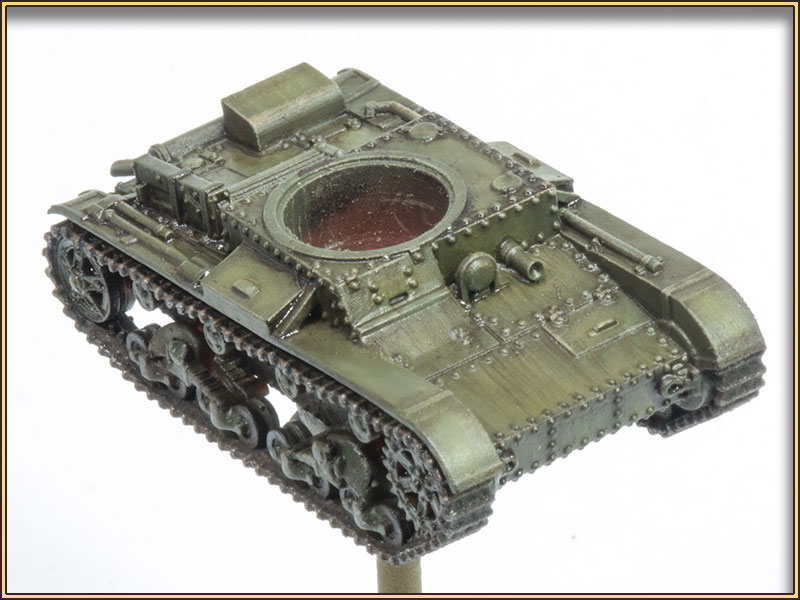
T-26B Model 1933


To go along with the T-35s, T-28s, and the SMK for my Winter War Soviets, I need some smaller, more useful tanks. I have some Zvezda T-26s, but they're a much later model with a snazzy drop-forged turret — the same turret, I think, as was used on the BT-7.

Zvezda 1:100 scale T-26

So I fired up Blender and whipped up this very early version of the T-26, from 1933. It was of all-riveted construction, and the turret-basket was a little tacked-on affair.

By 1940 it had been superseded by newer models, with more welded construction and a turret with an integrated basket.

I discovered, after I was well into the process, that Bergman has already done a 1:100 scale model of this very tank. Oh well, not to worry.


The test-print went well enough, and the model is printable. There are a couple of areas of distortion, but those are due to inadequate supports, not the model's geometry.

I may add some clutter — some tools and the like — but for all intents and purposes, the model is done and I can move on to something else.

Next day:

I've added some tools to the track guards, and an old-style box-shaped jack to the engine deck.

I've had to guess at the size of the jack from pictures, but its dimensions are correct in ratio, so it should be fairly close I think.


Next Next Day

I've added a couple of versions of the later (much more common) turret with an integral turret-bin. In truth, this type of turret would be much more appropriate for my Winter War force.

From memory, I think only about one in ten tanks carried a radio, and troop control was carried out via signal flags. That ratio improved markedly later in WWII, but to begin with the Soviets lagged far behind pretty much every other belligerent nation in that respect.

As of writing, I haven't yet printed these turrets. I suspect that aerial will require quite a delicate touch with the supports.


And now they're printed as well.

Addendum


On the suggestion of Richard Humble, over at the Facebook 3d Printing For Historical Wargames page, I modified my T-26 model to make this flamethrower variant, the OT-130 (or XT-130, or KhT-130, depending on who you read).

It's a very straightforward conversion. There are a bunch of little details to be modified, but the only major structural change was moving the turret over from the port to the starboard side of the hull.

Coupladays later...

Coupladays later...

The test-print went well.

The STLs for the OT-130 are available online at https://www.wargaming3d.com/product/ot-130-xt-130-kht-130/

The T-26 STLs are at https://www.wargaming3d.com/product/t-26-model-1933-early/

Wednesday, 21 April 2021

Winter War Baddies


I bought this set of STLs for 3d printing 15mm Soviet infantry in the 1936-40 uniform, suitable for the Winter War period. They were designed by a guy who goes by the moniker "just some miniatures" on wargaming3d.com, and this particular set can be had at https://www.wargaming3d.com/product/soviet-winter-war-squad-15mm/

I've always been interested in the Winter War between Finland and the Soviet Union in 1939-40, because it was a real David vs. Goliath affair, and one in which Goliath ( the Soviets) got their arses royally kicked until their numbers, and international apathy and obstructionism about supporting the Finns, began to make a difference. The Soviets won in the end, after taking horrendous casualties.

My sympathies in that fight were unequivocally with the Finns, who were bullied by the Soviets and shafted by everyone else in Europe (except, as it happens, the Nazis, so it's not that surprising they ended up on their side later on). However, by fielding the Soviets, I get to play with the ridiculous T-35 and T-28 land dreadnoughts, and even the SMK in the Experimental Heavy Tank Company.

The colours of the Soviet uniforms at this period were slightly different to the more familiar post-1940 changes, and about half of the figures are wearing the budenovka, the pointed felt hat worn by the Russians ever since WW1 (and maybe before, I'm not 100% sure).

I've printed these guys on my Mars Pro of course, and I've glued them to 12.5mm (½") steel washers, both to provide some bottom-weight, and also so I can use them with magnetised sabot bases to ease moving the vast numbers of infantry I'll be needing.


Here's the first test paint, and overall I'm not too dissatisfied.

I'll keep experimenting with the colour of the greatcoat though: at the moment the base colour is Vallejo Stone Grey, which I think is a little bit too green.

Tuesday, 15 September 2020

The Soviet Horde is Getting Out Of Hand


When I went to chuck my recently-completed T-70 into its box with all its friends, I suddenly realised that I'd accidentally amassed a fairly respectable amount of early-war Soviet kit.

That's mainly due to poor impulse control: if I see a whole bunch of T-34s on sale for very cheap, I just can't help but grab them, just in case.

The T-35, SMK and T-28 models I did because I'm fond of the ridiculous land-dreadnought designs of the 1930s, and pandering to that fondness got a lot easier when I got myself my 3d printer. The T-35s are from Zvezda, but the others (apart from one very old Battlefront T-28) are all printed.

The trouble I have with turning all this clutter into a usable wargaming army is that I don't much enjoy painting and basing infantry, and the Russians need a lot of infantry.

Then again, I just got a copy of What a Tanker from the Lardies, which is pretty much World of Tanks for the tabletop, so I guess I could start using them for that.

Monday, 14 September 2020

Oiling Up

This is a 3d-printed 1:100 scale T-70, printed on my Ender 3 from a (slightly changed) model by M. Bergman.

It's the first time I've tried using oil paints for pin-washes and streaking, and I think I like the process. The extended working and cleanup time is a boon, and the solvent (white spirit) wicks quickly and easily along creases and crevices.

The base colour is Vallejo's ModelAir Soviet 4B0 sprayed over black and white pre-shading.

I've only used one oil colour on this — raw umber. I've seen other modellers using spots of several colours for surface streaking, but that tends to be in larger scales (1/48 or 1/35), and this model is very tiny. I think a multi-toned streaking effect would get overdone very, very quickly.

Overall, I'm pretty happy with it so far. It could, no doubt, be done better, but that will come with experience. Now, on with all the detail painting.


And all done.

For someone with no intention of building a Soviet wargames army, I sure do have a lot of Soviet kit.

Friday, 10 April 2020

Voroshilovets — Painted

I've finally got my 3d-printed 15mm (1:100 scale) model of the Voroshilovets (see this earlier post) painted up and ready for the wargames table.

Rear-quarter view

The tilt is detachable, in the event that you prefer your tractors in the nude.

Friday, 7 February 2020

Bergman SU-76 M Remix


This is a remix I've done of M. Bergman's 1:100 scale SU-76 M model.

All I've done is separate the fighting compartment and gun, to ease the placement and removal of supports, and add track pin and guides detail.

You can get the STLs (free) at https://www.wargaming3d.com/product/su-76-m-bergman-remix/


Wednesday, 25 September 2019

Voroshilovets For Everyone!

Everyone with a 3d printer, that is.

I've rebuilt my 15mm (1:100) Voroshilovets model for home printing, and uploaded it to https://www.wargaming3d.com/product/voroshilovets-heavy-tractor/

The canopy is a separate STL, and there are two versions of the tractor itself: one all in one piece, and the other with the tracks split off to ease printing in FDM. The split-up version includes a few other tweaks aimed at FDM printing as well, so if that's the sort of printer you have, that's the version I'd recommend you print. The one-piece model would be better suited to resin printers.

One-piece tractor

Multi-part tractor